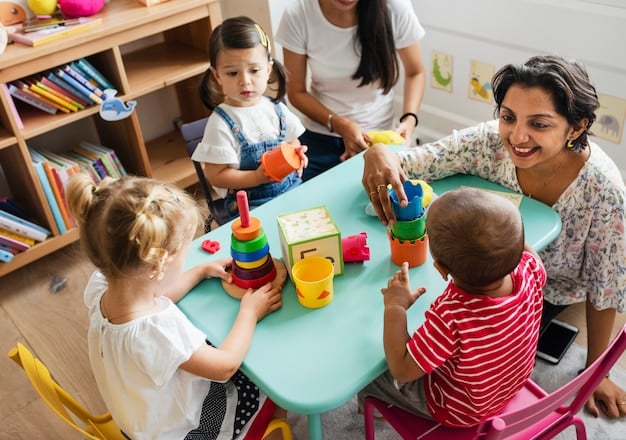
In this 45-hour coaching and mentoring course, aspiring coaches and mentors are introduced to the essential processes involved in coaching and mentoring in the context of #early-childhood-education. It emphasizes that while a coaching and mentoring program must be well-designed, its successful implementation is equally crucial to making a positive impact on the quality and effectiveness of a child care program. The primary objective in early childhood education coaching and mentoring is not only to enhance teachers instructional practices but also to enhance student academic outcomes, thereby nurturing a more productive learning environment for young learners.
*Maryland Providers*
This 45-hour course satisfies the training requirement for Level 4 of Marylands Administrator Credentialing.
By the end of this training, the learner will be able to:
- Give examples of ways to apply and model ethical behavior and professional integrity with all children and youth.
- Give examples of ways to apply and model ethical behavior and professional integrity with community members and organizations.
- Give examples of ways to apply and model ethical behavior and professional integrity with families.
- Demonstrate understanding of how teacher expectations/behaviors can contribute to student achievement.
- Explain the different characteristics of coaching and consulting.
- List the misconceptions about the use of coaching in early intervention.
- List the principles of Mentoring and Coaching foundations
- Demonstrate understanding of theory of coaching and mentoring.
- Identify coaching prerequisites.
- Define what it means to be a coach in the early childhood education setting.
- Define what it means to be a mentor.
- Demonstrate an understanding of the benefits of a coaching team.
- Distinguish between the personalities of coaches and mentors
- Identify if coaching and mentoring is for you.
- Demonstrate an understanding of the different learning styles of adult learners.
- Identify the components of active listening skills.
- Describe nonverbal communication as it relates to coaching and mentoring.
- Explain intercultural communication as it relates to coaching and mentoring.
- Explain the value of self-evaluation and reflection.
- Describe ways that coaches and mentors can observe and assess coachees and mentees.
- Define SMART goals and describe its historical context.
- Demonstrate understanding of the importance of professional etiquette while coaching and mentoring.
- List strategies for coaches and mentors on how to apply DEI practices in child care.
- Explain different types of modes/ delivery methods of mentoring.
- Describe what is a professional growth plan for coaching and mentoring.
- Identify strategies for coaching and mentoring individuals with challenging personalities.
- Demonstrate understanding of how to write effect SMART Goals.
- Recognize the importance of consistency, continuity, and responsiveness in supporting pro-social behaviors in children.
- Describe the importance of providing opportunities for children to practice independence.
- Explain the benefits of setting goals in a coaching/mentoring program.
- Identify and use strategies for effective communication with community and colleagues.
- Recognize the importance of responding to all children and youth behavior in a consistent, predictable manner.
- Demonstrate an understanding of the importance of establishing realistic expectations for behavior.
- Demonstrate the importance of using various strategies to develop language and communication skills.
- Recognize the importance of clear and appropriate articulation of sounds and words when communicating..
- Demonstrate an understanding of using community resources for referrals.
- Demonstrate an understanding of how to provide an environment that offers choices.
- Recognize the importance of maintaining confidentiality and privacy in communication with staff.
- Describe ways child care professionals can support advocacy issues.
- Identify coaching and mentoring strategies.
- Identify the process for coaching and mentoring.
- Define conflict resolution and explain why problem solving is important.
- Recognize the importance of a positive and respectful attitude in working with all children and their families.
- Identify ways to reflect on one's own personal perspectives with courage and/or humility
- Identify ways to interact respectfully and appropriately in a variety of cultural contexts
- Define and identify common signs and behaviors of children and youth with developmental disabilities.
- Define and identify common signs and behaviors of children and youth with ADHD.
- Demonstrate understanding of inclusionary practices for ADHD in the child care setting.
- Demonstrate understanding of inclusionary practices for developmental disabilities in the childcare setting.
- List community resources, support, and referrals for developmental disabilities.
- Demonstrate understanding of inclusionary practices for autism spectrum disorder in the child care setting.
- Demonstrate an understanding of inclusionary practices in the preschool setting.
- Demonstrate an understanding of how to support all children and youth at times of change, transition, or separation.
- Recognize the impact of unexpected changes on children and youth.
- Recognize that children develop independence at different stages.
- Define the meaning of professionalism in child care.
- Give examples of ways to apply and model ethical behavior and professional integrity with staff and administrators.
- Identify strategies to listen while withholding judgement about the new or unfamiliar
- Explain the importance of two-way communication.
- Define and identify common signs and behaviors of children and youth with Autism Spectrum Disorder.
- Demonstrate understanding of the dynamics and the importance of a relationship between a parent and professional (.5 hr).
- Demonstrate an understanding of how to be open to new perspectives and diverse others.
- Recognize the importance of collaborating to improve academic performance.
- Describe ways child care professionals can display leadership with families and the community.
- Demonstrate an understanding of how to engage all children and youth in leadership activities.
- Explain various methods of providing performance feedback in coaching and mentoring.
- Identify the criteria for evaluating the effectiveness of a coaching and mentoring programs.
- List strategies to implement SMART goals.
- Define the role of a Coach for child care providers
- Distinguish between coaching and mentoring.
- Identify the parts of a coaching cycle.
- Describe techniques used in successful coaching and mentoring.
- Describe approaches to coaching.
- Describe the steps to use when collaborative coaching with teachers are not a match.
- Identify the key elements of an effective staff mentor program.
- Explain the rewards of coaching and mentoring.
- Describe the importance and value of coaching and mentoring.
- Demonstrate an understanding of the underlying psychology of mentoring and coaching of Alfred Adler and Martin Seligman.
- Demonstrate an understanding of ethical conduct: Statement of Commitment & Preamble
- Identify the characteristics of personalities of effective coaches.
- Give examples of tools that record and communicate critical information to other staff and families.
- Demonstrate an understanding of diverse perspectives, and navigate the ambiguity and complexity that comes with that.
- Describe the importance of responding sensitively to differences in individual communication styles.
- Demonstrate communication skills that enable intercultural communication, including effective listening skills
- Demonstrate an understanding of how to foster self-regulation skills in children.
- Recognize the importance of problem solving and conflict resolution strategies with community members and families
- Identify the importance of encouragement and appreciation.
- Demonstrate an understanding of standards related to personal appearance, hygiene, and work habits.
- Demonstrate an understanding of the information that should be communicated regularly with staff, parents, and the community
- Criteria to earn CEUs:
- Certificates are awarded when the following criteria have been met by the learner:
- Class has been paid in full
- All material has been reviewed
- All review questions and final test have been completed with a passing score of 80% or higher.
- Learning Assessment Method:
- Learners will be assessed through questions after every section is completed. Learners will not be
allowed to proceed to the next section of the training until all questions have been answered correctly.
Learners will be presented with a final test composed of true/false and multiple choice questions.
Upon successful completion of the training, learners will receive their certificate by email.
- Learning Methodology:
- Online material will be presented in the form of slides,
accompanied with speech. Videos will be used to demonstrate ideas and concepts. Charts and tables
will be used for illustration.
- Logistics/Required Technology:
- A stable internet connection is required for the completion of this course. Users are highly encouraged to take their online course on Google Chrome on either a laptop or desktop computer. Speakers and/or headphones are also required to hear speech.
- Payment Policy:
- Payments need to be made in full. No refunds will be issued after starting the class.
- Proprietary or conflict of interest disclosure:
- Unless otherwise stated in the course description none of H & H subject matter experts and editor has any conflict or proprietary interests related to the material they prepared in this course.
- Support Services:
- Please visit our contact us page
You are purchasing a session of an online training that includes online assessments. Your certificate will be emailed to you once you pass the final exam with a passing grade of 80%.
Your certificate will bear the name you provided to us when you signed up. For support and questions regarding the material presented in this class please contact us at info@childcareed.com. Please consult our frequently asked questions page for other questions or feel free to contact us.
No prerequisites are required for the completion of this course.