Empower your expertise and secure your place at the forefront of family child care excellence with our comprehensive CDA Family Child Care Renewal course, designed to fortify your skills and ensure your continued proficiency in every facet of home daycare teaching.
After receiving their CDA credential, child care professionals must complete coursework to renew every three years before their credentials expires. The purpose of renewal is to reaffirm the provider’s knowledge and competence for teaching in the family child care/home daycare setting. This child care course provides all the needed hours in all eight of the CDA's competency standards.
By the end of this training, the learner will be able to:
- Identify resources addressing health, safety and nutrition topics (CPR, 911, CDC, WIC, Poison Control)
- Identify strategies for providing appropriate care for infants and toddlers with chronic health issues
- Identify and contemplate bias and explore anti-bias approaches that support working with children and families.
- Demonstrate understanding of an IEP and removing barriers
- Identify strategies to prevent Adverse Childhood Experiences
- Explain typical and atypical development.
- Identify strategies to promote cultural diversity and acceptance in the child care environment.
- List examples ways to incorporate inclusion and equity in the classroom
- Identify tips and strategies for successful mixed-age group instruction.
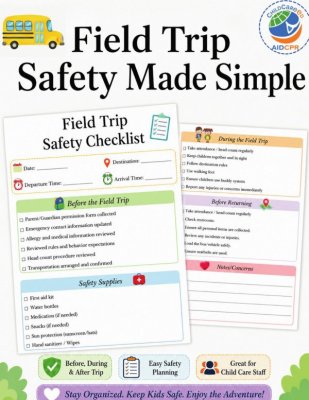
- Identify appropriate supervision practices for children during transportation and field trips.
- Demonstrate the elements of positive respectful relationships that include warm, nurturing interactions with children.
- Identify and demonstrate an understanding of National and State school readiness models and positions.
- List methods to help you plan a conference.
- Demonstrate understanding of how teacher expectations/behaviors can contribute to student achievement.
- Demonstrate an understanding of the importance of establishing realistic expectations for behavior.
- Identify guidance and discipline strategies to use with various behavior problems.
- Identify current events impacting Early Childhood Education.
- Give examples of strategies to help children resolve conflict amongst themselves.
- Give examples of ways to show respect for family differences.
- Recognizing and preventing shaken baby syndrome
- List safety risks for infants and toddlers and strategies to diminish these risks.
- List benefits to a multicultural and inclusionary environment.
- Identify ways to reflect on one's own personal perspectives with courage and/or humility
- Identify vehicle safety hazards that pose a major threat to children.
- Explain the possible causes and results of traumatic brain injury in infants and young children.
- Give examples of strategies teachers can use to communicate with parents regarding challenging behaviors.
- Identify Jean Piaget's stages of cognitive development.
- Demonstrate an understanding of how environment and equipment modifications support individual needs.
- Define resilience and identify ways it helps young children overcome toxic stressors.
- Define project based learning and the implications of practice.
- Identify resources for referral and specialized services.
- Describe the stages of emotional development in young children.
- Demonstrate an understanding of how chronic illness can affect development in ages four and above.
- Demonstrate understanding of how to assess and meet the needs of children with special needs.
- Demonstrate an understanding of the impact of culture and diversity in relation to school readiness.
- Demonstrate an understanding of potential violations of confidentiality and take steps to reduce the risk of occurrence.
- Demonstrate understanding of appropriate interaction with infants and toddlers.
- Identify strategies to listen while withholding judgement about the new or unfamiliar
- Identify the components of the MY Plate.
- Demonstrate understanding of an IFSP and removing barriers
- Explain the role of respect in children’s behavior.
- Demonstrate knowledge of appropriate reporting process.
- Identify appropriate practices communicable diseases/illnesses and immunizations and their schedules in child care setting
- Define basic skills children should have when they begin kindergarten
- Identify factors that may influence learning for a child in the family child care environment.
- Identify the benefits of field trips and the proper procedures for field trip planning.
- Explain the importance of two-way communication.
- Demonstrate understanding of developing strategies for involving parents in the child care setting.
- Describe the importance of monitoring the family child care environment for potential risks.
- Demonstrate an understanding of how promoting an integrated curriculum promotes development.
- Describe the stages of grief and the different ways children react to grief and stress.
- Distinguish between praise and encouragement.
- Identify teaching skills and techniques using the “I Message”
- Demonstrate an understanding of how to be open to new perspectives and diverse others.
- Recognize the importance of collaborating to improve academic performance.
- Identify stages and milestones of development for ages 1 to 5
- Demonstrate an understanding of diverse perspectives, and navigate the ambiguity and complexity that comes with that.
- Define healthy practices to mitigate the spread of germs and decrease the likelihood of SIDS in infants and toddlers.
- Demonstrate an understanding of how to foster self-regulation skills in children.
- Identify the importance of professional development for child care professionals and strategies to make meaningful choices.
- Identify causes of obesity in children.
- Identify strategies to assist children with food allergies/feeding concerns.
- Recognize the importance of problem solving and conflict resolution strategies with community members and families
- Demonstrate an understanding of how the community in which a child lives influences development
- Demonstrates understanding of community organizations that support early childhood programs.
- Identify communication issues that are common in the early care and education environment
- Demonstrate understanding of effective listening skills in childcare.
- Demonstrates understanding of the ADA and how it applies to childcare programs
- Explain the challenges behind mixed-age group instruction and strategies to overcome them.
- Criteria to earn CEUs:
- Certificates are awarded when the following criteria have been met by the learner:
- Class has been paid in full
- All material has been reviewed
- All review questions and final test have been completed with a passing score of 80% or higher.
- Learning Assessment Method:
- Learners will be assessed through questions after every section is completed. Learners will not be
allowed to proceed to the next section of the training until all questions have been answered correctly.
Learners will be presented with a final test composed of true/false and multiple choice questions.
Upon successful completion of the training, learners will receive their certificate by email.
- Learning Methodology:
- Online material will be presented in the form of slides,
accompanied with speech. Videos will be used to demonstrate ideas and concepts. Charts and tables
will be used for illustration.
- Logistics/Required Technology:
- A stable internet connection is required for the completion of this course. Users are highly encouraged to take their online course on Google Chrome on either a laptop or desktop computer. Speakers and/or headphones are also required to hear speech.
- Payment Policy:
- Payments need to be made in full. No refunds will be issued after starting the class.
- Proprietary or conflict of interest disclosure:
- Unless otherwise stated in the course description none of H & H subject matter experts and editor has any conflict or proprietary interests related to the material they prepared in this course.
- Support Services:
- Please visit our contact us page
You are purchasing a session of an online training that includes online assessments. Your certificate will be emailed to you once you pass the final exam with a passing grade of 80%.
Your certificate will bear the name you provided to us when you signed up. For support and questions regarding the material presented in this class please contact us at info@childcareed.com. Please consult our frequently asked questions page for other questions or feel free to contact us.
No prerequisites are required for the completion of this course.