Every day you meet big feelings in the room. A calm-down corner gives children a safe place to practice calming skills and come back ready to learn. This short guide helps directors and child care providers build a simple, useful corner that respects choice and teaches #preschoolers to self-soothe. You'll find easy lists, teaching tips, safety notes, and links to printable tools and trainin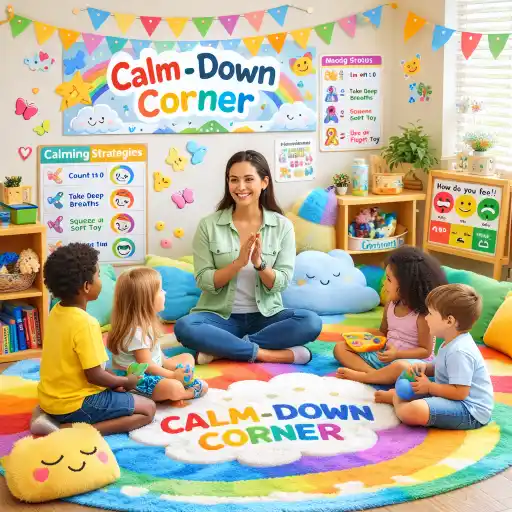
gs. For quick setup ideas, see Creating a Peaceful Retreat: The Power of a Calming Corner and the free "I Need a Break" posters at ChildCareEd Buy Now $0.00. Remember: state requirements vary - check your state licensing agency.
What is a calm-down corner, and why does it matter?
2) Why it matters: - It teaches #regulation so children can stay safe and learn. - It reduces repeated meltdowns and interrupts less classroom time. - It gives kids choice and builds independence. Research and practice show short, repeatable tools work best. See practical calm-down tools and routines at ChildCareEd.
3) Quick rules to share with staff and families: - The corner is voluntary. - Keep visits short (2–5 minutes) unless staff stays nearby. - Use clear visuals so non-readers know choices. Teach the corner when children are calm so they know it is a helpful tool, not a consequence.
What should I put in a calm-down corner?
- 🧸 Soft seating or a small rug and a pillow.
- 🔮 A sensory bottle or glitter jar for watching slow movement.
- 😮💨 A breathing visual (cards or a poster) and a stuffed “breathing buddy.”
- ✊ A small squeeze ball or safe fidget.
- 📘 One short feelings book or picture cards children can point to.
2) Label choices with pictures and one-sentence rules. ChildCareEd’s calm-down kit ideas and printable posters are useful: see Creating a Peaceful Retreat and the "I Need a Break" posters Buy Now $0.00.
3) Safety checklist (quick): - Use washable materials. - Avoid small parts for young children. - Keep the area visible to staff. - Rotate items to keep interest. For kit options and sensory tools, vendors like Nasco show product ideas, but simple homemade items work well too.
How do I teach children to use the corner so they choose it when upset?
2) Use a simple script to coach kids during upset moments: Connect → Calm → Coach. For example: - 🧑🤝🧑 Connect: “I’m here with you.” - 😮💨 Calm: “Breathe with me—1,2,3.” - 💬 Coach: “When you’re calmer, what helped?” ChildCareEd recommends this order in its practical guides on de-escalation and teaching calm tools: See the guide.
3) Teach feeling words and choices. Use short emotion labels from resources like the CSEFEL handouts on emotion vocabulary (examples at CSEFEL Handout 2.4) so children can point to feelings instead of acting out.
4) Practice through play: - 🎲 Games: Freeze Dance, Red Light/Green Light build stopping skills. - 🧘 Mindfulness moments (balloon breaths, breathing buddies) fit transitions. For many quick activity ideas, see Mindfulness for Little Learners.
How do teams keep the corner safe, avoid mistakes, and know when to get help?
1) Team rules and documentation: - Post clear rules: choice only, staff nearby, respect others’ space. - Train all staff to use the same short language and to model calm. - Log visits and triggers for patterns. The ChildCareEd posts about tracking behavior and team steps are helpful: team steps.
2) Common mistakes & fixes (quick):
- ❌ Mistake: Using the corner as punishment. ✅ Fix: Teach it during calm time and model visits.
- ❌ Mistake: Too many items that overstimulate. ✅ Fix: Limit to 2–4 low-stim items and swap occasionally.
- ❌ Mistake: Long lectures during meltdowns. ✅ Fix: One short sentence + one clear choice.
3) When to ask for extra help: - If a child hurts self/others often, has many long meltdowns, or doesn’t respond to tools after weeks, involve families, your director, or a mental health consultant. Use data from logs to guide next steps. ChildCareEd and early intervention guides describe referral steps and mental health supports.
4) Local resources and training: - Many states offer calming-corner training (see Nebraska’s Cozy Calming Corner program at Nebraska Children & Families Foundation). - For ready-made kits and sensory tool ideas see Nasco, but remember inexpensive items and printed cards often work just as well.
Conclusion and FAQ
Summary — 1) Keep the space simple and voluntary. 2) Teach tools by practicing when children are calm. 3) Use short scripts (Connect → Calm → Coach). 4) Track patterns and ask for help if safety is a concern. The calm corner supports #classroom routines and helps children manage #emotions while they learn lasting #calmdown skills.
FAQ (short):
- ❓ How long should visits be? — 2–5 minutes to reset; staff stay nearby for longer visits.
- ❓ What if a child refuses? — Offer one calm choice, stay nearby, and practice later when calm.
- ❓ What tools work best? — Breath visuals, a sensory bottle, a soft toy, and one squeeze ball.
- ❓ Where to get printables? — See ChildCareEd calm-down posters and calm-down kit checklists at ChildCareEd.
You are doing meaningful work. Small changes—one clear corner, short practice, and team consistency—help children build #regulation and return to learning calmly. State requirements vary - check your state licensing agency.
1) Teach with short practice sessions while children are calm: - Show the corner at circle time. - Model one breathing tool and have the group practice (1–2 minutes). - Let each child try the corner in a calm moment for 1–3 minutes.1) A calm-down corner is a small, low-stimulation space where children choose to go for a short break. It is not a punishment area. It helps children learn to calm their bodies, name feelings, and try a tool before rejoining the group. For why this helps learning and behavior, read How can child care teams de-escalate young children and How to Promote Self-Regulation Skills.1) Keep it simple. Pick 2–4 items so the space stays low-stimulus. Here are easy, low-cost ideas used in many programs:- Building Equity: Inclusionary Practices in Preschool
- 45 Hour Preschool Methods and Materials
- From Tantrums to Triumphs: Equipping Preschoolers with Self-Regulation Skills
- Birth to Five CDA Credential with Portfolio Review
- Teach with Respect!
- Pediatric RSV First Aid & CPR/AED
- Classroom Setup for Child Care
- CDA Bridge Bundle: Preschool without Portfolio Review
- Texas Director Credential Renewal
- Texas Director Credential
- Big feelings: helping kids calm down (age-by-age)
- How can we help children manage big emotions?
- Emotions for Kids: Fun Activities to Teach Feelings and Self-Control
- How can I reduce classroom conflicts among toddlers?
- What Can You Do Instead of Time-Out in Preschool?
- How can teachers use emotion coaching with little kids?
- Recursos en Español sobre el Sueño Seguro del Bebé
- Which preschool “soft skills” best predict later success?
- How can we encourage cooperation and sharing in our classroom?
- How can prevention plans help stop tantrums in the classroom?
- Capacitación en Salud y Seguridad Preventiva en Línea para Proveedores de Cuidado Infantil
- Lista para Guardería en Casa en Texas: Cómo Iniciar una Guardería en el Hogar
- How can preschool teachers use simple classroom management techniques that really work?
- How can I create calm classroom spaces that help children learn?
- How can DC early childhood educators use simple classroom management tips in busy preschool rooms?
- Canciones, juegos y preguntas de círculo para niños
- Cómo simplificar la capacitación para sus empleados de daycare
- How Can Staying Calm Help Children Calm Down? Co-Regulation Strategies for Child Care Teams
