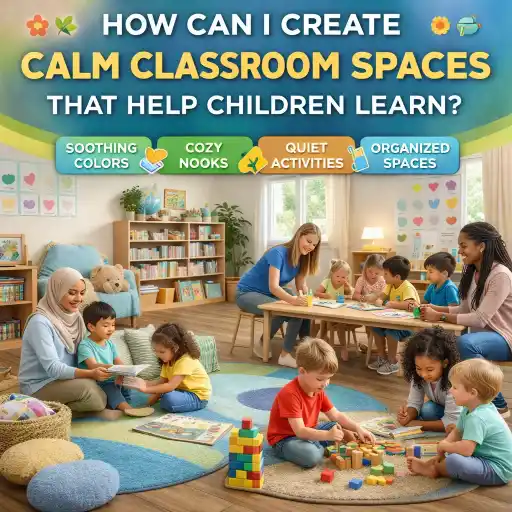
Your #classroom can feel peaceful and work for everyone. This article gives simple, practical steps for directors and child care providers to make rooms that help #children feel safe, learn, and play. We focus on easy changes you can try this week. For examples and printable ideas, see How Can I Create a Calm Classroom Environment? and Building a calm classroom. Remember: state requirements vary - check your state licensing agency.
1) How do I set up the room to feel calm?
- 🌞 Lighting — Use natural light when you can and add a soft lamp in quiet spots. Too-bright lights can make children restless. For ideas about light and color, read Building a calm classroom.
- 🔇 Noise control — Add rugs, curtains, and cushions to soak sound. Put noisy play away from reading areas to protect quiet time. Less is More shows why fewer things reduce overstimulation.
- 🛋️ Cozy corner — Create one small calm spot with 3–5 items: soft rug, pillow, breathing visual, sensory bottle, and feelings chart. Make it a choice, not a timeout. See Creating a Peaceful Retreat.
- 🧩 Order and labels — Put materials on low shelves and label with pictures so children find and return items easily. Organized shelves help independence and faster cleanup.
Tip: Keep one low-light quiet zone for books or puzzles. Even one calm corner can lower the whole room’s energy.
2) What routines and adult habits keep the room calm?
Routines and adult habits make calm last. When adults plan and model calm, children learn to do the same. For routines and schedule tips, see How can organizing materials and routines make my classroom calmer? and the CSEFEL brief on routines (CSEFEL).
- 🕒 Visual schedule — Post a picture schedule and review it each morning. Use photos of your room so children know what to expect.
- 🔔 Smooth transitions — Give 5, 2, 1 minute warnings, use a song, bell, or clap pattern, and teach a short clean-up song. See Transitions tips.
- 🧘 Mindful moments — Try 1–3 minute breathing breaks (balloon breath or smell the flower, blow the candle). Small mindfulness fits busy days; see Mindfulness for Little Learners.
- 🤝 Relationship-first responses — Get down to children’s level, use a warm voice, and name feelings. The order Connect → Calm → Coach works well in practice and in the ChildCareEd guides.
Adult habits matter: consistent words, calm tone, and short scripts help everyone. When staff use the same signal and schedule, days run smoother and stress goes down.
3) How do I teach children to use calm tools and check if they work?
- 🧑🏫 Teach & practice — Introduce one tool at circle time: show the sensory bottle, practice breath with a stuffed breathing buddy, and let each child try the cozy spot for 1–2 minutes.
- ✅ Keep rules simple — 1) The corner is a choice, 2) Visits start short (2–5 minutes), 3) Staff stay nearby. Remember to log visits if you want to track progress.
- ❌ Common mistakes & fixes:
- ❌ Using the corner as punishment → ✅ Teach and model when calm.
- ❌ Too many toys → ✅ Limit to 2–4 low-stim items and rotate.
- ❌ Long lectures during upset → ✅ One short sentence + one choice.
- 📈 How to know it’s working — fewer long meltdowns, faster returns to play, and more children using feeling words or asking for the corner. For tracking and next steps, see CSEFEL and ChildCareEd behavior posts.
If a child’s meltdowns are frequent, intense, or unsafe, partner with families and a mental health consultant. State requirements vary - check your state licensing agency before changing policies or using specific tools.
4) What quick steps can I try this week and what should I avoid?
Try a short checklist to make fast, visible change. Small steps add up and help staff feel more in control. Also learn common pitfalls so you can avoid them.
- 🔎 This week: Post or update a simple picture schedule at child eye level.
- 🎵 This week: Teach one clean-up song and use it every day for that step.
- 🛋️ This week: Make a tiny cozy corner with 3 items (rug, breathing visual, sensory bottle) and teach it during circle time. See Creating a Peaceful Retreat.
- 🧹 This week: Turn off one bright overhead bank of lights or open blinds to add natural light.
- 📋 Check common mistakes to avoid:
- ❌ Over-decorating walls — too many visuals can distract. Research shows sparse displays help attention (APS study).
- ❌ Inconsistent staff language — pick 2–3 short phrases and practice them in staff huddles.
- ❌ Using calm areas as punishment — teach and model use when children are calm.
- 📌 Consider special needs: Children with ADHD or sensory differences may need clear structure, brief movement breaks, or quieter spots. See tips from the CDC on ADHD and ChildCareEd’s sensory and trauma-informed posts (Trauma-Informed Care).
Small, steady changes make the biggest difference. Your calm choices help children grow social and learning skills and help staff keep energy steady. Keep trying one step at a time — your #cozycorner, your #routines, and your #calm work together to support your #children.
Conclusion: What next?
1) Pick one small change this week (a lamp, one rug, or one new song). 2) Teach it clearly when children are calm and practice often. 3) Use the same language across staff and track simple signs of progress.
Why it matters: A calm room helps children settle, pay attention, and be kinder to each other. Start with 1–2 changes and build from there. See practical layout tips at How Do I Create a Calm-Down Corner.Teaching tools takes practice. Use short lessons when kids are calm and role-play so children know how to use choices later. ChildCareEd’s calm-down corner guides have checklists and posters to print (Calm-Down Corner).- Behind the Scenes: Baby Routines ONLINE
- 45 Hour Child Growth and Development
- Building Equity: Inclusionary Practices in Preschool
- 45 Hour Preschool Methods and Materials
- Bienvenido! Welcoming All Families
- 45 Hour School Age Methods and Materials
- Classroom Setup for Child Care
- Texas Director Credential
- Professional Integrity in Child Care
- CDA Certification en Español: Recursos y Consejos para Educadores Bilingües
- How Can Nevada Child Care Providers Create Safe, Calm, and Well-Organized Learning Spaces?
- How can I create calm classroom spaces that help children learn?
- How can we create a calm classroom that helps children learn?
- How can I create a nurturing infant environment in my childcare program?
- What Can the Las Vegas Strip Teach Us About Making Sensory-Friendly Classrooms?
- Canciones, juegos y preguntas de círculo para niños
- Designing Classroom Spaces That Support Learning and Play
- What Is a Positive Classroom Climate?
- How Can We Create a Calm and Nurturing Infant Classroom?
- How can I create engaging learning centers for preschoolers?
- How Can Child Care Providers Help School-Age Children Manage Stress?
- How can daily routines teach self-regulation to young children?
- What small changes make child care classrooms feel more welcoming?
- How Can Thoughtful Design Create Calm Classrooms?
- After-School Activities for Kids: Calm, Creative, and Active Ideas for Every Energy Level
- Toddler Classroom Management Strategies for the 5 Hardest Parts of the Day
- How Can Child Care Providers Create Sensory-Friendly Learning Spaces for All Children?
- How Can Providers Create a Calm-Down Corner That Actually Works?
