Introduction
Toddlers in group care learn fast, but they also get into fights. Conflicts are normal as children learn words, sharing, and self-control. When staff use simple plans and calm routines, you can cut down fights and help children learn from them. This article is for child care providers and directors who want clear, practical steps to try right away.
Why it matters:
1) Fewer conflicts mean safer play and more time for learning. 2) When adults teach skills, children grow in confidence and make friends more easily. See ideas about using conflict as learning at Conflict in Early Childhood Education Classrooms.
In this article you will find easy steps for understanding why toddlers fight, how to set the room and routines to prevent fights, how to teach words and #empathy, and what to do in the moment. Use the tips with your team—and remember state requirements vary - check your state licensing agency.
Why do toddlers fight and what does that teach us?
Toddlers fight for simple reasons: a toy, too little wording, big feelings, or feeling tired or hungry. These fights are chances to teach new skills, not just punish. Adults who watch carefully find the real triggers and can fix things.
Key reasons toddlers disagree:
- 🔍 Limited language: They want something but can’t say it. See teaching problem words at Teaching kids to solve problems with words.
- 🧸 Resource fights: One toy, many kids. Duplicates and clear jobs help.
- 😣 Big feelings: Tired, hungry, or overstimulated children get upset fast. Calm adults help them learn to calm down (see self-regulation ideas at How to Promote Self-Regulation Skills).
Why this matters for your program:
- Better relationships: Adults who respond kindly build trust (read about teacher-child relationships at CSEFEL Brief #12).
- More learning time: Less fighting = more play that teaches skills.
- Stronger skills: When guided, toddlers learn sharing, turn-taking, and emotional words.
What classroom routines and room setup reduce fights?
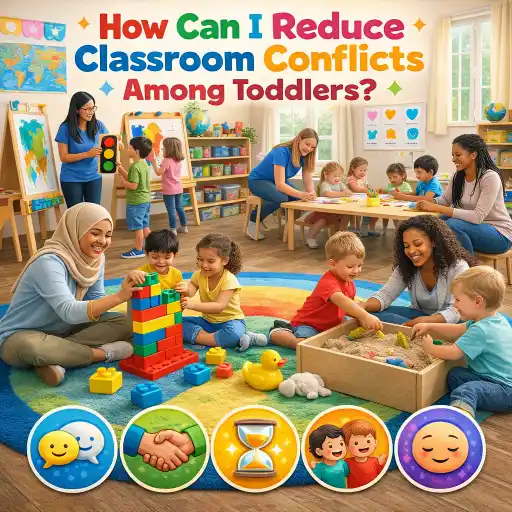
The room and routine do a lot of the work. A predictable day and smart layout make fighting less likely. Child care resources give step-by-step plans for calm classrooms—see How can I manage a toddler classroom so it feels calm and safe?.
Try this 6-step plan for the environment and routine:
- 🪴 Make clear zones: reading, blocks, art, and a quiet #calm corner. Low shelves show choices without shouting.
- 📋 Use a picture schedule: Toddlers know what’s next. Post photos where children can see them.
- 🧸 Limit toys out: Fewer choices reduce grabbing. Rotate materials each week to keep interest.
- 👣 Create walking paths: One clear loop means less bumping and chasing.
- 🔔 Teach short transitions: Signal → 1–3 steps → move. Small groups leave at a time to avoid crowding (see Montessori transition ideas at Montessori Transitions That Actually Work).
- 🧽 Give helper jobs: Children who help reset feel proud and are less likely to fight.
Practical tip: practice clean-up and lining-up as a game. Use timers, songs, or a bell so toddlers learn the routine. These environmental and routine steps make your room a supportive tool for behavior.
How do we teach toddlers to use words, share, and show empathy?
Teaching words and #empathy is step-by-step. Use short phrases, role-play, and games so toddlers can copy and practice. ChildCareEd resources give scripts and tools you can post at child height (Teaching empathy to young children and Conflict Resolution Solution Cards Buy Now $0.00).
Simple teaching routine (use daily):
- 💬 Name feelings: "You look sad." Do this often so children learn feeling words. Use the printable My Book of Emotions Buy Now $0.00.
- 🗣️ Teach power phrases: "My turn," "Help, please," "Can I have a turn?" Practice these when children are calm. See scripts at Teaching kids to solve problems with words.
- 🤝 Role-play: Use puppets or quick pretend scenes to show helping and sharing.
- ⏱️ Use timers and trade prompts: Timers teach turn-taking and make sharing fair.
- 🌟 Praise specific tries: "You asked with words—that was helpful!"
Short practice builds skill. Add a small peace spot and conflict solution cards so children can try steps on their own (Peace Corner Buy Now $0.00).
What do I do in the moment and how do I partner with families and staff?
In-the-moment responses should be brief, calm, and safe. Later, use the moment to teach a better choice. Work with families and train staff so everyone uses the same words and steps.
Quick 4-step in-the-moment script:
- 🛑 Stop the action: Move gently between children to keep them safe.
- 🧑⚕️ Care first: Check who is hurt and comfort them.
- 🗣️ One short sentence limit: "No hitting. Hitting hurts."
- 🔁 Offer a replacement: "Use gentle hands" or "Say, 'My turn'"—then coach the child to try it.
Partner with families and staff:
- 📞 Share patterns: Send short notes about what helps at school and ask families what works at home.
- 🤝 Make a 3-step plan: Pick 3 consistent words and one routine both staff and families use.
- 🧾 Track triggers: Note time, place, and trigger to find a pattern and fix the root cause.
- 👩⚕️ Ask for help when needed: If behavior is frequent or dangerous, bring in specialists or mental health consultants (see Ouch! Biting & Hitting Hurts
 Buy Now $24.00).
Common mistakes and how to avoid them
- 🚫 Too many rules at once — Fix: Teach 3 short rules and practice them daily (see How can I manage a toddler classroom…).
- 🚫 Inconsistent staff responses — Fix: Pick one short script and rehearse it with the team.
- 🚫 Long lectures in the moment — Fix: Calm first, teach later when the child is calm.
Conclusion
Reduce #conflict with simple, steady steps. Use the room and routine to prevent fights, teach short words and #routines, coach empathy, and respond calmly in the moment. Small practice each day leads to big change.
Quick checklist to try this week:
- ✅ Post a picture schedule and teach it each morning.
- ✅ Pick 3 classroom rules and one short transition signal.
- ✅ Teach 3 power phrases and practice with puppets or role-play.
- ✅ Make a small peace corner and add conflict solution cards.
- ✅ Meet with families to share one plan and track patterns.
FAQ
- Q: How many rules should toddlers learn? A: Three short rules work best.
- Q: When should I call a specialist? A: If a child hurts others often, has long meltdowns, or shows sudden big changes.
- Q: Are timers okay for turns? A: Yes—timers make turns fair and visible to toddlers.
- Q: Do visuals help? A: Yes—pictures and cards reduce talking and help children know what comes next (see Conflict Resolution Solution Cards Buy Now $0.00).
For more tools, printable cards, and short courses, visit ChildCareEd links used above. Your steady, caring work helps toddlers learn how to get along—and that matters for a lifetime.
- 45 Hour Child Growth and Development
- Moving About the Classroom: Effective Transitions for Everyday
- How To Keep A Healthy Class: Six Tips for Germ Control
- CDA Infant/Toddler Credential
- 45 Hour Infant and Toddler Methods and Materials
- CDA Infant/Toddler Credential with Portfolio Review
- CDA Bridge Bundle: Infant/Toddler without Portfolio Review
- 45-Hour Infant and Toddler Curriculum
- Texas Director Credential
- CDA Certification en Español: Recursos y Consejos para Educadores Bilingües
- 👶 ¿Cuáles son las proporciones y grupos requeridos en Dakota del Norte? 🏫
- Recursos en Español sobre el Sueño Seguro del Bebé
- 10 Ejemplos de Cómo la Cultura Influye en el Desarrollo Infantil
- Proporciones de Cuidado Infantil y Tamaños de Grupo por Edad en Virginia (Guía Rápida para Centros y Hogares)
- Teaching Preschoolers How to Work Through Conflict
- Daycare Conflict Resolution: Helping Children Get Along
- Cómo simplificar la capacitación para sus empleados de daycare
- How can New York child care programs teach conflict resolution and sharing?
- How Can We Create a Calm and Nurturing Infant Classroom?
- How can we teach kindness and friendship in our classroom?
- How can childcare programs talk to parents about screens and AI without starting a fight?
- Can your program go screen-free with engaging analog activities?
- How Can Child Care Providers Avoid Power Struggles with Young Children?
- How Can Child Care Providers Help Children Learn to Disagree Respectfully?
- How Can Child Care Providers Turn Conflict Into Learning?
- How Can You Create a “Yes Space” Where Infants and Toddlers Explore Safely?
- How Can Child Care Providers Teach Emotional Regulation to Toddlers and Preschoolers?
