Introduction — Why this matters
As a child care provider, you meet strong feelings every day. Helping young children learn to notice and 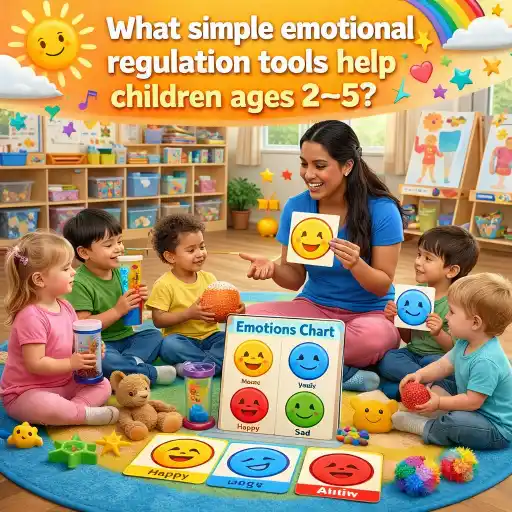 calm big feelings makes your room safer, helps learning, and supports healthy friendships. Teaching a few easy tools gives #preschoolers skills they will use for life. See practical guides at How can we help children manage big emotions? and ideas for building routines at How to Promote Self-Regulation Skills in Young Children.
1) What quick tools work in the moment?
Use short, predictable steps so children can follow when upset. Start with the simple order: Connect → Calm → Coach. For ideas from ChildCareEd, see Big feelings: helping kids calm down.
- 🧑🤝🧑 Connect: Get to child level and say, “I’m here.”
- 😮💨 Calm with breath tools: balloon breathing, 5-finger breathing, or turtle breaths (stop, tuck, breathe). These are short and repeatable.
- 💪 Heavy-work breaks: carrying books, pushing a cart, or wall push-ups to help bodies reset.
- 🔁 Replace unsafe actions: offer a stomp, squeeze toy, or stress ball rather than hitting.
- 📣 Simple scripts: “Breathe with me — 1, 2, 3.” Keep words tiny and clear.
Try using strategies from the Zones of Regulation to give children a common language for feelings. Tools are most helpful when you practice them often so kids build #regulation and notice their #emotions.
2) How do we teach these tools during the day so children learn them?
Teaching works best when it is short, fun, and repeated. Use routines, games, and moments of calm to practice skills — not only during meltdowns. The Pyramid Model and classroom routines give a strong framework; trainings and modules are free to explore at the National Center for Pyramid Model Innovations.
- 🎲 Practice with play: 1) Red Light/Green Light, 2) Freeze Dance, 3) Simon Says help build stopping and waiting skills.
- 🧘 Short daily breathing: 1–2 minute group practice at circle time. Use visuals and a calm voice.
- 🎵 Brain breaks: quick movement or mindfulness between tasks — see ideas at Scholastic.
- 📅 Routines + visuals: visual schedules and countdowns lower anxiety and support #co-regulation.
- 💬 Language practice: teach feeling words and model self-talk so children can use words instead of actions.
Use short coaching after calm: 1) What happened? 2) What did you feel? 3) What can we try next? Regular practice builds self-help skills and strengthens adults’ ability to support and teach #preschoolers.
3) What should a calm-down area include and how should staff use it?
A calm-down space (peace corner) is a safe choice spot — not a punishment. ChildCareEd gives setup ideas and a free Peace Corner resource at Big feelings, small bodies and Calm-Down Kit Checklist Buy Now $0.00.
- 🪟 Basics checklist:
- Soft rug or small seat
- Feelings chart with faces (non-readers can point)
- 2–4 calm tools: sensory bottle, soft toy, breathing visual, small squeeze ball
- Clear rule card: “This spot helps me calm.”
- 📚 Teach it when calm: model how to use the space and practice 2–5 minute visits so children know the routine.
- 👀 Supervision and choice: staff stay nearby, and child chooses to use it. Avoid using as time-out.
- 🔁 Keep tools limited and safe; rotate items to keep interest. For sensory ideas see sand, water, and sensory play resources like sand and water play.
Remember: state requirements vary - check your state licensing agency. Make sure items meet safety and sanitary rules for your program.
4) When should we ask for extra help and how do we avoid common mistakes?
Knowing when to refer and how to avoid pitfalls helps teams support children fairly and effectively.
- 🛑 Signs to get extra help:
- Frequent hurting of self/others
- Long meltdowns many times daily
- No response to usual calming tools over weeks
- 👥 Team steps: Share observation notes with families, your director, a mental health consultant, or early intervention. ChildCareEd courses like Mental Health in Early Childhood
 Buy Now $24.00 explain when to seek support.
 - 🚫 Common mistakes + fixes:
- ❌ Only teach tools during meltdowns → ✅ Practice daily when calm.
- ❌ Long lectures in the moment → ✅ Use one short sentence and one choice.
- ❌ Using calm corner as punishment → ✅ Teach it as a safe choice and model its use.
- 📈 Track patterns: Log triggers, time of day, and what helps. Data points guide referrals and behavior supports (see Pyramid Model modules at NCPMI).
If behavior could be linked to trauma or deeper needs, partner with families and specialists. Use positive guidance courses like Viewing Guidance in a Positive Light Buy Now $24.00 to build staff skills. You are not alone—small steps and consistent practice make a big difference for children learning #calming and self-#regulation.
Conclusion — Quick summary and FAQ
Summary (quick): Teach a few short tools, practice them often, use a calm, consistent plan (Connect → Calm → Coach), make a safe calm-down space, track patterns, and ask for help when needed. Use ChildCareEd resources and trainings to support staff growth.
FAQ (short)
- Q: How long should a calm corner visit be? A: 2–5 minutes to reset, longer only with staff nearby.
- Q: What if a child refuses help? A: Stay nearby, offer one choice, try again later, and practice tools when calm.
- Q: Where to get lesson plans? A: See ChildCareEd social skills and self-regulation resources like Self-Regulation and training courses.
- Q: When to refer? A: If safety is a concern or patterns persist despite supports—talk to families and specialists.
You are doing important work. Small, steady steps help children build lasting skills. For training and printable tools, visit ChildCareEd and the links above.
- 45 Hour Child Growth and Development
- 45 Hour Preschool Methods and Materials
- Bienvenido! Welcoming All Families
- Pediatric RSV First Aid & CPR/AED
- 24 Hour Texas Pre-Service
- CDA Bridge Bundle: Family Child Care without Portfolio Review
- CDA Bridge Bundle: Infant/Toddler without Portfolio Review
- CDA Bridge Bundle: Preschool without Portfolio Review
- Texas Director Credential
- 🤯 ¿Por qué este niño está teniendo un comportamiento difícil de repente?
- 🥺👋 ¿Por Qué la Despedida de la Mañana es Tan Emocional?
- 😅❌ ¿Cómo Puedo Manejar a un Niño que Dice “¡NO!” a Todo en el Aula?
- ¿Cómo explicar los colores a un niño ciego? Actividades con tacto, sonido y emociones
- Capacitación en Salud y Seguridad Preventiva en Línea para Proveedores de Cuidado Infantil
- Regulaciones de Licenciamiento de Cuidado Infantil en California para Centros y Hogares de Cuidado Infantil Familiar
- Proporciones de Cuidado Infantil y Tamaños de Grupo por Edad en Maryland (Guía Rápida para Centros y Hogares)
- Lista para Abrir una Guardería en Casa en Virginia: Cómo Empezar
- How Can Child Care Programs Support Children’s Mental Health?
- What Social-Emotional Learning Activities Work Best for Toddlers in Minnesota Classrooms?
- How can child care teams help children manage big emotions?
- How can child care providers support emotional regulation in young children?
- Celebrando la amistad en el cuidado infantil durante el Día de los Mejores Amigos
- Being Told No: Helping Children Manage Big Feelings
- How can child care teams help children manage big feelings?
- Can we tame the ‘monsters’ of big emotions in young children?
- Can a Superhero Week Help Preschoolers Learn to Name and Manage Emotions?
- How Can Staying Calm Help Children Calm Down? Co-Regulation Strategies for Child Care Teams
- How can we build emotional vocabulary through books and play?
