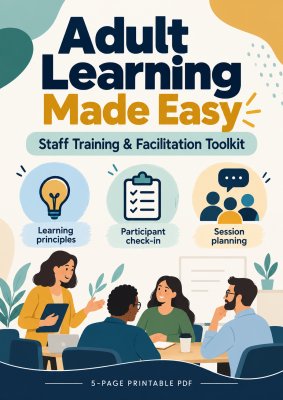

El Curso de 18 horas Train the Trainer, aprobado por MSDE, prepara a profesionales del cuidado infantil para formar y orientar eficazmente a aprendices adultos. Esta formación es esencial para los formadores aprobados por MSDE y se centra en desarrollar habilidades en comunicación, principios de aprendizaje de adultos, establecimiento de objetivos SMART y prácticas de diversidad, equidad e inclusión (DEI).
Los formadores desempeñan un papel crucial en mejorar las habilidades y conocimientos de los profesionales del cuidado infantil, fomentando una educación y atención de alta calidad para los niños. Este curso dota a los formadores de estrategias para involucrar a aprendices diversos, crear materiales profesionales y dirigir sesiones de capacitación impactantes.
Beneficios clave
- Ganar confianza y experiencia en impartir formaciones atractivas y eficaces.
- Aprender a diseñar materiales impactantes alineados con las mejores prácticas.
- Desarrollar habilidades esenciales como la escucha activa, la resolución de conflictos y la defensa.
Requisitos de finalización
Para completar el curso, los participantes deben presentar un esquema de capacitación Core of Knowledge, realizar una presentación en video de 15 minutos y proporcionar materiales de apoyo, como diapositivas y folletos. Las evaluaciones se basan en la claridad, la organización y el cumplimiento de los principios de aprendizaje de adultos.
Este curso asegura que los formadores cumplan con los estándares de MSDE mientras fomenta la excelencia en el desarrollo profesional para los proveedores de cuidado infantil.
By the end of this training, the learner will be able to:
- Dé ejemplos de formas de aplicar y modelar un comportamiento ético y la integridad profesional con los miembros de la comunidad y las organizaciones.
- Demostrar comprensión de los diferentes estilos de aprendizaje de los estudiantes adultos.
- Identificar los componentes de las habilidades de escucha activa.
- Explique el valor de la autoevaluación y la reflexión.
- Defina las metas SMART y describa su contexto histórico.
- Demostrar comprensión de cómo redactar objetivos SMART efectivos.
- Reconocer la importancia de mantener la confidencialidad y la privacidad en la comunicación con el personal.
- Describa formas en las que los profesionales del cuidado infantil pueden apoyar acciones de abogacía.
- Identify the importance of problem-solving and conflict-resolution strategies with colleagues and administrators.
- Identify the responsibilities of trainers.
- Identify steps in creating realistic training goals and objectives.
- Demonstrate an understanding of the importance of professional etiquette while training.
- Identify the necessary components of a successful training.
- Identify strategies for training individuals with challenging personalities.
- Identify the necessary skills of successful trainers.
- List MSDE basic requirements for trainers
- Give examples of approved types of continuing education for trainers.
- Demonstrate an understanding of the different principles behind adult learning.
- Define what it means to be a trainer.
- Identify trainer prerequisites.
- List strategies for trainers on how to apply DEI practices.
- List the elements of a training proposal.
- Identify ways to meet the needs of diverse learners during training sessions.
- Identify ways to determine training effectiveness.
- Demonstrate an understanding of how to develop assessments using Blooms Taxonomy.
- Identify presentation strategies and training techniques.
- Identify the components of a successful trainer presentation.
- Demonstrate an understanding of media trends in child care.
- Identificar formas de reflexionar sobre las propias perspectivas personales con valentía y/o humildad
- Identificar formas de interactuar de manera respetuosa y apropiada en una variedad de contextos culturales
- Dé ejemplos de maneras de colaborar con otros profesionales involucrados en el cuidado y la educación de todos los niños y jóvenes.
- Identificar estrategias para establecer conexiones e interactuar de manera sustantiva con personas diferentes a uno mismo.
- Identificar estrategias para escuchar sin emitir juicios sobre lo nuevo o lo desconocido
- Explique la importancia de la comunicación bidireccional.
- Enumere estrategias para colaborar con especialistas en la administración de evaluaciones del desarrollo.
- Demostrar comprensión de cómo estar abierto a nuevas perspectivas y a personas diversas.
- Enumere estrategias para implementar metas SMART.
- Demostrar una comprensión de diversas perspectivas y navegar la ambigüedad y la complejidad que ello conlleva.
- Describa la importancia de responder con sensibilidad a las diferencias en los estilos de comunicación individuales.
- Demostrar habilidades de comunicación que faciliten la comunicación intercultural, incluidas habilidades efectivas de escucha
- Demonstrate an understanding of the importance and components of a mission statement.
- Identificar los problemas de comunicación comunes en el entorno de atención y educación temprana
- Criteria to earn CEUs:
- Certificates are awarded when the following criteria have been met by the learner:
- Class has been paid in full
- All material has been reviewed
- All review questions and final test have been completed with a passing score of 80% or higher.
- Learning Assessment Method:
- Learners will be assessed through questions after every section is completed. Learners will not be
allowed to proceed to the next section of the training until all questions have been answered correctly.
Learners will be presented with a final test composed of true/false and multiple choice questions.
Upon successful completion of the training, learners will receive their certificate by email.
- Learning Methodology:
- Online material will be presented in the form of slides,
accompanied with speech. Videos will be used to demonstrate ideas and concepts. Charts and tables
will be used for illustration.
- Logistics/Required Technology:
- A stable internet connection is required for the completion of this course. Users are highly encouraged to take their online course on Google Chrome on either a laptop or desktop computer. Speakers and/or headphones are also required to hear speech.
- Payment Policy:
- Payments need to be made in full. No refunds will be issued after starting the class.
- Proprietary or conflict of interest disclosure:
- Unless otherwise stated in the course description none of H & H subject matter experts and editor has any conflict or proprietary interests related to the material they prepared in this course.
- Support Services:
- Please visit our contact us page
You are purchasing a session of an online training that includes online assessments. Your certificate will be emailed to you once you pass the final exam with a passing grade of 80%.
Your certificate will bear the name you provided to us when you signed up. For support and questions regarding the material presented in this class please contact us at info@childcareed.com. Please consult our frequently asked questions page for other questions or feel free to contact us.
To successfully complete the 18-hour Train the Trainer course, participants must meet the following submission and performance requirements. Submissions will be graded based on the rubric outlined below.
Submission Requirements
Participants must submit the following materials:
1. Core of Knowledge (CKO) Training Outline
- A training outline for a Core of Knowledge topic, which includes:
- Training Title: Strength-based and clearly reflective of the subject.
- Training Description: Detailed explanation of the content, the need for the training, and the benefits to participants.
- Learning Objectives: Clearly stated, measurable, and realistic objectives.
- Summary Statement: A concise overview of the training, including two key points.
2. 15-Minute Training Presentation
- Develop and submit a PowerPoint presentation covering your chosen topic.
- Record a 15-minute video of yourself delivering the presentation, ensuring:
- Clarity and engagement in delivery.
- Inclusion of objectives and a summary or wrap-up.
- Adherence to the principles of adult learning and active engagement.
3. Supporting Materials
Submit the following materials to support your presentation:
- PowerPoint Slides: Professional, clear, and free of errors.
- Handouts: Practical, user-friendly, and professionally formatted.
- Trainer Note Pages: Detailed notes for each slide or section.
Grading Rubric
Submissions will be evaluated using the following criteria, with scores ranging from 0 to 5 (5 being the highest). Must meet a minimum score of 40 out of 50 to be approved.
Organization
- PowerPoint, Training Proposal, and Documentation:
- Well-organized materials with clear structure and logical flow.
- Consistency among training description, learning objectives, content, and methods.
- Written Materials:
- High quality in writing, grammar, spelling, and mechanics.
Content
- Training Description and Objectives:
- Clear explanation of training content, its need, and benefits.
- Realistic and measurable learning objectives.
- Adaptations and Sensitivity:
- Addressing cultural sensitivity, diversity, and inclusion.
- Incorporation of ADA guidelines and person-first language.
- Relevance and Standards:
- Alignment with Core of Knowledge content areas.
- Use of reputable sources published within the last 5–7 years.
- Content reflects national standards and best practices.
Presentation
- Engagement and Clarity:
- Explicit explanation and illustration of content.
- Connection of training content to practical application.
- Methods of delivery cater to a variety of learning styles and promote active learning.
- Materials and Visuals:
- Professional quality handouts and visuals.
- Content adapted to audience needs and level.
- Time Management:
- Presentation timeline allows adequate time for content, activities, and assessment.
Additional Notes
- The video presentation is crucial for evaluating delivery style, clarity of content, and audience engagement.
- Reviewers will assess all materials and the video holistically to determine readiness as a trainer.
- Use the rubric provided as a guide when developing and submitting your materials.
By meeting these requirements and adhering to the grading criteria, participants demonstrate their ability to effectively plan, organize, and deliver training sessions in alignment with professional standards for adult learners.