Teaching kindness and friendship is one of the most meaningful ways child care providers can support children’s development. These skills help children form secure relationships, communicate their needs, cooperate with peers, resolve disagreements, and contribute to a caring classroom community. Strengthening social skills can also reduce recurring conflicts and create more time for play and learning. This article offers practical, classroom-ready strategies you can use immediately, including short kindness routines, guided-play activities, conflict-coaching scripts, inclusive supports, and simple ways to observe and document children’s progress. For guidance on interpreting common cues such as children saying “I’m hungry” or “I’m bored” and responding with supportive strategies that address both emotional and physical needs, see I’m Hungry, I’m Bored.
To build a more supportive classroom community, explore ChildCareEd’s self-paced online course Supporting Social Learning: Creating Classrooms that Care  Buy Now $24.00. The course provides practical strategies for strengthening social relationships, listening to children, addressing behavior concerns, and helping children succeed within the group. Providers can also take Brighter Futures: Social Emotional Development Buy Now $16.00 to deepen their understanding of emotional development and positive interactions among young children. State requirements vary, so always check with your state licensing agency.
1) How do I introduce a simple daily kindness routine that actually sticks?
Why it matters: short, predictable routines make kindness habitual. Start with one small, reliable moment each day and repeat it until it becomes classroom culture. For evidence-based prompts and examples, check How to Support Social and Emotional Learning in the Classroom.
- 😊 Morning greeting ritual (2 minutes): Invite children to choose how to greet peers—wave, high-five, or smile. This builds connection and starts the day with belonging.
- Model-and-name (ongoing): When you see a kind move, name it specifically: “You helped Maya find a seat—thank you for being kind.” This mirrors the approach in Helping Children Learn Kindness, Empathy, and Belonging.
- Kindness spotlight (weekly): Each week, pick 1 short goal (invite someone, share, help). Track with a simple board or jar so the class sees progress.
Tips: keep language short (one script), repeat it everywhere, assign a rotating “Friendship Foreman” to invite quieter children. These small steps build #kindness and a safer, calmer learning environment.
2) What short activities and guided-play scripts teach friendship and empathy?
Guided play gives children low-pressure practice with social language. Use short activities (5–15 minutes) and repeat the same script several times a day. For practical guided-play lesson plans, see How to Foster Friendship Skills Through Guided Play and the friendship activity ideas in How can preschool teachers teach friendship skills.
- 🎨 Cooperative Art (5–10 min): Two or three children share one paper and must agree on who paints which part. Script to teach: “Can I paint the sun? You paint the grass?”
- 🎭 Puppet problem-solving (5 min): Use puppets to act a small conflict; ask the group: “What could Puppet A say?” This models empathy and gives repeatable language.
- ⏳ Timer-turn practice (2–3 min): Use a sand timer for high-demand toys and teach: “Your turn in two minutes.”
- 🧩 Team build (10–15 min): Small groups build a bridge or track—cooperation is required. Praise specific moments: “You asked, ‘Can I help?’ Great friend words.”
Repeat scripts, model once, then step back—this scaffolding helps children internalize #friendship and #empathy. ChildCareEd’s short activity packs and read-aloud prompts (see Reading Aloud in Child Care) pair well with guided play.
3) How do I coach children through conflicts so they repair relationships?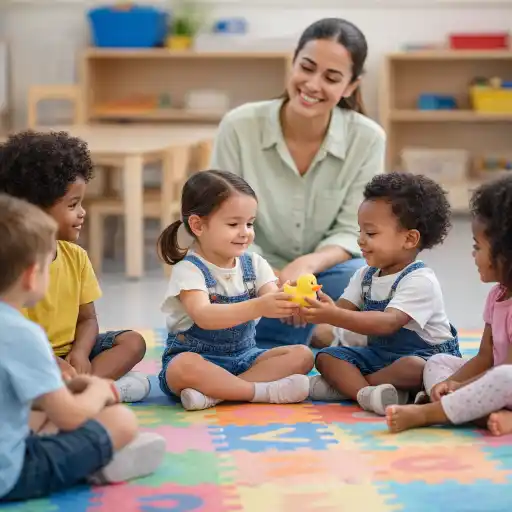
Conflicts are teaching moments if you keep responses short and focused. Use a 4-step routine that children can learn and use during play. For scripts and coaching ideas, see Teaching Preschoolers How to Work Through Conflict and the CSEFEL problem-solving steps (CSEFEL).
- 🛑 Stop & calm: “Hands down. Safe bodies.” Give one breath to reset.
- 🔍 Name the problem: “You look upset because you both want the red truck.”
- 💬 Offer options with scripts: “You can say, ‘Can I have a turn when you’re finished?’” or “Use the timer for turns.”
- 🔧 Repair and praise: Ask for a small fix (help rebuild, say ‘I’m sorry’) and name the skill: “You used words and fixed it—well done.”
Keep coaching brief and consistent across staff. If conflicts repeat, collect simple notes (when, where, who) and plan targeted guided-play practice. These teachable moments strengthen #communication and lasting friendships.
4) How do I include children with different needs and partner with families?
Inclusion and family partnership multiply your efforts. Practical adaptations and consistent home-school language help every child belong. See inclusion tips in Helping Children Learn Kindness, Empathy, and Belonging and peer-buddy strategies in the ECMHC resource Ideas for Teaching Children about Friendship.
- 🔎 Prime and rehearse: Before free play, practice one short script with a child who needs support: e.g., “Can I play?” This increases success dramatically.
- 🤝 Peer buddies: Assign friendly peers as invitation partners or a daily “Friendship Foreman.”
- ♿ Environmental tweaks: Offer larger manipulatives, quieter corners, visual cue cards, and extra time for transitions.
- 📣 Family notes: Send one-line strengths-first messages and one script families can use at home. State requirements vary - check your state licensing agency.
These steps respect individual differences while teaching the same friendship language. Families become co-teachers when you share simple scripts and celebrate small wins together—see family engagement ideas at 14 Days of Valentine Kindness Buy Now $0.00. You can also highlight events such as the International Day of Families to encourage quality family time and share simple home activities that reinforce friendship, empathy, and the classroom scripts you use.
5) How will I know it’s working, and what common mistakes should I avoid?
Look for stepped progress rather than overnight change. Use a short checklist and simple data collection to monitor growth.
- 📋 Quick progress markers (daily/weekly):
- Number of peer invitations you overhear.
- Fewer repeated conflicts over the same toy.
- More voluntary helping acts spotted and named.
- 🧾 Simple tracking: Keep a one-line note each day: what worked, what didn’t. If patterns repeat, add targeted guided-play practice.
- 🔁 Celebrate micro-wins: name specific acts of kindness immediately to reinforce them.
Common mistakes and how to avoid them: 1. ❌ Forcing sharing — teach offers, trades, and timed turns instead. 2. ❌ Long lectures during a conflict — use short scripts and teach later during calm moments. 3. ❌ Inconsistent staff language — pick 3 power phrases and use them program-wide (CSEFEL provides scripted language suggestions).
FAQ (short): 1) How long to see progress? Small steps within weeks; steady culture change in months with daily practice. 2) What if exclusion keeps happening? Use joining scripts, buddy roles, and targeted small-group practice. 3) Are visuals helpful? Yes—timers, cue cards, and pictures reduce language load and increase success. 4) Where to find lesson plans? Start with ChildCareEd articles listed above and CSEFEL scripted stories.
Conclusion: Start small—one script, one guided-play activity, one family note this week. Repeat often, name the skill, and celebrate tiny wins. Your daily, patient work grows lifelong #friendship, #kindness, #empathy, #play, and #inclusion in the children you serve. For printable scripts, lesson ideas, and training, visit ChildCareEd and CSEFEL resources cited above.
- Tailoring Instruction to Children's Needs
- Teach with Respect ONLINE
- CDA Home Visitor Subject Area 3 Part 3 Birth to 5
- 45 Hour Preschool Methods and Materials
- Teach with Respect!
- Brighter Futures: Social Emotional Development
- Creating Environments that Nurture Growth and Community
- Texas Director Credential
- The Right Kind of Influence for Young Children
- Supporting Families and Caregivers in Language and Literacy
- Celebrating International Women's Day
- Building Social Foundations
- National Grandparents' Day: Timeless Life Lessons from Grandparents
- Proporciones de Cuidado Infantil y Tamaños de Grupo por Edad en Maryland (Guía Rápida para Centros y Hogares)
- Proporciones de Cuidado Infantil y Tamaños de Grupo por Edad en Nueva Jersey (Guía Rápida para Centros y Hogares)
- How can Georgia preschool teachers use positive guidance to help preschoolers share during indoor play?
- How can rainy day indoor activities help preschoolers learn kindness and cooperation in Georgia?
- Helping Children Learn Kindness, Empathy, and Belonging
- How Can We Help Children Make Friends?
- Best Friends Day: Helping Children Learn Kindness and Friendship
- Celebrating Friendship in Child Care on Best Friends Day
- Celebrando la amistad en el cuidado infantil durante el Día de los Mejores Amigos
- What Can the Golden Gate Bridge Teach Preschoolers About Connection?
- How can we teach kindness and friendship in our classroom?
- How can child care providers help children build friendship skills?
- How can we effectively teach children to wait, share, and take turns?
- Team-Building Games for Preschoolers That Teach Cooperation
- Preschool Team-Building Activities for Better Communication and Friendship
- How Can Child Care Providers Teach Friendship Skills Through Everyday Classroom Activities?
- How Can Educators Teach Children to Comfort a Friend Without Requiring Hugs?
