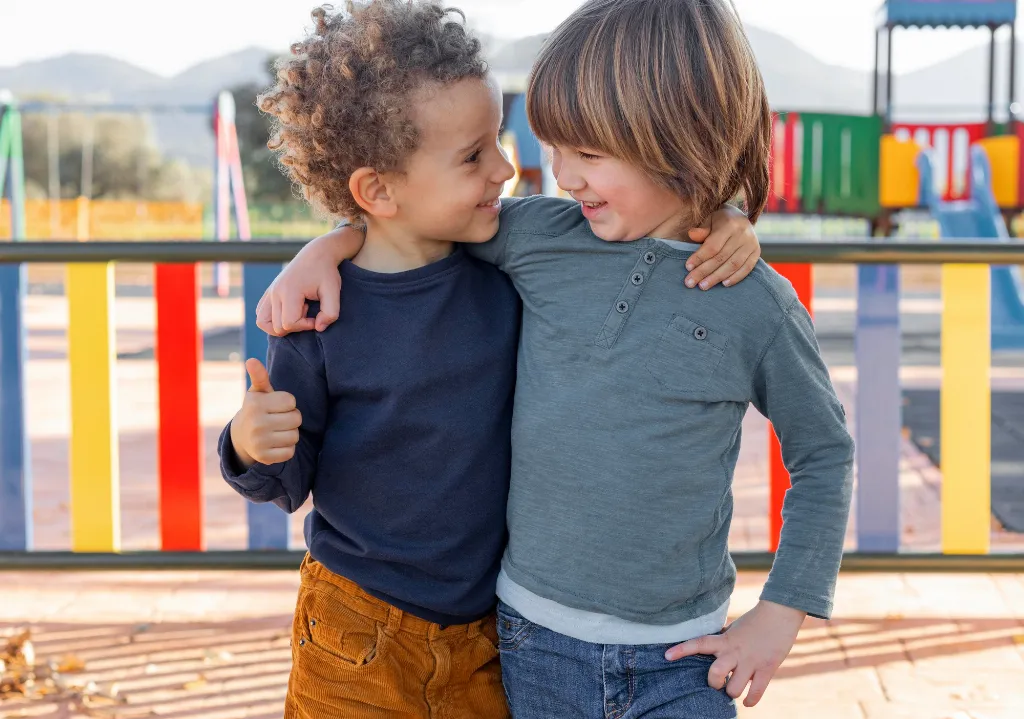
 Best Friends Day is a great chance for child care programs to help young children practice being kind, make friends, and learn how to solve problems together. This short article gives easy ideas, simple scripts, and step-by-step ways to celebrate the day and teach lasting skills. You will find links to helpful resources from ChildCareEd and others so you can try ideas this week. You can also tie Best Friends Day activities to National Random Acts of Kindness Day by running short, classroom-friendly kindness challenges that reinforce prosocial behaviors. You can also connect Best Friends Day activities to National Random Acts of Kindness Day (February 17) to extend kindness practice and link classroom routines to a wider community observance.
For more on why peers matter, see Better Together: Why Little Friends Make a Big Difference.
How can we celebrate Best Friends Day in a child care setting?
Celebrate simply and with purpose. Use the day to make kindness visible and to practice quick friendship routines. Here are easy steps you can follow.
- 🎈 Plan a one-hour block for friendship activities. Use circle time, centers, and outdoor play so all children get chances to connect.
- 📚 Read a short book about friends and pause to ask feelings questions. ChildCareEd offers read-aloud tips in Will You Be My Friend?.
- ✂️ Do a simple craft to share: friendship cards, heart whatchamacallits, or paper chains—these are small, inexpensive swaps that teach giving. See Best Friends Day ideas at National Best Friends Day.
- 🤝 Try a swap or buddy system: each child makes one small token to trade. Swaps build connection and practice saying kind words.
- 🕒 Add a kindness routine: each day this week, invite children to name one kind thing they will do.
Quick tip: state requirements vary - check your state licensing agency about supervision, materials, and parent permission for activities that send items home.
Hashtag highlights: in your #classroom let children try being a #friend and practice #kindness during #play with other #children.
What quick activities teach kindness and help children make friends?
Pick short, repeatable activities (5–15 minutes). Repeat often so words and actions stick. Try these classroom-friendly ideas drawn from practice and ChildCareEd guides.
- 😊 Cooperative Art: One large paper, two or more children share paints or crayons. They must name a role ("You paint the sun, I paint the grass") and practice taking turns. See cooperative ideas in Friendship Theme for Preschool.
- 🎭 Puppet Problem-Solving: Use puppets to act out a small conflict ("I want that truck!"). Ask the group to suggest kind words. ChildCareEd shows puppet scripts and role-play tips in How can preschool teachers teach friendship skills.
- 🧩 Team Build: Small groups build a tower or puzzle that needs cooperation. Praise specific actions: "You asked, 'Can I help?' Good friend words!"
- 📣 Kindness Cards: Children write or draw a thank-you or compliment and give it to a friend. This simple act makes kindness concrete.
- ⏳ Timer Turn-Taking: Use a 1–3 minute sand timer for popular toys so children learn waiting and fairness.
Why these work: They create low-pressure chances to practice scripts, show empathy, and try repairs. For ready-to-use lesson ideas and printable prompts, check ChildCareEd and curriculum lists like Pre-K Printable Fun.
How can guided play and role-play build friendship skills?
Guided play gives children a safe way to practice words and actions. Adults set a simple goal, model once, then step back to let children try. Use these steps from guided-play research and ChildCareEd methods.
- 🎯 Pick one clear goal (e.g., joining a game, asking for a turn, saying sorry).
- 👩🏫 Model the script using an adult, puppet, or peer: "Can I play?" "Your turn in two minutes."
- 🔁 Give many short practice chances across the day: during centers, snack, and outside play. The CSEFEL module explains why short, repeated practice works—see CSEFEL Module 2.
- 👏 Prompt and praise: notice small wins and name the skill: "You waited your turn — great sharing!"
- 🔧 Adapt supports: visual cards, timers, and peer buddies help children who need extra help. ChildCareEd outlines adaptations in Social skills in action.
For a full guided-play lesson and scripts, see How to Foster Friendship Skills Through Guided Play. These methods help children build empathy, cooperation, and longer play episodes with peers.
Hashtag highlights: use guided #play to teach real #friendship words so #educators can support #children to be kinder.
How do we handle conflicts and make sure every child feels included?
Conflicts are teachable moments when handled calmly. Use short scripts, repairs, and inclusion strategies so children learn to fix problems and keep playing together.
- 🛑 Stop and calm: "Hands down. Safe bodies." Give one or two deep breaths.
- 🔍 Name the problem: "You look upset because you both want the red truck."
- 💬 Offer two choices and a script: "You can ask, 'Can I have a turn after you?'" or use a timer for turns.
- 🔁 Repair: Ask a small fix: "Can you tell your friend you are sorry?" Then praise the repair.
- 🤝 Inclusion habit: Use buddy times, partner jobs, and planned invitations so children learn to include classmates. The ECMHC and ChildCareEd list many practical daily ideas at ECMHC Ideas for Teaching Children about Friendship and Social skills in action.
Common mistakes and how to avoid them:
- 💡 Forcing sharing — instead, teach offers/trades and timed turns.
- 💡 Long lectures — use short scripts and role-play instead.
- 💡 Ignoring small wins — name and celebrate tiny acts of kindness.
When conflicts repeat, plan extra guided practice and consider family partnerships. For more on teaching conflict resolution, ChildCareEd offers the course You're Not My Friend Anymore  Buy Now $16.00.
Hashtag highlights: coach kids to use calm words for #friendship so #educators can model #kindness when #children disagree during #play.
Conclusion
Best Friends Day is more than a holiday. It is a focused chance to teach, practice, and celebrate kindness and friendship. Use short activities, guided play, and simple scripts. Repeat often. Partner with families and remember: small steps add up to big changes.
Quick resources:
- National Best Friends Day (ideas and swaps)
- Guided play (lesson ideas)
- CSEFEL Module 2 (teachable moments)
FAQ
- Q: How long before I see progress? A: Small steps in weeks; steady change in months with daily practice.
- Q: What if a child is excluded often? A: Teach joining scripts, use buddy roles, and plan invitations.
- Q: Can children with delays learn these skills? A: Yes—use visuals, repetition, and peer supports.
- Q: Where can I get lesson plans? A: ChildCareEd articles and the Pre-K lesson packs linked above.
You are doing important work. Celebrate small wins, keep scripts short, and make kindness part of every day.
- 45 Hour Child Growth and Development
- You're Not My Friend Anymore: Learning Conflict Resolution
- 45 Hour Preschool Methods and Materials
- 1,2,3, Eyes on Me: Classroom Safety
- 45 Hour Infant and Toddler Methods and Materials
- CDA Bridge Bundle: Family Child Care without Portfolio Review
- Texas Director Credential
- Prevention of Sudden Infant Death Syndrome and Use of Safe Sleep Practices
- The Right Kind of Influence for Young Children
- Building Social Foundations
- How can Georgia preschool teachers use positive guidance to help preschoolers share during indoor play?
- How can rainy day indoor activities help preschoolers learn kindness and cooperation in Georgia?
- How Can We Help Children Make Friends?
- Best Friends Day: Helping Children Learn Kindness and Friendship
- Celebrating Friendship in Child Care on Best Friends Day
- Celebrando la amistad en el cuidado infantil durante el Día de los Mejores Amigos
- “Remember the Alamo: Teaching Texas Young Children Courage, Teamwork, and Classroom Community”
- How can we teach kindness and friendship in our classroom?
- How can child care providers help children build friendship skills?
- How can we effectively teach children to wait, share, and take turns?
- How Can We Teach the Forgotten Skill of Being a Good Friend to Young Children?
- How Can Providers Support Children Through Friendship Changes?
- Team-Building Games for Preschoolers That Teach Cooperation
- Get to Know You Activities for Preschool: 12 Easy First-Week Ideas
- How Can Kindness Challenges Strengthen Classroom Community?
- How Can Child Care Providers Teach Friendship Skills Through Everyday Classroom Activities?
- How Can Writing and Art Activities Help Children Name What They Appreciate?
- How Can Meaningful Juneteenth Vocabulary Support Early Writers?
- How Can You Help a Preschool Group Include the Child Who Is Often Left Out?
