Why can small kindness routines make a difference during December?
The weeks before a holiday break can be full: special events, family schedules, seasonal excitement, and children who may be tired or overstimulated. In that context, an elaborate new project can add pressure. Short acts of kindness, woven into familiar routines, offer a manageable way to help children connect with peers while keeping the classroom day grounded. ChildCareEd’s Staying Positive: Guidance for Preschoolers  Buy Now $24.00 provides practical guidance on positive discipline and supporting children's social-emotional development through everyday classroom interactions.
Kindness is more than a pleasant theme or a demand to “be nice.” It includes actions children can see and try: offering help, inviting someone to play, listening, making room, and checking whether a peer is okay. These experiences support #empathy, cooperation, and positive relationships. Head Start describes relationships and caring settings as foundations for children’s social and emotional learning, including making friends, understanding feelings, and solving problems. For additional professional development, explore Classroom Positivity Buy Now $24.00, which focuses on nurturing positive relationships with children, families, and colleagues.
A countdown can also give the group a shared focus during an unpredictable season. The goal is not to complete every square or produce perfect behavior; it is to notice opportunities to practice. Even a few minutes can be meaningful when adults model the action, name what happened, and help children reflect on its effect. To bring these ideas into daily classroom experiences, explore ChildCareEd’s Teaching Kindness, Consent, and Independence in Preschool: A Practical Guide Buy Now $1.75. This resource includes friendship-situation picture cards and Helping Hands action cards that encourage preschoolers to practice kindness, respect personal boundaries, and communicate their preferences during play.
How can you plan a countdown that fits a busy classroom?
Start with a realistic structure. A 24-day calendar does not need 24 separate lesson plans. Choose brief actions that can be completed in a routine already on the schedule, such as arrival, group time, play, snack, or cleanup. The ChildCareEd resource Kindness Countdown Calendar | 24 Days of Kindness | Bingo & Award | PreK-2 Buy Now $1.49 includes daily kindness prompts, bingo, a reflection page, and an award certificate that can help providers get started.
Before introducing the calendar, select a few shared expectations and explain that kindness can look different for different people. Invite children to contribute ideas, and make participation flexible: a child might do the act, help an adult prepare, draw about it, use a gesture, or observe first.
- Keep each prompt short enough to fit into the day.
- Connect prompts to routines already happening, such as helping return materials or greeting a peer.
- Offer nonverbal and home-language ways to participate.
- Use seasonal themes without assuming all children celebrate the same holiday.
- Make the calendar optional and adaptable; missed days are not a problem.
A flexible countdown protects the purpose: shared practice, not a display that must be completed on time.
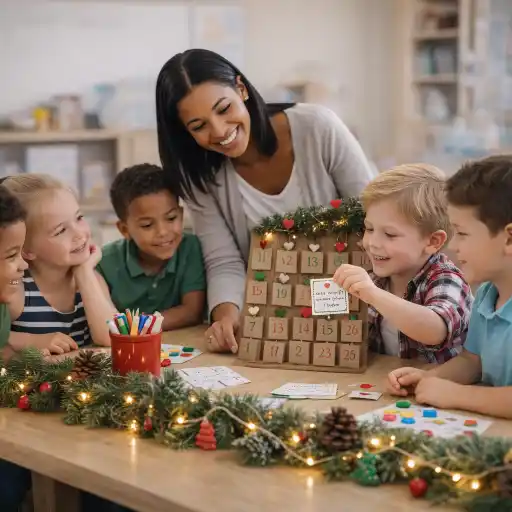
Which quick kindness prompts encourage cooperation and connection?
Choose actions that give children authentic chances to notice and support one another. Keep the task concrete and appropriate to children’s ages and abilities. The point is to create connection, not to ask children to perform affection or share belongings before they are ready.
- 😊 Make room: Invite children to notice whether a peer would like space at a play area, and support a friendly invitation.
- Help a friend: Offer to carry a light item, pass a material, or help put a shared activity away.
- Use kind words: Practice a phrase such as “Would you like to play?” or “Can I have a turn when you’re finished?”
- Notice a contribution: Name something a peer added to a shared drawing, block structure, or pretend-play idea.
- Care for the classroom: Work together to return books or materials so everyone can use them.
- Offer comfort with consent: Ask “Would you like help?” or “Would you like me to stay nearby?” rather than assuming a hug is welcome.
After an action, take a brief moment to reflect: “What did you notice?” or “How did that help our group?” Children may answer with words, drawings, gestures, or a simple point. These small conversations help make the meaning of kindness visible without turning it into a test.
How can educators coach kindness without adding pressure?
Adult modeling is central. Children see how educators speak to them, to colleagues, and to families—and how adults respond when something goes wrong. Use specific language that connects an observable action to its effect: “You moved the basket so Lee could reach the crayons. That helped Lee join the art.” This is more instructive than general praise alone.
Keep the prompts warm and brief, especially during busy transitions. When children disagree, pause unsafe behavior, acknowledge feelings, and help them choose a next step. A conflict does not mean the kindness activity failed; it may be the moment when children need the most guidance. Head Start notes that children need many opportunities to learn and practice social-emotional skills, while behavior can communicate a need or a skill that is still developing.
- Describe what you observed rather than labeling a child as “good” or “unkind.”
- Offer choices: “You can wait for a turn, trade, or choose another marker.”
- Let children decline public sharing or a particular role.
- Support repair through actions—returning an item, rebuilding, or checking in—rather than requiring a scripted apology.
Consistency helps. Directors can agree on a few phrases for staff to use and make time to share examples of what worked. For additional grounding in social-emotional development and relationship-based practice, the two courses linked above offer further learning. State requirements vary - check your state licensing agency when connecting professional learning to training requirements.
What common pitfalls should providers avoid?
Kindness activities are most useful when they respect children’s boundaries and developmental differences. A calendar can unintentionally become another source of pressure if it rewards public performance, expects identical participation, or treats the season as joyful for every child. Keep the emphasis on belonging, practice, and shared care.
- Forcing affection or sharing: Teach children to ask, listen to the answer, and find a fair alternative.
- Making completion the goal: Skip a prompt or repeat a favorite when the day is demanding.
- Rewarding only visible acts: Notice quiet, nonverbal, behind-the-scenes, and observed participation.
- Assuming one holiday tradition: Use inclusive language about winter, care, friendship, and community, and invite—not require—family perspectives.
- Overloading the schedule: Keep the activity brief and preserve familiar routines and downtime.
Adapt materials and roles for communication, sensory, mobility, and developmental needs. A child can contribute by pointing to a picture, holding a material, dictating an idea, or watching before joining. Peer relationships develop through repeated, supported opportunities, not through one perfect group activity.
How can a kindness countdown become part of classroom culture?
Use the countdown as a starting point, then carry successful ideas into everyday routines. A short weekly reflection can help staff notice whether children are inviting peers, offering help, waiting for turns, or using words to solve small problems. Keep observations descriptive and private; the purpose is to plan responsive support, not rank children.
Families can be included with a simple, optional note about the classroom’s focus. Invite them to share a phrase or everyday example of kindness from home if they wish, while respecting different languages, traditions, and schedules. Avoid sending home tasks that create extra work or imply that families must participate in a particular seasonal celebration.
Conclusion: How can a December kindness countdown build a kinder classroom? Make it brief, flexible, and rooted in real classroom relationships. Choose small actions children can practice in routines, model specific language, and respond to conflicts as opportunities for coaching and repair. Most of all, recognize varied ways of participating. Consistent, low-pressure moments can help children experience cooperation and belonging even when the December calendar feels full.
- CDA Certification en Español: Recursos y Consejos para Educadores Bilingües
- 💛🧩 ¿Cómo puedo hacer que mi enseñanza sea inclusiva para los niños con autismo?
- 👶 ¿Cuáles son las proporciones y grupos requeridos en Dakota del Norte? 🏫
- Recursos en Español sobre el Sueño Seguro del Bebé
- Curso de Comunicación de 9 Horas de Maryland
- Apoyo en Español para Capacitaciones Grupales Presenciales y por Zoom en Cursos Selectos
- ¿Cuáles son las mejores actividades del Día de la Tierra para niños en casa o en el aula?
- ¿Cómo pueden los equipos de cuidado infantil practicar habilidades rápidas de primeros auxilios en situaciones reales?
- 10 Ejemplos de Cómo la Cultura Influye en el Desarrollo Infantil
- Proporciones de Cuidado Infantil y Tamaños de Grupo por Edad en Maryland (Guía Rápida para Centros y Hogares)
- Proporciones de Cuidado Infantil y Tamaños de Grupo por Edad en Nueva Jersey (Guía Rápida para Centros y Hogares)
- Proporciones de Cuidado Infantil y Tamaños de Grupo por Edad en Virginia (Guía Rápida para Centros y Hogares)
- Temas y Actividades para el Día Nacional del Kindergarten para Proveedores
- Retraso del Habla en la Guardería: Cómo Pueden Ayudar los Proveedores
- Cómo Trabajar en el Cuidado Infantil en Carolina del Norte: Requisitos y Pasos
- Celebrando la amistad en el cuidado infantil durante el Día de los Mejores Amigos
- Canciones, juegos y preguntas de círculo para niños
- Cómo simplificar la capacitación para sus empleados de daycare
- How Can Child Care Providers Teach Christmas, Hanukkah, and Kwanzaa Respectfully?
- How Can a December Kindness Countdown Build a Kinder Classroom Before the Holiday Rush?
