Friendship skills grow through repeated, meaningful interactions—not occasional lectures about being nice. By embedding invitations, cooperation, empathy, and problem-solving into routines and play, you can help children build relationships while making the classroom calmer and more connected; Supporting Social Learning: Creating Classrooms that Care  Buy Now $24.00 offers additional strategies for community building and social success. For a ready-to-use starting point, consider pairing this training with the Friendship Activity Pack and “Let’s Be Friends!” lesson resource Buy Now $0.00 to strengthen daily practice.
Why Do Everyday Activities Matter for Friendship Development?
Young children learn social behavior in context. A child may understand that friends take turns during group discussion yet still need support when two peers want the same truck. Everyday classroom moments provide authentic opportunities to practice communication, emotional awareness, cooperation, and repair.
Friendship is also connected to belonging. Research on early peer relationships describes friendships as valuable contexts for social, cognitive, communicative, and emotional development. When children feel accepted, they are more likely to participate, persist, and seek help. This is especially significant for children who are learning English, children with disabilities, and children who need more time or support to enter group play.
Rather than expecting friendship skills to appear automatically, make them visible and teachable:
- Name the specific behavior: “You invited Mateo to build with you.”
- Model brief language children can copy.
- Offer repeated practice during low-pressure activities.
- Notice attempts, not only successful outcomes.
These small responses communicate that #friendship is part of the curriculum and that every child has a meaningful place in the group.
How Can Arrival and Transition Routines Build Connection?
Arrival and transitions are often busy, but they can become predictable relationship-building moments. Begin with a greeting choice—wave, smile, fist bump, or verbal greeting—so children can connect in a way that respects comfort and sensory preferences. Use each child’s name and acknowledge their presence: “Good morning, Amina. We are glad you are here.”
Partner jobs extend this connection. Two children can carry a lightweight basket, distribute napkins, check the book area, or water plants together. Assign roles that require reciprocal communication, such as giving an item to a peer and hearing “Thank you.” Rotate partners so social networks expand without labeling one child as the “helper” permanently.
Transitions can include short social games:
- 😊 Friend-to-friend greetings: Children greet a new partner using a gesture or words.
- Telephone message: Children whisper a positive classroom message down a line.
- Walking partners: Pairs move together while practicing “Are you ready?” and “Let’s go.”
- Friendship spotter: A child notices and reports a cooperative action after center time.
Keep these routines brief and consistent. Predictability lowers cognitive load, while rotating roles gives children authentic reasons to speak, listen, wait, and collaborate.
Which Play and Art Activities Encourage Cooperation?
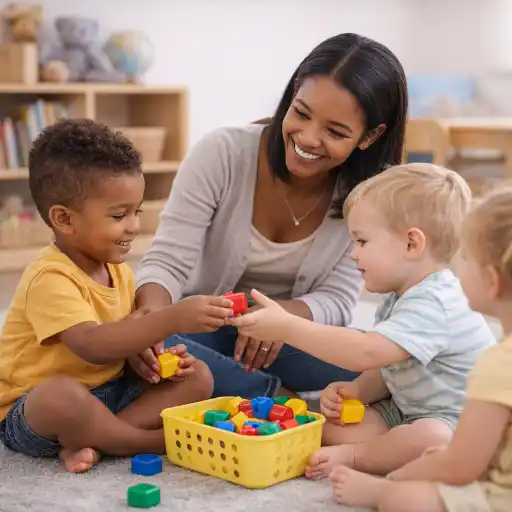
Choose activities with a shared goal rather than activities that simply place children beside one another. Guided play works particularly well because the adult establishes a social objective while children retain meaningful choice. Before beginning, identify one target skill—joining, turn-taking, listening, or problem-solving—and teach one short phrase.
- Collaborative painting: Two children share one large sheet and negotiate colors or spaces. Model, “Can I paint beside you?”
- Team construction: Give a small group one set of blocks and invite them to build a bridge, home, or roadway. Assign flexible roles such as designer, builder, and material collector.
- Puppet problem-solving: A puppet takes a toy or excludes a friend. Ask, “What could the puppet say next?”
- Cooperative puzzles: Encourage children to request pieces, offer suggestions, and celebrate a shared accomplishment.
- Partner sensory exploration: Provide two tools or containers that work best when children coordinate their actions.
Use the sequence model, prompt, step back, and acknowledge. Avoid directing every interaction; children need room to experiment. Specific feedback is more useful than general praise: “You listened to Jo’s idea and changed the plan together.” These experiences support #communication, #empathy, and flexible thinking.
How Can Stories, Songs, and Classroom Jobs Teach Empathy?
Books, songs, and jobs translate abstract social concepts into concrete experiences. During a read-aloud, pause when a character faces a problem and ask, “How might they feel?” and “What could a friend do?” Accept multiple reasonable responses, including gestures, home-language contributions, drawing, or pointing to a feeling card.
Songs can rehearse social language in a playful format. Adapt familiar songs to include “high-five a friend,” “invite a friend,” or “help a friend.” Pair movement with words so children can participate through voice, gesture, or body movement. For children who are hesitant to speak, participation can begin with imitation.
Classroom jobs also create daily opportunities for responsibility and belonging. Consider:
- A greeter who welcomes visitors or classmates.
- A materials partner who distributes supplies with a peer.
- A care team that checks plants, books, or classroom materials.
- A conversation helper who asks, “What are you making?” during center time.
Connect the task to the social meaning: “You noticed the basket was heavy and asked for help. That is teamwork.” Ensure jobs are accessible through visual directions, adapted materials, or additional time. Inclusion is not merely placing children together; it is designing participation so each child can contribute and experience reciprocity.
What Should Teachers Say During Conflict and Exclusion?
Conflict is not evidence that friendship teaching has failed. It is a moment when children need concise coaching. First ensure safety, then guide children through a repeatable process:
- Stop and regulate: “Hands down. Safe bodies.” Pause for a breath if needed.
- Name the problem: “You both want the red truck.” Avoid assigning blame.
- Offer language and choices: “You can say, ‘Can I have a turn when you are done?’ or use the timer.”
- Repair: “How can we fix what happened?” Children might rebuild, return an item, check on a peer, or practice an apology.
When a child says, “You can’t play,” protect the ongoing play while teaching inclusion: “You may be using the materials now. You can say, ‘You can join when we finish this part,’ or give the child a role.” This approach respects boundaries without making exclusion the default solution.
Keep explanations short during intense emotion and rehearse the language later with puppets or role-play. Staff should use the same core phrases across classrooms. State requirements vary - check your state licensing agency when implementing program-wide procedures or documentation systems.
How Can Directors and Teachers Plan, Adapt, and Measure Progress?
Effective friendship instruction is intentional but manageable. Begin with a weekly focus such as inviting someone to play, asking for a turn, or helping a peer. Map where the skill can occur naturally: arrival, snack, centers, outdoor play, cleanup, and departure. A simple planning matrix helps staff avoid relying only on crisis moments.
Adapt supports to children’s strengths and needs:
- Prime a child immediately before play: “Ask Kai, ‘Can I build with you?’”
- Use picture scripts, feeling cards, timers, and turn markers.
- Offer quieter spaces or smaller groups for children who become overwhelmed.
- Provide duplicate popular materials when possible.
- Teach peer buddies to invite, wait, and respond—not to take over.
- Share one consistent phrase with families for practice at home.
Track attempts rather than ranking children. Once or twice each week, note invitations, cooperative exchanges, repairs, and recurring barriers. Look for patterns by location, time, materials, group size, or communication demand. Celebrate micro-wins publicly without comparing children: “I saw three children solve a building problem with words.”
Common mistakes include forcing children to share, delivering long lectures during conflict, and praising vague traits such as “good.” Teach timed turns and choices instead, coach briefly, and describe the observable skill. The ChildCareEd guidance on kindness and friendship also emphasizes predictable routines, guided play, conflict coaching, inclusion, and simple observation.
Conclusion: How Do Everyday Activities Grow Stronger Friendships?
Teaching friendship skills through everyday classroom activities means turning ordinary moments into intentional practice. Greet children warmly, create partner responsibilities, design cooperative play, pause during stories, model inclusive language, and coach conflicts with calm consistency. Use visuals and individualized supports so children with different communication styles and abilities can participate meaningfully.
Begin this week with one phrase, one cooperative activity, and one observation goal. The Friendship Activity Pack can help you organize engaging practice, while Supporting Social Learning: Creating Classrooms that Care Buy Now $24.00 offers a broader professional learning experience focused on relationships, community, problem-solving, and open dialogue. Repeated, respectful opportunities help children develop #kindness, #inclusion, and friendship skills that strengthen both peer relationships and the classroom community.
- 45 Hour Child Growth and Development
- From Tantrums to Triumphs: Equipping Preschoolers with Self-Regulation Skills
- Moving About the Classroom: Effective Transitions for Everyday
- Connections That Count: Building Relationships in Child Care
- Texas Director Credential
- Montessori Cultural Activities: Exploring the World Through Play and Learning
- Every Moment Matters: Schedules and Transitions
- Moving About the Classroom: Effective Transitions for Everyday
- Building Social Foundations
- Increasing Fine Motor Skills in the Early Childhood Education Classroom
- CDA Certification en Español: Recursos y Consejos para Educadores Bilingües
- 🎈 Better Together: Why Little Friends Make a Big Difference in Early Childhood
- Proporciones de Cuidado Infantil y Tamaños de Grupo por Edad en Maryland (Guía Rápida para Centros y Hogares)
- Proporciones de Cuidado Infantil y Tamaños de Grupo por Edad en Virginia (Guía Rápida para Centros y Hogares)
- How can rainy day indoor activities help preschoolers learn kindness and cooperation in Georgia?
- How can indoor creative play encourage teamwork for preschoolers in California?
- How Can We Help Children Make Friends?
- Best Friends Day: Helping Children Learn Kindness and Friendship
- Celebrating Friendship in Child Care on Best Friends Day
- Celebrando la amistad en el cuidado infantil durante el Día de los Mejores Amigos
- What Can the Golden Gate Bridge Teach Preschoolers About Connection?
- How Can We Teach the Forgotten Skill of Being a Good Friend to Young Children?
- Team-Building Games for Preschoolers That Teach Cooperation
- Preschool Team-Building Activities for Better Communication and Friendship
- Why Are Coping Skills Important for Preschoolers?
- How Can Child Care Providers Teach Friendship Skills Through Everyday Classroom Activities?
- How Can Child Care Providers Help Children Build Healthy Friendship Skills?
- How Can You Welcome a New Child After the Class Has Already Bonded?
