Introduction
Friendship skills help young children play, solve problems, and feel safe at school. This article gives simple, practical ideas you can use tomorrow in your classroom. We focus on short activities, role-play, and quick scripts that preschoolers can learn and repeat.
Why it matters:
1. Children with good #friendship skills have fewer fights and more learning time.
2. Teaching #empathy and sharing helps children trust classmates and adults.
3. Small, repeated lessons build big changes over weeks and months.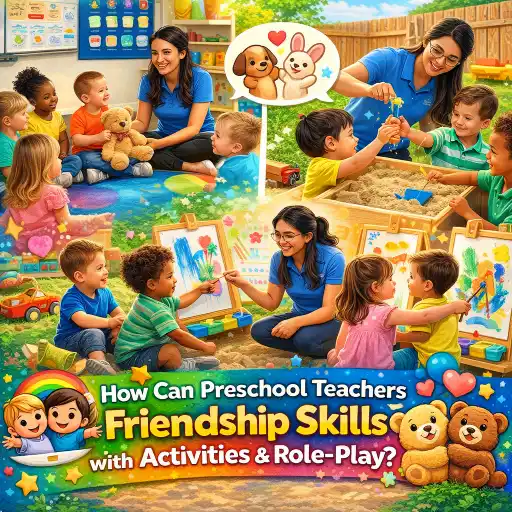
state requirements vary - check your state licensing agency.
What simple activities help preschoolers learn friendship skills?
Use short, repeatable games and group tasks. Try these easy ideas (each takes 5–15 minutes):
You can also set aside a brief classroom celebration to practice these skills; see simple ideas for celebrating National Friendship Day in early childhood classrooms that make inclusion, turn-taking, and friendship-building concrete.
- 😊 Cooperative Art: One big paper, two children share crayons to make a picture together. This teaches taking turns and talking while working.
- 🧩 Team Build: Small groups build a bridge or track. Only teamwork makes the project work—great for #sharing and planning.
- 🎭 Puppet Problems: Use puppets to act out small conflicts and ask children to suggest kind responses. For more puppet scripts see How to Foster Friendship Skills Through Guided Play.
- ⏳ Timer Turn-Taking: Use a 1–3 minute sand timer for popular toys so children learn waiting and patience.
- 📚 Read-and-Reflect: Pause a story and ask, “How does this character feel? What could a friend do?” ChildCareEd shows many story prompts in Social skills in action.
Tips:
- Keep activities short and frequent.
- Model words children can copy ("Can I play?" "Your turn next.").
- Celebrate small wins right away with specific praise.
How can role-play and guided play build sharing, turn-taking, and empathy?
Role-play and guided play give children safe practice. Use scripts and coach during play. Follow these steps:
- 🎭 Introduce 1 short script: "Can I play with you?" or "Your turn in two minutes." Practice with puppets first.
- 🧑🏫 Model the behavior yourself. Children learn by watching you use the words and kind actions.
- 🔁 Provide many short practice chances during centers or circle time. Repeat the same words so they stick.
- 👏 Prompt and praise: give a quick cue, then acknowledge the effort (see CSEFEL prompting and acknowledgment strategies at CSEFEL).
Use guided play to focus a skill. For example, set up a grocery store: children must ask, take turns as cashier, and share props. For ideas and lesson plans, see the sample plan "Let’s Be Friends!" Buy Now $0.00.
Why this works:
- Children try scripts when the stakes are low.
- Adults can step in with short coaching instead of long lectures.
- When practiced often, skills transfer to free play.
How do I support children who struggle to join in or keep friends?
Some children need extra help to connect with peers. Use small, clear supports and partner with families.
- 🔎 Prime and plan: Before free play, tell the child who they can ask and what to say. Practicing before the moment raises success. ChildCareEd describes priming and scripts in How can preschoolers learn to share, take turns, and make friends?.
- 🤝 Peer buddies: Pair the child with a friendly peer helper or a "Friendship Foreman" who invites others to join.
- 🎲 Role-play joins: Rehearse joining a game with a script: "Can I play? I will be the driver." Use puppets or adults as partners first.
- ♿ Adapt the environment: Bigger blocks, quieter spaces, visual cards, or fewer toys can reduce overwhelm and increase success.
- 📣 Work with families: Send home short scripts and celebrate small wins. Share observations and quick tips.
Also consider assessment and targeted teaching if a child continues to struggle. For children with special needs, the Indiana Resource Center article on social skills instruction outlines step-by-step assessment and teaching ideas (Making (and Keeping) Friends).
How do I use conflicts as teachable moments so children repair and stay friends?
Conflicts are learning moments when handled briefly and calmly. Use a short script and a quick repair step.
- 🛑 Stop: "Hands down. Safe bodies." This keeps children safe and calm.
- 🔍 Name the problem: "You look upset because you both want the red truck."
- 💬 Offer 2 choices and a script: "You can ask, 'Can I have a turn after you?'" or "Use the timer for turns." For deeper training, ChildCareEd offers the course You're Not My Friend Anymore: Learning Conflict Resolution
 Buy Now $16.00.
 - 🔧 Repair: Ask for a small fix—"Can you put the blocks back?" or "Can you tell your friend you are sorry?"—then praise the repair.
Keep coaching short. If conflicts repeat, add planned practice during guided play and collect notes to share with families. For problem-solving steps and teaching moments, see CSEFEL Module 2 (CSEFEL Module 2).
Providers who want to build stronger friendship skills, empathy, and cooperation in the classroom may benefit from Supporting Social Learning: Creating Classrooms that Care Buy Now $35.00. This training focuses on creating caring classroom communities, strengthening relationships, and helping children learn the social-emotional skills they need to play, connect, and work through problems with others. (ChildcareEd)
For teachers who want practical help with everyday peer conflicts, You’re Not My Friend Anymore: Learning Conflict Resolution Buy Now $16.00 is a strong choice. This course helps child care professionals teach developmentally appropriate conflict resolution strategies so children can solve problems, use words more effectively, and build healthier friendships. (ChildcareEd)
Conclusion
Quick classroom checklist:
- Model short scripts and practice with puppets.
- Plan 5–15-minute guided play sessions focused on one skill.
- Use visuals and timers for turn-taking.
- Prime children who need extra help and set up peer buddies.
- Praise repairs and small kind acts right away.
Common mistakes and how to avoid them:
- Forcing sharing—teach offers and trades instead.
- Long lectures—use short scripts and practice moments.
- Ignoring small wins—notice and name them to build habits.
FAQ
- Q: How long before I see progress? A: Small steps in weeks; steady change in months with daily practice.
- Q: What if a child is excluded often? A: Teach inclusion scripts, prime peers, and use buddy roles.
- Q: Can children with delays learn these skills? A: Yes—use adaptations, repetition, and visual supports.
- Q: Where can I find lesson plans? A: Try the sample plan "Let's Be Friends!" Buy Now $0.00 and other ChildCareEd resources.
You are doing important work. Keep lessons short, practice often, and celebrate tiny steps. Your classroom kindness will grow into lifelong #sharing, joyful #play, and stronger days for your #preschoolers.
- CDA Home Visitor Subject Area 2 Part 3 Birth to 5
- Professional Presence in Early Childhood
- Building Equity: Inclusionary Practices in Preschool
- 45 Hour Preschool Methods and Materials
- 1,2,3, Eyes on Me: Classroom Safety
- Play Safe, Think Big: Literacy Through Play
- The Best Promotion is Play
- Texas Director Credential
- Montessori Cultural Activities: Exploring the World Through Play and Learning
- Wellness in Action: Teaching Healthy Habits to Children
- Exploring the World: Fun and Educational Social Studies Activities for Preschoolers
- Building Social Foundations
- How can rainy day indoor activities help preschoolers learn kindness and cooperation in Georgia?
- How can indoor creative play encourage teamwork for preschoolers in California?
- Team-Building Activities for Daycare: Helping Children Learn Together
- How Can We Help Children Make Friends?
- Best Friends Day: Helping Children Learn Kindness and Friendship
- Celebrating Friendship in Child Care on Best Friends Day
- Celebrando la amistad en el cuidado infantil durante el Día de los Mejores Amigos
- What Can the Golden Gate Bridge Teach Preschoolers About Connection?
- How can child care providers encourage cooperative play among preschool children?
- How can child care providers help children build friendship skills?
- How Can We Teach the Forgotten Skill of Being a Good Friend to Young Children?
- Team-Building Games for Preschoolers That Teach Cooperation
- Preschool Team-Building Activities for Better Communication and Friendship
- Get to Know You Activities for Preschool: 12 Easy First-Week Ideas
- Belonging Activities for Kids Who Feel Left Out: Simple Ways to Help Them Join In
- How Can Child Care Providers Teach Friendship Skills Through Everyday Classroom Activities?
- How Can Child Care Providers Help Children Build Healthy Friendship Skills?
