November’s changing weather and familiar seasonal themes offer easy ways to help children practice working together, listening, and caring for peers. For practical strategies that extend beyond activity ideas, explore Supporting Social Learning: Creating Classrooms that Care Buy Now $35.00 and Connections That Count: Building Relationships in Child Care  Buy Now $55.00; these courses offer providers approaches to strengthen classroom relationships, problem-solving, and cooperation.
With brief, playful activities and thoughtful adult support, everyday moments can become meaningful practice in social skills. The ideas below are flexible, low-preparation options for preschool and mixed-age groups.
Why do simple cooperative activities matter in November?
Cooperation is learned through repeated experiences, not a single reminder to “share.” When children work toward a common goal, they get chances to communicate ideas, wait, take turns, solve small problems, and notice what others need. These are complex skills that develop gradually, so a child’s hesitation or disagreement is not a sign that an activity has failed.
November offers engaging starting points: leaves, harvest foods, cooler-weather movement, friendship, and gratitude. Seasonal themes can invite children to create or play together without assuming that every child celebrates the same holiday. Providers can center nature, kindness, food, or community and welcome children’s varied family traditions.
For educators, simple cooperative routines also make the day more connected. A shared collage, partner cleanup, or short circle game gives adults a chance to model respectful language and recognize small steps forward. As described in team-building games for preschoolers, clear shared goals and adult coaching can help children practice communication and friendship in ordinary play.
Which quick November activities help children practice taking turns?
Choose games with short turns and a visible shared purpose. Brief rounds reduce waiting and make it easier for children to stay involved. Demonstrate the activity, use one or two simple expectations, and let children know that participation can include talking, pointing, watching, or helping.
- Pass the gratitude picture: Sit together and pass a soft object. Each child may name, draw, or point to something they enjoy or appreciate—a friend, a pet, a favorite place, or a cozy blanket. Passing the object makes the turn easy to see.
- Leaf-and-feather pattern: Offer large paper leaves or feather shapes. Children take turns adding one piece to a shared pattern or class display. Invite them to notice what a peer added before choosing the next piece.
- Turkey bowling team: Set up lightweight plastic bottles and a soft ball. Children take turns rolling, then work together to reset the pins and count how many fell.
- Freeze-and-follow dance: Dance to music, then pause for everyone to freeze. Let children take turns choosing a movement for the group to copy.
For mixed-age groups, simplify the task for younger children and offer preschoolers helper roles, such as passing materials or counting. Use large, age-appropriate materials and supervise closely. The ChildCareEd guide to safe Thanksgiving games for toddlers and preschoolers also recommends short activities, clear spaces, and alternatives for children who need a quieter choice.
How can art, building, and pretend play encourage teamwork?
Open-ended activities naturally invite children to contribute in different ways. A shared outcome—rather than an identical product—lets children make decisions, negotiate space, and build on one another’s ideas. Keep materials accessible, provide enough room, and resist the urge to direct every choice.
- One big November mural: Tape a large sheet of paper to a table or wall. Invite children to make a fall garden, neighborhood, or friendly gathering. Offer crayons, washable markers, or collage pieces, and coach phrases such as “Where could we add this?” or “Can I use that when you’re finished?”
- Harvest market: Arrange pretend produce, baskets, and play food in a dramatic-play area. Children can take turns being shoppers, cashiers, stockers, or helpers. Add picture cards to support children who are still developing language.
- Build a leaf shelter: With blocks, cardboard, or large fabric pieces, invite a small group to build a home for toy animals preparing for cold weather. Ask, “What could each animal need?” and let children choose roles.
- Classroom kindness chain: Add a paper link when the group notices a helpful act, such as making room for a peer or returning a shared material. Describe the observed action rather than ranking children.
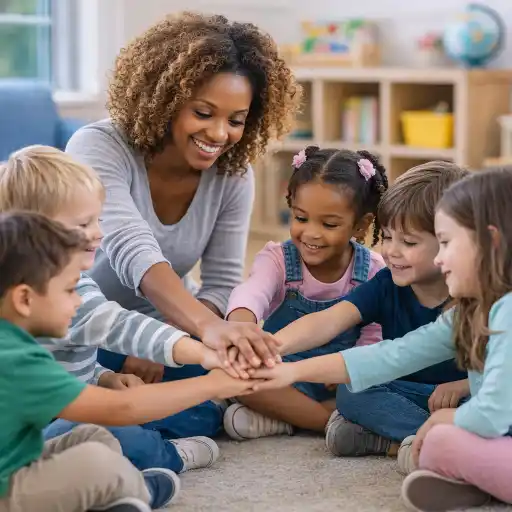
These activities develop #cooperation and #communication while honoring different strengths. A child might suggest an idea, place materials, watch before joining, or help with cleanup. Each contribution can be meaningful without requiring every child to participate in the same way.
How can providers coach empathy and solve small conflicts?
Disagreements are a normal part of group play and can become opportunities to practice social problem-solving. Stay calm, make sure everyone is safe, and describe what you observe without blame: “You both want the blue marker.” Acknowledge the children’s feelings, then help them consider a manageable next step.
Use short, repeatable language children can borrow:
- “Can I have a turn when you’re done?”
- “Let’s build it together.”
- “I don’t like that. Please stop.”
- “What could we try next?”
Try a four-step coaching routine:
- Pause: Stop unsafe actions and give children a moment to settle.
- Name: Describe the problem and feelings neutrally.
- Plan: Offer a few fair choices, such as taking turns, using a timer, trading, or choosing another material.
- Repair: Support a practical next action—rebuild the tower, return an item, or check whether a peer is okay.
Read-alouds, puppets, and picture cards can help children think about how a character might feel before they face a similar situation themselves. Avoid demanding an apology or physical affection; meaningful repair and respect for boundaries are more important than a scripted response. Notice specific efforts: “You waited, then asked for a turn.”
How can activities include children with different needs and backgrounds?
Plan inclusion from the beginning by considering language, mobility, sensory preferences, attention, culture, and developmental readiness. A cooperative activity should offer more than one way to participate. Children can speak, point, gesture, sign, demonstrate, hold a picture, or observe before joining. A quieter nearby option can help a child remain connected while regulating.
- Use picture cues, simple demonstrations, turn cards, or a visual timer to make expectations predictable.
- Adapt distance, materials, and roles—for example, offer a seated version of a movement game or larger collage pieces.
- Rotate helper roles and peer partners so leadership and access are shared.
- Choose themes that do not presume every family celebrates a particular holiday; invite children to share only what feels comfortable.
- For toddlers, keep turns short, use safe large materials, and provide close supervision.
Watching first can be a valid way to participate. Invite rather than pressure: “You can help hold the picture, watch, or join when you’re ready.” Directors can help staff make these adaptations consistently by discussing what worked and adjusting activities together. State requirements vary - check your state licensing agency.
What common pitfalls should educators avoid?
A seasonal activity can become frustrating when it asks children to wait too long, follow too many rules, or produce identical results. Cooperation is not simply quiet compliance; it involves children contributing to a shared experience at a level that is manageable for them. Keep the emphasis on practice, connection, and small successes rather than a perfect finished product.
- Too many directions: Start with one or two expectations and demonstrate them.
- Long waits: Use small groups, duplicate popular materials, and keep turns brief.
- Over-directing: Ask an open question, allow time for children to respond, and step back when they can continue on their own.
- Forced sharing: Teach children how to request a turn and make a predictable plan for shared materials.
- One definition of participation: Accept speech, gesture, observation, or a helper role as valid contributions.
- Holiday assumptions: Use broad seasonal themes and respect families who do not observe a particular holiday.
Observe small indicators of growth: a child invites a peer, waits briefly, offers an idea, asks for help, or helps repair a play problem. These everyday moments show that #empathy and #friendship are developing through practice. The November activity ideas in Ways to Play Every Day offer further prompts centered on kindness, helpfulness, giving, and gratitude.
Conclusion: What helps November activities build cooperation?
Simple November activities build cooperation and social skills when children share a clear purpose, have manageable turns, and receive calm, responsive adult coaching. Collaborative art, pretend harvest play, movement games, gratitude circles, and classroom helper routines can all become practice in listening, communication, empathy, and problem-solving.
Keep activities brief, adapt them for children’s different needs, and treat disagreements as part of learning rather than as evidence of failure. Most importantly, notice and name the small steps: inviting someone in, waiting, contributing an idea, or helping a peer. Repeated, supportive experiences make the classroom a place where children can grow together—one playful November moment at a time.
Five relevant ChildCareEd courses
- Supporting Social Learning: Creating Classrooms that Care Buy Now $35.00
- Connections That Count: Building Relationships in Child Care Buy Now $55.00
- The Best Promotion is Play Buy Now $24.00
- Social Foundations and Responsive Classrooms Buy Now $24.00
- You're Not My Friend Anymore: Learning Conflict Resolution Buy Now $16.00
- CDA Home Visitor Subject Area 3 Part 3 Birth to 5
- CDA Home Visitor Subject Area 2 Part 3 Birth to 5
- What Makes Me Special: An Overview of Autism and ADHD
- TEAM: Together Everyone Achieves More
- Art from the Heart for Preschoolers: Open Ended Art Projects that Build Self-Esteem
- The Best Promotion is Play
- Connections That Count: Building Relationships in Child Care
- Bienvenido! Welcoming All Families
- Wellness in Action: Teaching Healthy Habits to Children
- Resources: Building Blocks to Excellence
- CDA Certification en Español: Recursos y Consejos para Educadores Bilingües
- 🔍 ¿Qué ves cuando observas a un niño aprender?
- Celebra El Cumpleaños de Dr. Seuss En Tu Guardería Con Actividades Fáciles y Divertidas!
- ¿Cómo hacer actividades navideñas inclusivas para todas las familias?
- Apoyo en Español para Capacitaciones Grupales Presenciales y por Zoom en Cursos Selectos
- Actividades de Motricidad Gruesa que Desarrollan el Equilibrio, la Coordinación y la Fuerza
- Actividades de Fiesta para Niños de Preescolar y Primaria
- Cómo Celebrar el Día Nacional del Kindergarten
- Actividades de Otoño Fáciles para Preescolares esta Temporada
- Lista para Guardería en Casa en Texas: Cómo Iniciar una Guardería en el Hogar
- Las Mejores Ideas de Excursiones para Guarderías en Georgia
- Calabazas, hojas y manzanas: actividades de otoño para preescolares
- Celebrando la amistad en el cuidado infantil durante el Día de los Mejores Amigos
- Canciones, juegos y preguntas de círculo para niños
- How Can November Activities Help Children Learn to Work Together Inclusively?
- What Simple November Activities Build Cooperation and Social Skills?
- How Can November Classroom Activities Help Preschoolers Build School Readiness Skills?
- How Can Child Care Providers Encourage Cooperative Play in November?
- How Can Everyday November Routines Grow Cooperative Play?
- How Can Providers Model Meaningful Polite Language During November Routines?
