November’s seasonal themes can do more than brighten a classroom—they can give children meaningful, low-pressure ways to practice listening, sharing ideas, and solving problems together. Explore Supporting Social Learning: Creating Classrooms that Care Buy Now $35.00 for focused professional learning on community-building and children’s social problem-solving; it can help you bring these skills into daily practice while you plan engaging activities for every child.
For more focused professional development, consider Inclusive Lessons for Preschoolers  Buy Now $16.00, which offers practical strategies for adapting activities so children with different abilities and learning needs can participate. These courses provide a deeper learning experience to complement the ideas below.
November offers rich possibilities for cooperation: changing leaves, harvest themes, family stories, music, and classroom projects. Yet a seasonal activity becomes genuinely inclusive not because every child makes the same craft, but because each child has a meaningful way to contribute. Providers can use simple, flexible experiences to help children build relationships and a sense of belonging—without assuming that every family celebrates the same holiday or tradition.
Why does teamwork matter in November activities?
Cooperation develops through repeated, supported experiences. Young children are learning to wait, listen, share materials, communicate preferences, and manage frustration. A joint goal—such as building a pretend farm stand or creating a class mural—gives those skills an authentic purpose. Teachers can intentionally model the specific behaviors children need, rather than expecting them to know how group work should look.
Whole-group and small-group activities can strengthen community and give children opportunities to practice communication, turn-taking, and problem-solving. However, inclusion means more than inviting everyone to sit together. Children need access to materials, understandable expectations, and options for participating at their own pace. One child may contribute by painting, another by choosing colors, and another by pointing to a picture or observing before joining.
November themes also require cultural care. “Harvest,” “kindness,” “friendship,” and “seasonal change” can invite broad exploration without presenting one holiday or family tradition as universal. Build on children’s curiosity and family knowledge, while making sharing optional and respectful. Small, repeated opportunities to cooperate help children recognize that their contribution matters and that the group benefits from different strengths.
How can providers plan activities that welcome every child?
Start with a clear shared purpose and a few simple steps. Before an activity, demonstrate how to use the materials and what cooperation might sound like: “Can I have a turn?” “Let’s try your idea,” or “What should we add next?” Explicit modeling helps children understand expectations and reduces the pressure to infer unwritten rules.
- Offer choices in how to join: speak, gesture, point, move, create, or watch before taking a turn.
- Use visuals, picture cues, simple language, and predictable routines to make directions accessible.
- Provide adapted tools and reachable materials; consider mobility, sensory preferences, communication, and developmental differences.
- Keep groups small enough that every child has time and space to contribute.
- 🧡 Notice the process: name listening, helping, waiting, and trying a peer’s idea—not only the finished product.
Plan a calm alternative or a pause area for children who need a break from noise, touch, or group demands. Ask families about relevant preferences, communication supports, allergies, or traditions, and honor their input without asking any child to speak for a community. Inclusive planning is responsive, not one-size-fits-all; the aim is shared participation with flexible pathways.
Which November activities naturally encourage teamwork?
Choose activities where the group needs more than one person’s contribution, and where success is not determined by speed or competition.
- Collaborative leaf mural: Children collect or use paper leaves, choose colors, and add marks to a shared display. Assign flexible roles such as material helper, artist, or idea chooser.
- Classroom harvest market: Set up a pretend market with reusable play food, baskets, and signs. Children can take turns as shopper, sorter, cashier, or sign maker; use home languages and familiar foods when families wish to share.
- Kindness chain: Invite children to draw or dictate helpful actions on paper links, then connect the links as a group. Emphasize real, observable acts of care rather than requiring children to perform kindness on demand.
- Team nature hunt: Search for shapes, colors, sounds, or signs of seasonal change. Children can hold a picture list, point, describe, or photograph items with adult support.
- Shared story and movement: Read a seasonal or friendship story, then invite children to contribute a movement or sound for the group to repeat.
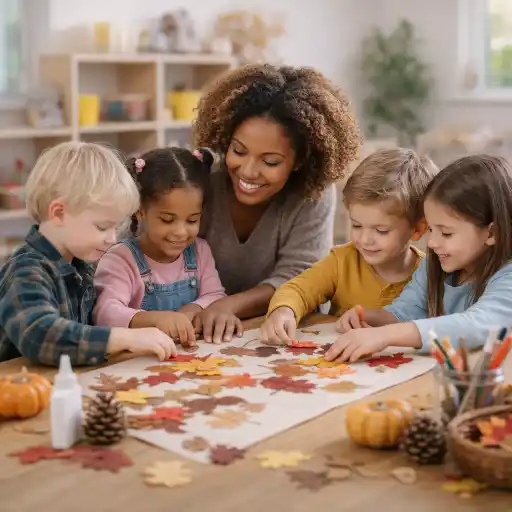
These activities create natural moments for children to negotiate roles and listen to peers. They also support language, early math, creativity, and problem-solving alongside social development.
How should educators support cooperation during play?
Stay close enough to scaffold without taking over. When children disagree, slow the moment down, describe what you notice, and offer language or choices: “You both want the basket. We can use a timer, find another basket, or take turns carrying it.” Avoid solving every minor disagreement immediately; supported problem-solving gives children practice making decisions together.
Pair or group children thoughtfully, considering interests, strengths, communication preferences, and opportunities to learn from peers. Do not assign one child a permanent helper role or expect a child with a disability to be included only through adult assistance. Every child should have agency and a valued role. A peer can model a step or offer an idea, while the educator ensures the activity remains reciprocal.
- Teach one cooperation skill at a time, such as passing materials or asking before taking.
- Use brief prompts and demonstrate the words and actions you want children to try.
- Recognize effort specifically: “You waited until Amira finished, then asked for the scoop.”
- Allow children to decline, observe, or return later; forced participation can undermine trust.
For children who communicate without speech or are still developing language, provide picture choices, signs, gestures, or assistive communication as appropriate. Observe which supports help each child engage, and adjust the activity rather than interpreting different participation styles as a lack of interest.
How can programs honor family and cultural differences?
November often includes conversations about gratitude, food, family gatherings, and Thanksgiving. These topics can be meaningful, but families do not all observe the same holidays or hold the same traditions. Frame activities around broad, child-centered ideas—care, friendship, seasonal change, community helpers, or sharing—while explaining that families may experience the season differently.
Invite family contributions without pressure. Caregivers might choose to share a story, word, photo, song, or everyday tradition; they should also be able to opt out. Avoid asking one child to represent a culture or treating cultural objects as decorations without context. Use books and materials that show varied families, languages, abilities, and experiences throughout the year, not only during a themed week.
Teamwork activities can reflect familiar routines and community knowledge. A pretend market, for example, can include foods and languages children recognize, while a nature walk can focus on local seasonal observations. Keep food activities optional and follow program allergy and sanitation practices. If a family raises a concern, listen privately, clarify the impact, and revise the plan collaboratively. Respectful inclusion grows from ongoing relationships, not a single event.
What common pitfalls should providers avoid?
Good intentions do not always guarantee that an activity feels accessible. Review the plan for hidden barriers: instructions that rely only on spoken language, materials that are difficult to reach or manipulate, overly long waits, loud group expectations, or an outcome that allows only one “right” contribution. A few practical adjustments can make participation easier for the whole group.
- Making speed or winning the goal: Choose shared-goal games in which children solve or create something together.
- Requiring every child to speak publicly: Accept gestures, home-language words, pictures, drawing, movement, or quiet observation.
- Assuming all families celebrate Thanksgiving: Use inclusive seasonal language and offer alternatives without singling out children.
- Taking over when conflict occurs: Coach children with brief language and choices, then allow them to try a solution.
- Using small seasonal materials without a safety review: Consider age, choking risks, allergies, sanitation, and supervision before introducing materials such as seeds or small objects.
After the activity, reflect on who participated, what made participation easier, and what barriers remained. Invite staff and family observations where appropriate. State requirements vary - check your state licensing agency, particularly when activities involve food, outdoor materials, or group supervision.
Conclusion: How can November become a season of shared belonging?
November activities can help children work together when educators design for a shared purpose, model cooperation, and welcome different ways of participating. A collaborative mural, pretend market, kindness chain, or nature hunt can give children authentic practice in listening, negotiating, helping, and problem-solving. The activity’s value lies not in a uniform result, but in each child having a meaningful part in the process.
Begin with one simple activity. Demonstrate one skill, offer flexible roles and materials, and notice specific moments of cooperation. Ask families for optional input and remain attentive to cultural, sensory, communication, and access needs. With thoughtful planning and a willingness to adapt, seasonal play can help every child experience the central lesson: we can create more when we make room for one another.
Five ChildCareEd courses for continued learning
- CDA Home Visitor Subject Area 3 Part 3 Birth to 5
- CDA Home Visitor Subject Area 2 Part 3 Birth to 5
- Bienvenido! Welcoming All Families
- TEAM: Together Everyone Achieves More
- Working Together: Teachers & Preschoolers
- Wellness in Action: Teaching Healthy Habits to Children
- Families, Communities, and Classrooms: Working Together for Children
- Bridging Cultures: Family Communication & Collaboration
- Supporting Families and Caregivers in Language and Literacy
- Professional Integrity in Child Care
- CDA Certification en Español: Recursos y Consejos para Educadores Bilingües
- 💛🧩 ¿Cómo puedo hacer que mi enseñanza sea inclusiva para los niños con autismo?
- Proporciones de Cuidado Infantil y Tamaños de Grupo por Edad en Nueva Jersey (Guía Rápida para Centros y Hogares)
- Proporciones de Cuidado Infantil y Tamaños de Grupo por Edad en Virginia (Guía Rápida para Centros y Hogares)
- Retraso del Habla en la Guardería: Cómo Pueden Ayudar los Proveedores
- Cómo Trabajar en el Cuidado Infantil en Carolina del Norte: Requisitos y Pasos
- Celebrando la amistad en el cuidado infantil durante el Día de los Mejores Amigos
- Canciones, juegos y preguntas de círculo para niños
- How Can You Plan a November Preschool Curriculum Around Gratitude and Community?
- How Can November STEM Activities Encourage Curiosity and Discovery?
- How Can November Outdoor Activities Help Children Explore and Appreciate Nature?
- How Can November Classroom Observations Guide Developmentally Appropriate Activities?
- How Can Child Care Providers Help Families Recognize Their Children’s Developmental Progress in November?
- How Can November Progress Updates Build Stronger Parent-Teacher Relationships?
- How Can November Classroom Observations Strengthen Family Communication?
- How Can November Activities Help Children Learn to Work Together Inclusively?
- How Can Anecdotal Observations Make November Parent Conferences More Meaningful?
- What Simple November Activities Build Cooperation and Social Skills?
- How Can November Classroom Activities Help Preschoolers Build School Readiness Skills?
- How Can November Professional Development Improve Infant and Toddler Teaching Practices?
