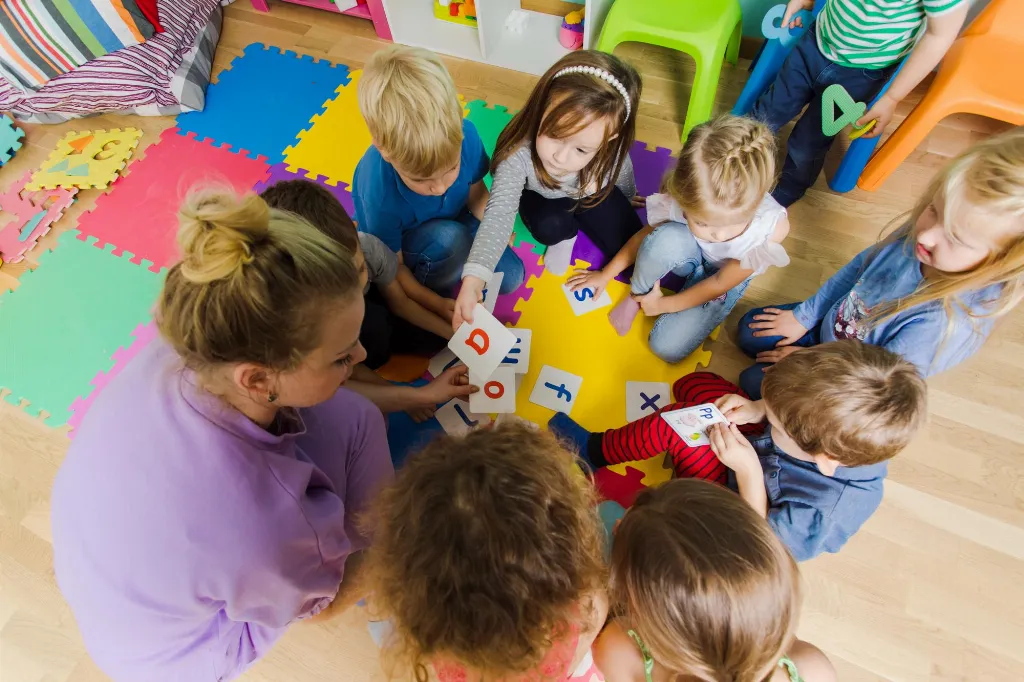
 Circle time is a chance to teach children to listen and get along. Use #circletime to teach #listening and #socialskills to #preschoolers for better #engagement. These ideas are for child care providers and directors. They are simple, short, and ready to try tomorrow.
For quick tips and ideas see the ChildCareEd article Circle Time Ideas That Keep Young Children Engaged.
1) What short circle time activities teach listening?
Short activities help children focus. Try a 3-part plan: greeting, short activity, wrap-up. Use a song or bell as your attention signal. For step-by-step routines and scripts, see How can circle time stay fun and keep children engaged?.
- 🔔 Start with a 30–60 second welcome song to gather attention.
- 📚 Use a 3–5 minute interactive story with props (puppet, felt pieces).
- 🕺 Add a 1–2 minute action song (freeze dance or “Head, Shoulders…”) to reset focus.
- ✅ End with a one-line wrap and a helper job for the day.
Why these work: short chunks match young attention spans. Props and movement make listening active, not passive. For more movement song ideas see Circle Time for Toddlers and the ChildCareEd story-time tips in Circle Time Ideas.
2) How do activities help children build social skills?
Circle time is a natural place to teach sharing, turn-taking, and friendship. Use short, repeated chances to practice words and roles. For practical scripts and social skill steps, see How can preschoolers learn to share, take turns, and make friends?.
- 🙂 Rotate a "Circle Helper" each day to pass out books or props.
- 🎤 Use a talking object (shell, microphone) so only the holder speaks. This teaches turn-taking.
- 🤝 Role-play short scripts during circle: “May I have a turn?” and “Thank you for sharing.”
- 📣 Praise specifically: “I liked how Alex waited and then asked, ‘Your turn?’”
These steps give many real chances to practice. The CSEFEL brief on routines shows how jobs and daily tasks create peer interactions naturally — a big boost for social learning (CSEFEL What Works Brief #5).
3) How can I include children with different needs and keep everyone engaged?
Plan for differences with visuals, choices, and quiet options. Use the ChildCareEd guide on inclusion for concrete ideas: How to Make Your Circle Time More Inclusive.
- 📷 Use a picture schedule so children know the order (greeting → story → song → helper).
- 🪑 Offer seating options: a chair, a cushion, or standing space for children who need movement.
- 🔁 Give multiple response modes: voice, thumbs up, or pointing to a picture.
- 🧸 Provide fidget tools or a quiet corner for one child to still be part of the group while regulating.
Teach the routine and practice it a few times. Short, repeated practice helps shy or nervous children join in slowly. For more supports and scripts on listening and adult language try Active Listening from ChildCareEd.
4) How do I run circle time well and avoid common mistakes?
Use clear rules, short steps, and a calm teacher voice. Here are common mistakes and fixes.
- 🚫 Mistake: Too long. ✅ Fix: Keep circle time 5–10 minutes for toddlers, 10–20 for preschoolers.
- 🚫 Mistake: Many steps at once. ✅ Fix: Give 1 instruction at a time and use the phrase “First __, then __.”
- 🚫 Mistake: No practice of cues. ✅ Fix: Practice your attention signal daily until it works automatically.
- 🚫 Mistake: Forcing sharing. ✅ Fix: Teach offers and use timers rather than take-away commands.
Quick ways to measure progress:
- Count: How many children freeze when the music stops?
- Observe: Who uses the turn-taking script without prompts?
- Note: One quick line after circle — what worked and one tweak for next time.
For more ideas on transitions and routines that back good circle time, see Transition Trouble? Can Easy Routines Help? and the CSEFEL brief on teacher-child relationships (Brief #12).
Conclusion: What can I try tomorrow?
Try one small change and watch for small wins. A simple plan to try:
- 🔷 Pick one attention signal (bell, clap, song).
- 🔷 Use one short prop or a talking object each circle.
- 🔷 Add one helper job and one movement break.
Keep a short note: what worked and who needs more practice. Share wins with families and staff. For ready-made lessons and more training, explore the ChildCareEd resources cited above. You are building big skills with small steps — and that matters.
FAQ (short):
- Q: How long is enough? A: 5–10 mins for toddlers, 10–20 for preschoolers.
- Q: What if a child won’t join? A: Offer a helper job or quiet role nearby.
- Q: How often to practice scripts? A: Daily short practice works best.
- Q: Where to learn more? A: See ChildCareEd articles linked above and CSEFEL briefs.
- CDA Home Visitor Subject Area 3 Part 3 Birth to 5
- CDA Home Visitor Subject Area 2 Part 3 Birth to 5
- Balancing Physically Active Play in Child Care
- TEAM: Together Everyone Achieves More
- Moving About the Classroom: Effective Transitions for Everyday
- Open Ears: Listening in Child Care
- Balancing Active Play in Child Care
- Getting on the Right Path to Teaching
- Can simple indoor movement games teach listening and cooperation to preschoolers in Oklahoma?
- How can rainy day indoor activities help preschoolers learn kindness and cooperation in Georgia?
- Team-Building Activities for Daycare: Helping Children Learn Together
- Fall Circle Time Ideas for Preschool and Daycare
- Circle Time Activities That Build Listening and Social Skills
- Circle Time Songs, Games, and Questions for Kids
- Canciones, juegos y preguntas de círculo para niños
- Preschool Circle Time Ideas for Learning and Connection
- How Can I Make Circle Time Activities Work for Preschoolers?
- How can we use team activities to help preschoolers learn and cooperate?
- One, Two, Eyes on You: A Fun Way to Build Listening Skills
- How can music and movement help New York preschoolers?
- How Can Early Childhood Providers Help Young Children Build Real-World Social Skills?
- Team-Building Games for Preschoolers That Teach Cooperation
- Preschool Team-Building Activities for Better Communication and Friendship
- Daycare Team-Building Activities That Encourage Cooperation
- Get to Know You Activities for Preschool: 12 Easy First-Week Ideas
- Getting to Know You Activities for Preschoolers When a New Child Joins the Class
- How Do You Keep Preschoolers Engaged During Group Activities?
