Young children learn with their bodies and voices long before they master formal lessons. Practical, low-prep musical practices—simple songs, chants, body percussion, call-and-response, and movement games—produce measurable benefits for classroom routines, language growth, memory retention, and peer relationships. Use short bursts of activity, repeat favorites, and adapt for diverse needs. Remember: state requirements vary - check your state licensing agency.
Why does this matter for early childhood programs?
1) Practical gains: short songs reduce transition friction, increase on‑task behavior, and give children predictable linguistic frames to practice new words and grammar—see classroom examples and ready-to-use ideas in ChildCareEd’s guide.
2) Developmental gains: rhythmic entrainment and synchronous movement align auditory and motor systems, supporting timing, sequencing, and social bonding—described in research reviews and applied articles like the work summarized at the ChildCareEd movement overview and recent developmental syntheses (APS review).
How does singing and rhythm strengthen language skills?
- 🎵 Repetition with melody: melodies and predictable rhythms make novel words salient and easier to retrieve later—see practical classroom examples in Circle Time Songs.
- 🗣️ Prosody and phonology: children learn stress, syllable timing, and intonation from songs; rhythm highlights syllable boundaries and improves phonological awareness, a precursor to reading (Mind's Medicine: Music in Early Childhood).
- 📚 Turn-taking and expressive language: call-and-response and echo songs scaffold conversational turn‑taking and boost expressive vocabulary—useable in greetings, sharing, and story extensions (practical lesson ideas).
Evidence caveat: experimental research shows mixed effect sizes for broad transfer claims (e.g., the so-called "Mozart effect" is not a general intelligence boost), but consistent near-transfer effects exist for auditory discrimination, phonological skills, and verbal memory when music-making is sustained and intentional (see synthesis at Neuroscience for Kids and meta-analyses summarized in scholarly reviews).
How do musical activities support memory and cognitive skills?
- 🎶 Chunking and melody: songs naturally chunk information (e.g., alphabet, steps, routines) so children can hold and rehearse multi-step sequences in working memory.
- 🧠 Rhythmic timing and prediction: rhythmic patterns strengthen temporal prediction and processing speed, supporting tasks that depend on sequencing (music cognition reviews).
- 🥁 Motor coupling: movement paired with verbal content (clapping syllables, marching to a chant) creates multisensory memory traces that improve recall—see applied strategies in Color Dance Parade Buy Now $0.00.
Research nuance: sustained, active engagement (lessons, instrument play) shows stronger and longer-lasting changes than brief passive listening. For classroom use, prioritize repeated active participation: singing, echoing, and rhythm games over background music alone (music therapy literature).
How do singing, rhythm and movement foster social and emotional development?
Musical activities create synchronized experiences that scaffold cooperation, empathy, and regulation.
- 🤝 Shared timing builds connection: moving or singing in synchrony increases prosocial sharing and tr
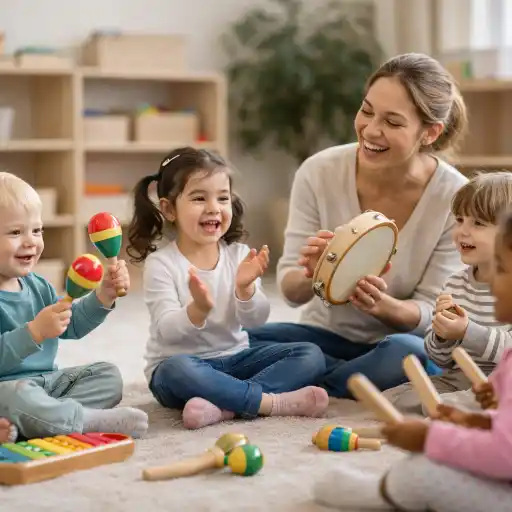 ust—use group drumming, call-and-response, or circle songs as brief community builders (program-level ideas).
 - 🧘 Regulation through tempo: fast movement can expend energy; slow lullaby‑style songs help children down-regulate before rest or table work—incorporate calm songs for transitions (transition strategies).
- 🎭 Emotional language: musical storytelling and dramatic movement give children safe ways to name feelings and practice perspective taking—pair emotion cards with a song or movement prompt.
Why inclusion matters here: synchronous play benefits emerge when activities are accessible; simple adaptations (seated movement, soft instruments) let children with diverse needs join and bond—see practical inclusion strategies in ChildCareEd resources like Montessori Meets Music and inclusion courses.
How can providers implement musical play effectively in busy programs?
Implementation should be intentional, feasible, and embedded into daily routines. Use numbered, practical steps you can try this week.
- 📅 Plan small and regular: 1) Morning welcome song (2–3 min), 2) Two movement bursts (1–5 min each), 3) Calm goodbye (2 min). See sample schedules in ChildCareEd scheduling guide.
- 🎒 Low-cost materials: scarves, shakers, a small drum, and a playlist of 8–12 songs—store in a labeled tub for quick access.
- 👩🏫 Build staff skill: model one short session, then coach. Short PD + follow-up coaching works better than one-off workshops (professional development guidance available on ChildCareEd).
- 🧩 Make it inclusive: offer multiple response modes—sing, point, sign, play an instrument; adjust volume and space for sensory needs. State requirements vary - check your state licensing agency. For programs using Montessori principles, see Montessori active-play strategies that align child-led exploration with movement and routine transitions.
- 📈 Observe and adapt: track 1–2 classroom goals (e.g., fewer transition disruptions; 3-step listening tasks achieved) and celebrate small wins.
How can we include every child and avoid common mistakes?
Common mistakes are avoidable with planning. Here are numbered pitfalls and fixes.
- ❌ Mistake: Too long or teacher-heavy sessions. ✅ Fix: Keep songs under 10 minutes for preschoolers; chunk activities into short, repeatable moments (circle time guidance).
- ❌ Mistake: One response mode only. ✅ Fix: Offer 2–3 ways to participate (speak, point, sign, instrument).
- ❌ Mistake: Overly loud or crowded space. ✅ Fix: Use soft instruments, smaller groups, and a marked movement zone—see safety tips in indoor movement guide.
- ❌ Mistake: No cultural connection. ✅ Fix: Invite family songs, vary musical genres, and honor home languages.
- ❌ Mistake: No teacher follow-up. ✅ Fix: Schedule brief reflection; pair new staff with a mentor for one music session.
Conclusion — practical checklist and FAQ
Try this quick checklist this week:
- 🎵 Add one 5–10 minute movement or singing moment each day.
- 🥁 Choose 3 classroom songs for transitions and repeat them for a week.
- 👀 Pair a teacher for modeling and one short coaching visit.
- 🔉 Check volume and seating options; adapt for sensory needs.
- 📝 Track one classroom goal (language turn-taking, fewer transition disruptions).
FAQ
- Q: How long should music/movement times be? A: 1–3 minutes for toddlers per burst; 5–15 minutes for preschool group times—short, repeated exposures create learning.
- Q: Does background music help? A: Passive listening is weaker. Prioritize active, participatory music (singing, echoing, instruments) for language and memory gains (review).
- Q: What about children with developmental delays? A: Adapt with seating options, soft instruments, picture cues, and buddy systems—see inclusion courses at ChildCareEd and clinical music therapy summaries (UND).
- Q: How do we show this is working? A: Use simple measures: count successful freezes in Freeze Dance, observe increased vocabulary during choice songs, or note fewer behavioral transitions.
Takeaway: integrating joyful, repeatable musical moments into the day — anchored by short routines, clear signals, and inclusive options — advances #language, #memory, and #social development in ways that are affordable, scalable, and child-centered. For lesson plans, adaptations, and staff courses, start with ChildCareEd resources like Color Dance Parade Buy Now $0.00 and Mind's Medicine. You've already got what matters: children's voices and bodies — bring them into your daily learning with intention.
Short answer: songs provide repeated, rhythmic language frames that make vocabulary, sentence structures, and phonological patterns easier to notice and remember.In practice, music and movement tune attention and provide retrieval cues that support working memory and sequence learning.Why it matters: integrating #music and #movement into daily practice is not an add‑on; it is a pedagogical strategy that scaffolds attention, memory consolidation, and social routines. Two short paragraphs:- CDA Subject Area 2
- Recognize, Respond, Respect: Supporting Diverse Learners
- The Best Promotion is Play
- Sensitive Periods in Montessori: Guiding Natural Learning
- Language Development in Early Childhood
- Mind's Medicine: Music in Early Childhood
- Texas Director Credential
- Montessori Cultural Activities: Exploring the World Through Play and Learning
- Wellness in Action: Teaching Healthy Habits to Children
- Supporting Families and Caregivers in Language and Literacy
- CDA Certification en Español: Recursos y Consejos para Educadores Bilingües
- 🔍 ¿Qué ves cuando observas a un niño aprender?
- Apoyo en Preescolar para Retrasos del Habla: Estrategias Simples que Ayudan
- Retraso del Habla en la Guardería: Cómo Pueden Ayudar los Proveedores
- Canciones, juegos y preguntas de círculo para niños
- How can bilingual music transform your early childhood classroom?
- How and Why Does Music Boost Brain Development in the First Five Years?
- How Does Singing Together Build Community in the Classroom?
- How do singing, rhythm, movement and musical play support language, memory and social development in young children?
- What Does Ms. Rachel Get Right About Talking to Babies and Toddlers?
- How can songs and routines be used to teach emotional skills in early childhood?
- How can I introduce children to rhythm and musical patterns?
- How Can Music and Movement Activities Boost Learning and Inclusion for Young Children?
- Kindergarten Songs for Circle Time: 15 Sing-and-Move Ideas That Sneak in Learning
- How Can Music and Movement Enrich Early Childhood Learning?
- How Can Songs and Rhymes Build Young Children’s Language Skills?
- How Can Families and Educators Connect Early Literacy With STEM, Art, Music, and Creativity at Home?
- How Can Simple Music and Movement Activities Build Early Literacy Skills?
- How Can You Add Rhythm to a Preschool Weather Movement Activity?
