Team activities are short, fun games and routines that help children practice working together. This article gives simple, ready-to-use ideas for directors and child care providers. You will find easy games, planning tips, inclusion strategies, and common mistakes to avoid. Try one idea tomorrow and build from there. Remember: state requirements vary - check your state licensing agency. You’ll see links to helpful ChildCareEd resources as you read.
What simple team activities can we try tomorrow?
- 😊 Circle Pass: Sit in a circle and pass a soft ball. Each child names one kind thing they did. Great for listening and turn-taking.
- 🔵 Hoop Challenge: Hold hands in a circle and pass a hula hoop without letting go. Good for problem solving and cooperation.
- 🟡 Partner Obstacle: Pairs guide each other through a simple course—one leads, one helps. Use cones or taped lines from Gross Motor Games.
- 🟣 Group Story: One child starts a sentence; each child adds a line. Builds language and listening.
- 🟠 Clean-Up Race: Count how many toys the group returns in two minutes and celebrate the total.
Tip: Prep small tubs with materials and a one-line script so activities start fast. For more activity lists see Team Building and Small Group Activities. These quick games help your #preschoolers practice sharing and listening while having fun.
How do team activities help learning and behavior?
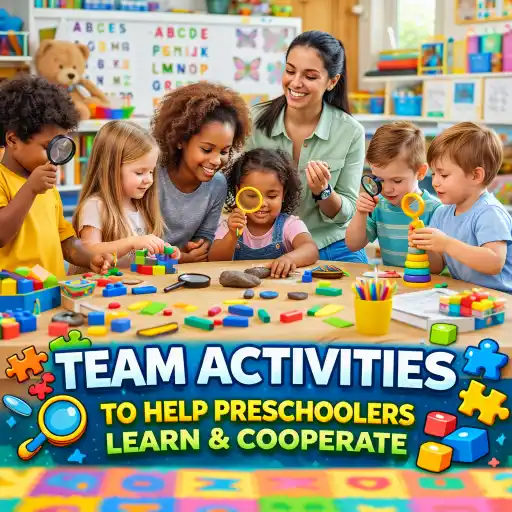
Team activities teach big skills through play. Here are clear reasons why they matter and what they build. For research and practical examples, see How can we encourage teamwork and the CDC milestones page for development checks (CDC Milestones).
- Social skills: Children practice sharing, waiting, and helping. Short turns let them try again and get it right.
- Language: Team stories and songs add new words and build talking skills.
- Self-regulation: Stop-and-go games (like Freeze Dance) teach children to follow signals and calm down.
- Problem solving: Group puzzles and hoop games ask children to plan together. For detailed classroom activities and step-by-step strategies to strengthen collaboration, see building cooperative and problem-solving skills.
- Empathy: Cooperative play helps children notice others’ feelings and help each other.
Why it matters: Small daily practice lowers conflict and makes routines smoother. Staff notice fewer disruptions and more peer helpers. For more classroom ideas that connect movement and thinking, see Gross Motor Activities. Use team time to teach one target skill each week—this keeps progress visible and doable. Keep the focus on progress, not perfection, and celebrate the group wins to build confidence and #teamwork.
How do we plan and lead team activities so every child joins?
Good planning and clear roles make team time work. Use a simple routine each day so children and staff know what to expect. ChildCareEd shows practical steps in Small Group Planning and staff team tips in TEAM: Together Everyone Achieves More Buy Now $25.00.
- 🎯 Pick one skill: Choose one tiny goal (sharing, waiting, or a new word).
- 🕒 Time it: 5–15 minutes depending on age. Preschoolers often do best at 10–15 minutes.
- 📦 Prep a tub: Put all props, a short script, and a timer in a labeled box.
- 🔹 Assign staff roles: Leader, helper, floater. Post one-sentence role cards for substitutes.
- 🔁 Rotate jobs: Use simple job cards (line leader, prop passer, helper) so everyone has a role and feels needed.
- ✍️ Reflect: After each session jot 1 quick note—what worked and one child to watch next time.
Include families by sharing one photo and one sentence idea to try at home. For mixed-age groups, see Mixed-Age Group Activities Buy Now $0.00. Adapt for different learners with visual supports, bigger pieces, or buddy help. These steps make team time predictable and help children with different needs join the fun. State requirements vary - check your state licensing agency. Use the word and practice routines often so staff and children use the same language—this builds steady #transitions and clear expectations.
What common mistakes should we avoid and how do we include every child?
Team activities fail less often when you plan for simplicity and inclusion. Here are common mistakes and easy fixes, plus a quick FAQ for busy providers. For inclusion ideas see Circle Time and Encouraging Cooperation.
- ❌ Too many rules. ✅ Fix: Offer 1–2 steps and show them. Use visuals or a photo sequence.
- ❌ One-time staff training. ✅ Fix: Short repeat trainings plus on-the-floor coaching help new routines stick.
- ❌ Leaving children out. ✅ Fix: Give roles that match strengths (color helper, music helper). Offer observer or helper options.
- ❌ Forcing sharing. ✅ Fix: Teach timers, offers, and trading language instead of taking toys away.
- ❌ Forgetting movement. ✅ Fix: Add a 2–3 minute gross motor burst; it helps self-regulation and focus (see Gross Motor Truth).
Quick FAQ (4 Qs):
- Q: How long should team activities be? A: 5–15 minutes usually.
- Q: What if a child won’t join? A: Offer a low-pressure role (observer, prop holder) or a buddy helper.
- Q: How do we measure success? A: Look for more turns taken, fewer conflicts, and smoother transitions.
- Q: Where to learn more? A: Explore ChildCareEd posts like Team Building and short courses like TEAM: Together Everyone Achieves More Buy Now $25.00.
Finish small and steady. Pick one team activity this week, prep a tub, assign roles, and celebrate one group win. Small routines build big skills and stronger classroom communities. Use these ideas to support #inclusion and joyful #activities for your classroom.
Conclusion
Team activities are a low-prep, high-impact way to teach social skills, language, and self-control. Start with one short activity, keep rules simple, and plan clear staff roles. Track one goal, celebrate progress, and adjust as you learn. For many more ideas, see Team-Building Activities for Daycare, Small Group Planning, and related ChildCareEd resources. Your small steps will make your classroom kinder, calmer, and more cooperative.
- CDA Home Visitor Subject Area 3 Part 3 Birth to 5
- CDA Home Visitor Subject Area 2 Part 3 Birth to 5
- 45 Hour Preschool Methods and Materials
- TEAM: Together Everyone Achieves More
- Working Together: Teachers & Preschoolers
- Positive Attention: Interactions & Supervision for Infants & Toddlers
- Connections That Count: Building Relationships in Child Care
- Texas Director Credential
- Wellness in Action: Teaching Healthy Habits to Children
- Tiny Hands, Big Dreams: Fostering Creativity in Preschoolers
- CDA Certification en Español: Recursos y Consejos para Educadores Bilingües
- Actividades de Motricidad Gruesa que Desarrollan el Equilibrio, la Coordinación y la Fuerza
- How to Write an Early Childhood Lesson Plan Step by Step
- Memorial Day Activities for Kids: Simple Ways to Honor the Day
- How can indoor creative play encourage teamwork for preschoolers in California?
- Celebrando la amistad en el cuidado infantil durante el Día de los Mejores Amigos
- How can we use team activities to help preschoolers learn and cooperate?
- How can outdoor learning help young children grow and learn?
- What Do Superheroes Teach Kids About Kindness and Courage?
- How Does Singing Together Build Community in the Classroom?
- Can Screen-Free Board and Movement Games Help Young Children Learn and Stay Calm?
- Why Do Classroom Management Strategies Fail With 3-Year-Olds—and What Works Instead?
- Rosh Hashanah Sensory Bin Ideas: Apples, Honey, Shofars, and Sweet New Year Play
- How Can Child Care Providers Set Clear Classroom Rules and Expectations?
- What Are 10 Proactive Classroom Management Techniques for Early Educators?
- How Can Child Care Providers Teach Preschoolers to Wait Their Turn?
- How Can You Help a Preschooler Rejoin the Group After a Conflict?
- What Are the Best Ways to Support Cooperative Play in Preschool?
- How Can Child Care Providers Support Children Who Have Difficulty Waiting Their Turn?
