When preschoolers struggle to share ideas, enter play, or resolve small conflicts, intentional team-building can turn everyday moments into meaningful practice. This guide offers practical, inclusive activities for building communication, cooperation, and friendship; for deeper strategies, explore Supporting Social Learning: Creating Classrooms that Care Buy Now $35.00, which can strengthen classroom practices and contribute to professional learning hours where applicable.
Why do team-building activities matter in preschool?
Team-building is more than keeping children busy. It gives children repeated, developmentally appropriate opportunities to listen, express ideas, wait, negotiate, and experience the satisfaction of reaching a shared goal. Research-informed guidance from CSEFEL emphasizes that children learn peer interaction skills through intentional teaching, rehearsal, adult prompting, and positive feedback—not simply by being placed near other children. A classroom that deliberately teaches these skills becomes a more supportive setting for #communication and belonging.
Friendship also depends on skills that are still emerging between ages three and five: emotional awareness, self-management, cooperation, trust, and perspective-taking. Cooperative play helps children move from parallel activity toward shared plans and reciprocal relationships. The goal is not perfect behavior or constant agreement. The goal is to help children notice one another, communicate needs safely, and repair interactions when something goes wrong.
For providers and directors, these activities can also improve the daily rhythm of care. When children have language for joining play, requesting a turn, or asking for help, adults spend less time reacting and more time coaching. Small successes—one child passing a block, another inviting a peer, or a group completing a mural—build confidence across the classroom community.
Which low-preparation activities build communication?
Choose activities with a clear shared purpose, limited materials, and short turns. Introduce one or two expectations, demonstrate briefly, and let children begin. The following ideas can be used during circle time, centers, indoor movement, or outdoor play.
- 🔵 Circle Pass: Children pass a soft ball and say a kind word, name a feeling, or answer a simple question. Encourage eye contact or another comfortable way of acknowledging the recipient.
- Cooperative Story: One child begins a story and each participant adds a word, action, or sentence. Use picture cards to support children who are developing language or learning English.
- Group Collage: Provide one large sheet and shared materials. Children decide where pieces belong and practice phrases such as “Can I use the blue?” and “Where should we put this?”
- Partner Obstacle Course: One child describes the next step while the other moves, then roles switch. Offer visual cues and ensure the course is safe and accessible.
- Animal Parade: The group chooses an animal, movement, or sound together. Children practice proposing an idea, listening to alternatives, and waiting for a turn.
- Clean-Up Team: Assign complementary jobs—collector, sorter, shelf helper, or checker—and celebrate completion as a group rather than rewarding speed alone.
Keep most activities between five and fifteen minutes. Repetition matters more than novelty: children need multiple chances to use the same words in different contexts. Circle-time guidance similarly recommends short, active segments that combine listening, movement, props, and predictable roles.
How can cooperative play turn activities into friendship practice?
Cooperative play involves a shared goal, shared materials, and some form of planning or role-taking. A block challenge might ask children to build a bridge for toy animals; dramatic play might transform the classroom into a market, clinic, or restaurant. The adult’s role is to create conditions for collaboration without controlling every decision.
Before play begins, state the shared goal: “We are making one road for all the cars.” Offer role cards or picture choices when helpful: builder, material finder, designer, customer, or helper. Roles should rotate so that confident leaders do not always direct while quieter children remain observers. Invite children to contribute ideas, but accept different forms of participation, including pointing, gesturing, watching first, or working beside a peer.
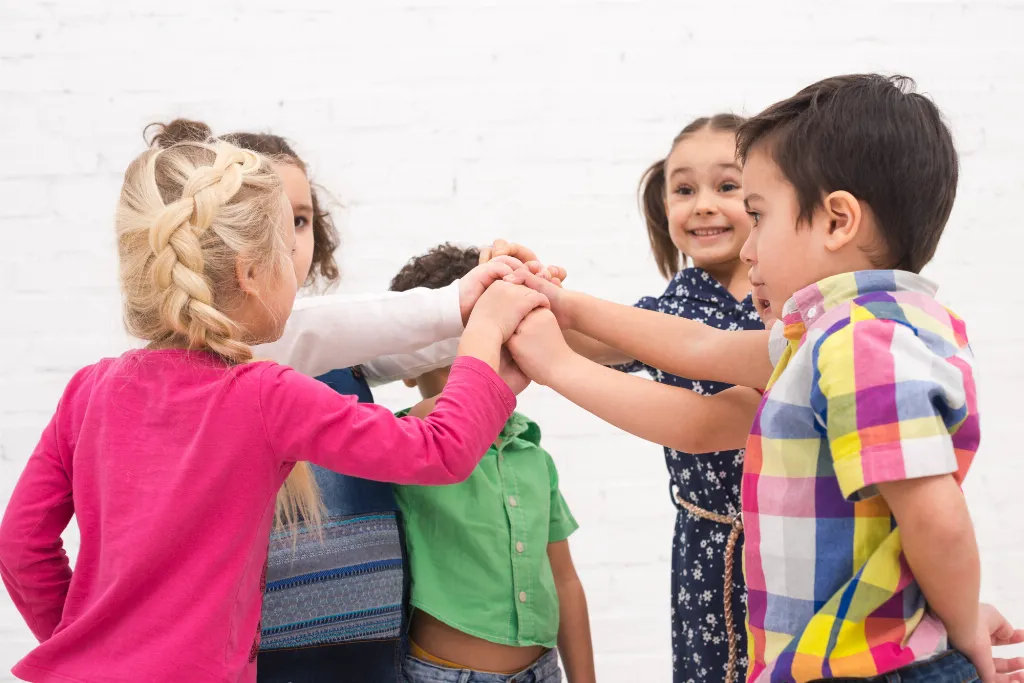
Guided play is especially useful because it balances structure with child choice. You might place puppets in a conflict and ask, “What could the puppet say?” or model how to join a game: “Can I play?” “What are you building?” and “Can I be the helper?” After modeling, step back. Children need ownership of the interaction, not a performance directed by the adult.
Useful friendship scripts include:
- “Can I have a turn when you are finished?”
- “Let’s do it together.”
- “You can play with us.”
- “I don’t like that. Please stop.”
- “Are you okay?”
- “What should we try next?”
Post these phrases with pictures at children’s eye level. Practice them during calm play, not only after conflict occurs. This approach supports #friendship while honoring children’s developing language and self-regulation.
How should educators coach listening, conflict resolution, and empathy?
Children often need adult support before they can use communication skills independently. Effective coaching is brief, calm, and consistent. First, regulate the moment: “I’m here. Let’s make our bodies safe.” Then describe the problem without assigning blame: “You both want the same truck.” Finally, teach a next step and allow children to try it.
A practical four-part routine is:
- Pause: Stop unsafe actions and create enough space for everyone to calm.
- Name: Identify the problem and feelings in neutral language.
- Plan: Offer two or three options, such as taking turns with a timer, trading, playing together, or choosing another material.
- Repair: Help children restore the relationship by returning an item, rebuilding, checking on a peer, or trying the words again.
Empathy can be taught through feelings charades, read-aloud pauses, puppets, and observation. Ask, “How might this child feel?” and “What clue helped you decide?” Avoid requiring children to hug, apologize on demand, or share a private feeling publicly. Instead, teach meaningful repair and respect each child’s boundaries.
Specific feedback reinforces the behavior you want repeated. Say, “You looked at Maya, asked for the shovel, and waited,” rather than “Good job.” CSEFEL guidance also highlights the value of arranging routines so children can practice positive peer interactions frequently, including arrival, snack, job assignments, and cleanup. Consistent adult language helps children transfer skills across settings.
How can we make team-building inclusive for every child?
Inclusion means designing participation from the beginning rather than adding accommodations after a child struggles. Consider language, sensory needs, mobility, attention, culture, and communication preferences when selecting materials and grouping children. State requirements vary - check your state licensing agency.
- Use visual schedules, picture scripts, gestures, timers, and role cards.
- Offer multiple ways to participate: speak, point, sign, demonstrate, observe, or serve as a helper.
- Adapt materials with larger pieces, stable surfaces, accessible tools, or fewer steps.
- Pair children thoughtfully and rotate peer partners to prevent fixed roles.
- Include books, music, names, family structures, and play themes that reflect the children and families served.
- Provide a quieter nearby option for children who need to regulate while remaining part of the group.
Do not confuse inclusion with forcing group interaction. A child who watches first may be gathering information and building readiness. Invite without pressuring: “You can hold the picture, watch, or join when you are ready.” For dual language learners, accept home-language communication, gestures, and brief responses while pairing spoken words with visuals.
Directors can support inclusion by giving staff time to plan adaptations, sharing common scripts, and reviewing observations together. A short staff reflection—one success, one barrier, and one adjustment—can turn individual creativity into program-wide practice. The aim is not identical participation; it is meaningful access, belonging, and opportunity for connection.
What common mistakes should providers avoid?
Even thoughtful activities can become stressful when expectations exceed children’s developmental readiness. The most common mistake is treating cooperation as compliance. A child who follows an adult’s command may not yet understand negotiation or shared decision-making. Use genuine shared goals and allow children to make manageable choices.
- Too many rules: Teach one or two actions, demonstrate, and add complexity gradually.
- Competition as the main motivator: Emphasize collective accomplishments, such as finishing a mural or helping every puppet.
- Long activities: Stop while children are still successful; repeat later rather than extending until frustration rises.
- Adult over-direction: Ask open questions and wait before offering a solution.
- Public correction: Coach privately when possible and publicly notice effort, kindness, and repair.
- Inconsistent language: Select a few program-wide phrases so children hear the same routine from every adult.
Observe progress through small indicators: more peer invitations, increased use of turn-taking language, fewer repeated conflicts around a material, and more children helping one another. Record brief, objective notes rather than labeling children as “social” or “difficult.” Use observations to adjust the environment, group size, timing, or prompts.
For continued professional learning, providers may find You’re Not My Friend Anymore: Learning Conflict Resolution  Buy Now $16.00 useful for expanding conflict-coaching strategies. Directors strengthening adult collaboration can explore TEAM: Together Everyone Achieves More Buy Now $16.00, while Building Equity: Inclusionary Practices in Preschool Buy Now $10.00 addresses inclusive classroom practice.
Conclusion: How can one week of intentional practice strengthen friendship?
Preschool team-building activities strengthen communication and friendship when they are brief, purposeful, inclusive, and repeated across the day. Begin with one shared activity, one friendship script, and one routine-based opportunity for peer interaction. For example, use a circle pass on Monday, cooperative art on Tuesday, a puppet problem on Wednesday, partner jobs on Thursday, and a group reflection on Friday.
Watch for process rather than perfection: a child asks instead of grabs, listens to a peer’s idea, waits with support, invites someone into play, or helps repair a mistake. These moments are evidence of growth. When educators model respect, arrange environments thoughtfully, and coach with empathy, children learn that communication is a tool for connection and that friendship is something they can actively build.
Five-course learning path:
- Supporting Social Learning: Creating Classrooms that Care Buy Now $35.00
- You’re Not My Friend Anymore: Learning Conflict Resolution Buy Now $16.00
- TEAM: Together Everyone Achieves More Buy Now $16.00
- Building Equity: Inclusionary Practices in Preschool Buy Now $10.00
- Social Foundations and Responsive Classrooms Buy Now $24.00
Small, steady opportunities help children become more confident communicators and caring friends. That is the central answer to the question: team-building works when children are given meaningful reasons to listen, contribute, solve problems, and belong together.
- Turning Behavior Around for Toddlers and Preschoolers
- Building Equity: Inclusionary Practices in Preschool
- TEAM: Together Everyone Achieves More
- From Tantrums to Triumphs: Equipping Preschoolers with Self-Regulation Skills
- Birth to Five CDA Credential with Portfolio Review
- Art from the Heart for Preschoolers: Open Ended Art Projects that Build Self-Esteem
- CDA Infant/Toddler: Parent Relationships
- Play, Learn, Grow
- Diversity, Equity, and Inclusion in Education
- Connections That Count: Building Relationships in Child Care
- CDA Certification en Español: Recursos y Consejos para Educadores Bilingües
- Apoyo en Español para Capacitaciones Grupales Presenciales y por Zoom en Cursos Selectos
- Actividades de Motricidad Gruesa que Desarrollan el Equilibrio, la Coordinación y la Fuerza
- Can simple indoor movement games teach listening and cooperation to preschoolers in Oklahoma?
- How can rainy day indoor activities help preschoolers learn kindness and cooperation in Georgia?
- How can indoor creative play encourage teamwork for preschoolers in California?
- Team-Building Activities for Daycare: Helping Children Learn Together
- How can we encourage teamwork and cooperation in early childhood programs?
- Canciones, juegos y preguntas de círculo para niños
- Superhero Activities for Preschoolers: Play, Create, and Learn
- How Can We Teach Self-Regulation Skills to Preschoolers?
- How can we use team activities to help preschoolers learn and cooperate?
- One, Two, Eyes on You: A Fun Way to Build Listening Skills
- Can sports-themed play teach cooperation and build team spirit in young children?
- Team-Building Games for Preschoolers That Teach Cooperation
- Preschool Team-Building Activities for Better Communication and Friendship
- How Can Bingo Games Support Turn-Taking and Social Skills?
- How Can Child Care Providers Teach Sharing Without Forcing It?
- How Can Child Care Providers Teach Preschoolers to Wait Their Turn?
