Bring a little World Cup energy to your DC circle time rug, and you get more than fun — you get real chances to teach #teamwork, #turntaking, and how to handle big #feelings with your #preschoolers at circle. This short guide is for child care providers and directors who want quick, practical steps. You’ll find simple game ideas, scripts, calm-down tips, and planning shortcuts that connect s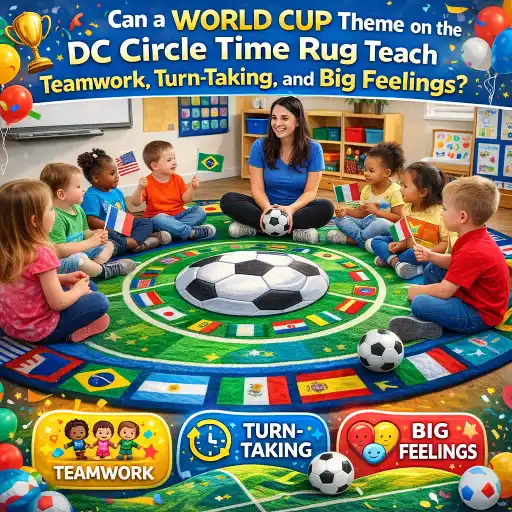 ports play to circle-time learning. State requirements vary - check your state licensing agency.
Why does a World Cup-style game and the DC rug matter for social skills?
2) Short, playful routines build SEL. Use books, songs, and role-play to name feelings and repair friendships. For SEL ideas, see Emotions in Motion.
3) Circle time is a practice field for group habits. Simple circle games teach listening, waiting, and turn rules — skills summarized in practical lists like Circle Time Ideas and ChildCareEd’s small group planning tips here.
- 🎯 Benefit: Repetition = learning. Short rounds mean many chances to try again.
- ⚽ Benefit: Sports themes motivate cooperation and cheering for others.
- 🧠 Benefit: Games build attention, language, and self-control together.
How do I teach turn-taking and cooperation using the World Cup and the rug?
Try this 6-step mini-lesson:
- 🔹 Gather on the #circletime rug and name the rule: "We pass kindly and wait."
- 🔸 Demo and practice (2 minutes): Teacher and a volunteer pass a soft ball while narrating language scripts: "My turn — your turn."
- 🔹 Play short rounds (3–5 passes each): rotate groups so everyone practices.
- 🔸 Use a timer or sand glass as a visual turn cue. ChildCareEd suggests timers and visuals to support kids learning to share here.
- 🔹 Praise specifically: "You waited and handed the ball—great sharing!"
- 🔸 Quick reflection: 1 sentence, "What felt good when we passed?"
Low-fi props: soft soccer ball, picture cards of roles (passer, goalie helper, cheerleader), and a small timer. Use simple scripts and practice during calm moments, not only during problems. For activity ideas to adapt to a sports theme, see the preschool sports theme resource Preschool Sports Theme.
How do I support big feelings when teamwork breaks down?
- 👋 Connect: Move to child level and name the feeling. "I see you’re upset because you wanted the ball."
- 😮💨 Calm: Use a short breathing tool or the "turtle technique" from CSEFEL — stop, go into your shell, take deep breaths, then come out to solve the problem (CSEFEL strategies). For classroom-ready calming tools, see ChildCareEd’s SEL post: Emotions in Motion.
- 💬 Coach: Offer a tiny script and a choice: "You can ask, 'Can I try next?' or take two deep breaths and then try again."
Set up a calm spot near the rug with 2–4 tools (soft toy, breathing visual, small sensory bottle). Teach the spot during calm times and practice short visits of 2–5 minutes so it isn’t seen as a punishment. For ideas on calm corners and cue cards, ChildCareEd offers a helpful calm-down kit checklist in this post. Remember: state requirements vary - check your state licensing agency.
How can I plan quick World Cup-to-rug lessons and avoid common mistakes?
Keep planning fast with a 6-step template you can repeat each week. ChildCareEd’s small-group and team-building posts give ready ideas you can drop into a 10–15 minute slot: Small Groups Fast and Team-Building.
- 🗂️ Prep a week basket: ball, role cards, 1 book about feelings (story helps depersonalize conflict — see Literature for Emotions).
- ⚽ Pick 1 goal: e.g., "pass twice and say 'nice!'"
- 🎲 Choose 2 short activities: demo on rug (2–3 min), small-group practice (6–8 min), wrap-up cheer (1 min).
- ⏳ Use visual timers and simple scripts so kids know who goes next.
- 📋 Quick note: jot one observation per child after the group to track progress.
- 👥 Rotate roles so every child practices leader, passer, and helper.
Common mistakes and fixes:
- ❌ Too long circle times → ✅ Keep rounds 5–12 minutes and add movement.
- ❌ Teaching only during meltdowns → ✅ Practice scripts and games when calm.
- ❌ No visual cues → ✅ Use timers, cards, and a consistent stop signal.
Try this quick plan tomorrow: 1) Put out the week basket, 2) Do a 3-minute demo on the rug, 3) Run two short practice groups, 4) Close with a group cheer and a 1-sentence reflection. For more lesson pack ideas and templates, see ChildCareEd’s lesson plan resources and preschool sports ideas: Lesson Template Buy Now $0.00 and Preschool Sports.
Conclusion — Quick checklist and FAQ
Quick checklist:
- ✅ One clear goal per activity.
- ✅ Short, repeated practice on the #circletime rug.
- ✅ A calm spot and 2–3 regulation tools nearby.
- ✅ Use scripts, timers, and rotate roles.
- ✅ Note one observation per child each week.
FAQ (short):
- Q: How long should a World Cup-style circle activity be? A: 5–12 minutes for whole group, 6–8 minutes for small groups (Small Groups Fast).
- Q: What if a child refuses to join? A: Offer a helper role or watcher job and practice scripts later (Sharing & Turns).
- Q: When to ask for extra help? A: If safety is a concern or usual supports don’t work — consult your director and specialists (see behavior supports at CSEFEL).
You are building big social skills in short playful steps. Start simple, practice often, and celebrate the small wins your team makes every day. For more classroom-ready ideas and trainings, visit ChildCareEd.
Use one clear goal per activity (for example: pass twice, wait your turn, say “nice pass”). Keep whole-group moments short (5–12 minutes) and follow a small-group or circle script. ChildCareEd’s quick small-group plan shows how to choose one goal and two short activities: How to Plan Small Groups Fast. Kids will feel disappointed when a pass is missed or when someone gets the ball first. These are teaching moments. Use the Connect → Calm → Coach order recommended in ChildCareEd’s regulation tools: What simple emotional regulation tools help children ages 2–5?.1) Kids copy what they practice. A soccer-themed activity gives repeated chances to share space, pass, wait, and cheer — the same skills you coach on the rug. ChildCareEd explains how team-building activities make classrooms kinder and calmer in Team-Building Activities for Daycare.- CDA Certification en Español: Recursos y Consejos para Educadores Bilingües
- March Madness in Child Care: Simple Activities for Big Energy Days
- Recursos en Español sobre el Sueño Seguro del Bebé
- 10 Ejemplos de Cómo la Cultura Influye en el Desarrollo Infantil
- Actividades de Fiesta para Niños de Preescolar y Primaria
- Normas de Licenciamiento de Cuidado Infantil en Virginia para Centros Diurnos Infantiles y Hogares Diurnos Familiares
- Temas y Actividades para el Día Nacional del Kindergarten para Proveedores
- How can rainy day indoor activities help preschoolers learn kindness and cooperation in Georgia?
- How to Help Children Feel Safe and Welcome in Child Care
- How can Georgia preschoolers manage big feelings and classroom routines?
- How can observation help us better understand children in DC early childhood classrooms?
- How can DC classrooms welcome every child and make inclusion real?
- How can we encourage teamwork and cooperation in early childhood programs?
- How do Stone Mountain and strong foundations help build social-emotional skills in early childhood?
- What Can the Golden Gate Bridge Teach Preschoolers About Connection?
- Canciones, juegos y preguntas de círculo para niños
- Can a World Cup theme on the DC circle time rug teach teamwork, turn-taking, and big feelings?
- How can I integrate the World Cup into my daycare program in an inclusive, safe, and developmentally appropriate way?
- How can I teach kids about different countries during the World Cup?
- How can we help children learn to wait, take turns, and manage frustration?
