As a child care provider or director, you want every child to join in, learn, and feel proud. This article shows simple, practical ways to change activities so children with different needs can take part. You will find easy steps, examples, and things to avoid. Remember: state requirements vary - check your state licensing agency.
Why should we adapt activities for diverse learners?
1. Children learn in different ways. Some need movement, some need pictures, and some need extra time. When we adapt activities, we make sure everyone can try and succeed. This helps children build skills and feel safe in your #classroom. See why small classroom changes matter at How can simple classroom changes make inclusion work for everyone?.
2. Adapting supports social growth. Kids who can join play make friends and practice sharing, language, and self-control. Project-style learning and UDL approaches let children lead and show what they know in many ways, as explained in the project approach story “Trees and Things That Live In Trees” and the UDL guide What is a simple starter guide to UDL.
3. Adapting reduces frustration and behavior problems. When tasks fit a child’s current skills, kids stay engaged longer. For practical tips on adapting activities for developmental delays, read Adapting Activities for Children with Developmental Delays.
Why it matters: 1) Inclusion builds trust with families and staff, and 2) small changes often help many children at once. Use simple steps first — they make a big difference.
How can we adapt activities simply and quickly?
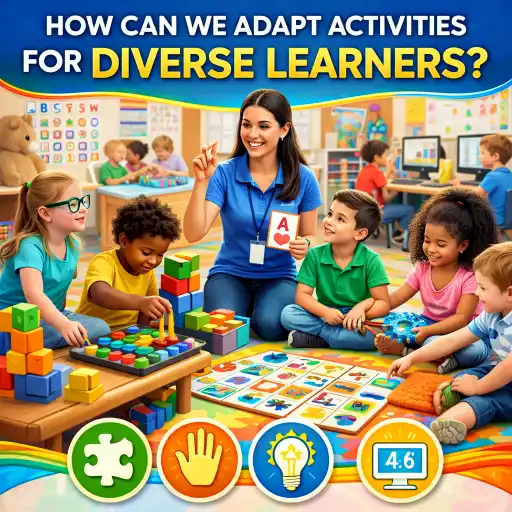
Start with three things: Space, Stuff, and Steps. These are easy to remember and to share with your team.
- 😊 Space — change where the activity happens
- 1. Move a child to a quieter corner.
- 2. Make a calm spot with soft lighting and a visual schedule.
- 🎨 Stuff — change materials
- 1. Use thick crayons, larger blocks, or trays to keep pieces together.
- 2. Offer picture cards or real objects to show meaning. ChildCareEd gives many material ideas in Adaptations that support children's learning.
- 🧭 Steps — break the work down
- 1. Divide tasks into 2–3 clear steps with pictures.
- 2. Model first, do it together, then let the child try.
- 3. Give extra wait time so children can process instructions.
Examples you can use today:
- 🧩 Blocks: use bigger pieces or fewer pieces.
- ✂️ Art: tape paper down, give stampers or dot markers instead of tiny brushes.
- 📚 Story time: offer picture cards, a recording, or a small acting area so kids can choose how to join.
For more simple routines and circle time ideas, see How to Make Your Circle Time More Inclusive. Keep notes on what works and share with families and staff.
How do UDL, differentiation, and sensory supports work together?
Use these numbered teaching moves:
- 🎯 Offer choices for joining activities (sit, stand, move).
- 📚 Give information in pictures, words, and hands-on objects.
- 🧩 Let children show learning by drawing, talking, or building.
- 🔈 Add sensory supports: quiet corner, headphones, or heavy-work tasks like carrying books.
- 🔁 Repeat routines and use short practice sessions so skills stick.
Sensory needs matter. Some children are sensitive to noise or touch; others need movement. Simple supports include a calm spot, visual schedules, and permitted headphones. See sensory planning and UDL examples in the ChildCareEd UDL resources and the article on sensory processing at Understanding Sensory Processing in Young Children (linked in the ChildCareEd library).
Different frameworks often point to the same idea: plan ahead, keep choices clear, and let children use strengths. These practices support #UDL and help with daily #engagement.
How do we partner with families and avoid common mistakes?
- 🤝 Start small: ask one question at pick-up — “What helps your child at home?”
- 📣 Use clear, regular communication: weekly notes, quick texts, or a photo of progress.
- 📝 Co-create one simple goal with the family and share how you’ll try it at school.
- 🔗 Include specialists when needed and make warm referrals. ChildCareEd explains family partnership steps in How can we partner with families to support diverse learners?.
Common mistakes and how to avoid them:
- ⚠️ Mistake: Doing nothing until there is a diagnosis. Fix: Try simple adaptations right away; you don’t need a diagnosis to help.
- ⚠️ Mistake: Changing the child to fit the activity. Fix: Change the activity or materials instead.
- ⚠️ Mistake: Overloading visuals or steps. Fix: Use 1–2 clear pictures and be consistent.
For adapting activities for developmental delays, ChildCareEd’s practical guide is useful: Adapting Activities for Children with Developmental Delays. Also consider local supports like inclusion coaches (example: Tennessee CCR&R inclusion coaches), and always remember: state requirements vary - check your state licensing agency.
Conclusion
1. Start with small, low-cost changes: a visual schedule, thicker tools, or a calm corner.
2. Use Space, Stuff, and Steps to adapt quickly.
3. Plan with UDL ideas and work with families daily.
Quick FAQ
- Q: Do I need special tools? A: No — many adaptations are free or low-cost. See Adaptations that support children's learning.
- Q: How long before I see change? A: Small wins can show in days; bigger skills take weeks. Track and celebrate progress.
- Q: Who trains staff? A: ChildCareEd offers courses like Strategies for Differentiating Instruction. Teachers can also build on those courses with professional credentialing guidance; see Using the CDA Credential to Provide Differentiated Instruction for All Levels of Development for practical steps to align CDA learning with classroom differentiation.
- Q: When to refer to specialists? A: If adaptations help only a little or challenges grow, talk with families and refer early intervention or local inclusion coaches.
Adapting activities is kind, simple, and powerful. With small steps and team work you can make your program a place where every child belongs and learns. #inclusion #UDL #adaptations #families #engagement
Universal Design for Learning (UDL) and differentiated instruction help you plan with many learners in mind. UDL means offering multiple ways to engage, present information, and let children show what they know. For a starter guide, see this ChildCareEd UDL article.Families are experts about their children. Good partnerships help you choose the best adaptations. Try these numbered steps for strong teamwork:- 45 Hour Child Growth and Development
- 45 Hour Preschool Methods and Materials
- Easy Steps to Resume and Interview Success
- Bienvenido! Welcoming All Families
- Pediatric RSV First Aid & CPR/AED
- 45 Hour School Age Methods and Materials
- 24 Hour Texas Pre-Service
- Texas Director Credential
- Effective Coaching & Mentoring in ECE
- Language and Literacy Preschool Curriculum
- How Can Childcare Educators Thrive in the Big Apple?
- Tiny Tots, Big Learning: Crafting Curriculums for the Littlest Learners!
- 🤝¿Cómo fomentar respeto e inclusión en el aula infantil? 🌻
- ¿Cómo incluir a niños con necesidades especiales en cuidado infantil? Guía práctica y sencilla
- Actividades de Motricidad Gruesa que Desarrollan el Equilibrio, la Coordinación y la Fuerza
- Proporciones de Cuidado Infantil y Tamaños de Grupo por Edad en Maryland (Guía Rápida para Centros y Hogares)
- How can we adapt activities for diverse learners?
- How can music and movement help New York preschoolers?
- How can childcare providers support fine motor development with simple activities?
- How can friendly-monster crafts teach children about feelings?
- How can superhero-themed winter science activities energize your classroom?
- Can sports-themed play teach cooperation and build team spirit in young children?
- How can pumpkin science create meaningful, hands-on fall learning for preschool classrooms?
- How Can Bingo Games Support Turn-Taking and Social Skills?
- ¿Todos los niños deben participar en el tiempo de círculo?
