Introduction
In this article you'll find easy, practical ideas to make your #classroom more welcoming. Small changes help every child join routines, play with friends, and learn — not just children with diagnosed needs. You will see how visuals, room layout, routines, and simple adaptations support #children and help #teachers feel confident.
Why it matters: Inclusive spaces build friendships, reduce fights, and let children spend more time learning. Research and field guides show that predictable routines, clear visuals, and flexible furniture make classrooms kinder and calmer (see Inclusive Practices in Early Childhood Education).
Quick note: state requirements vary - check your state licensing agency. Many programs link to local inclusion supports and coaching; start with your early learning office or resources like Inclusion in Child Care.
What simple changes help children follow routines and feel safe?
Start with predictable routines and clear pictures. Visual supports are a low-cost, high-impact change. A simple schedule helps children know what comes next and lowers anxiety for many learners.
- 🟢 Use a visual daily schedule at child eye level. Put pictures for arrival, snack, centers, outside play, and rest. Learn how to make one from How to Create a Visual Schedule.
- 🔵 Give a two-minute warning before transitions. Repeat visuals and name the next step.
- 🟣 Teach routines with short practice sessions (1–3 steps at a time). Use games or songs to teach lining up, handwashing, and clean-up.
Why this works: predictable steps build independence and reduce challenging behavior. The Center on Social and Emotional Foundations describes how picture and object schedules help children learn routines and feel secure (CSEFEL routines brief).
Tips for success:
- 1. Keep visuals simple and consistent.
- 2. Offer extra practice for children who need it.
- 3. Let children check the schedule when they want — that builds independence.
How can I arrange the room so all children can join play and learning?
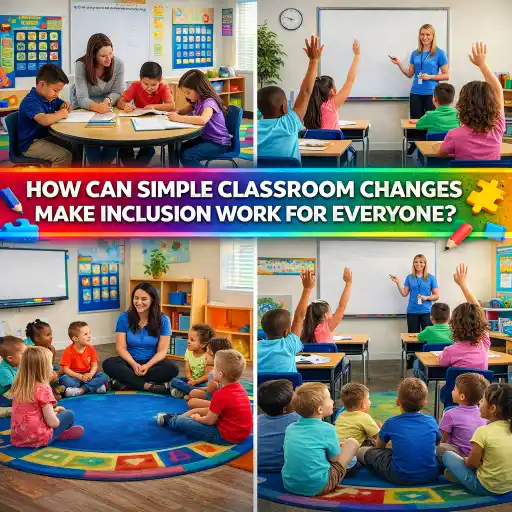
Thoughtful room setup is one of the easiest ways to support inclusion. The physical space acts like a "second teacher" when it is organized for play, learning, and calm moments (Rethinking Your Classroom Arrangement).
Try these layout changes:
- 🔸 Create clear learning centers with a labeled sign and a picture (e.g., blocks, books, art). Limit noisy and quiet centers by placing them apart.
- 🔸 Use flexible furniture: low shelves as dividers, soft rugs, and beanbags for a calm corner.
- 🔸 Keep pathways open for children who move with walkers or need space.
- 🔸 Put messy activities near sinks and open windows where possible.
Numbered steps to set up a center:
- Choose a location and a clear sign.
- Pick 3–6 materials that match children’s skills.
- Post a small visual rule for the center (e.g., "3 friends max").
Design notes: consider light, noise, and traffic flow. The design research shows children need space for movement, calm, and choice — which supports engagement and belonging (Building Blocks of Designing ECE Environments).
What low-cost materials and adaptations help diverse learners participate?
Simple adaptations let children do the same activity in ways that suit them. These changes honor differences without singling anyone out.
Easy adaptations you can try today:
- 🧩 Offer choices of tools: thick crayons, adapted scissors, timers, slant boards.
- 🎯 Break tasks into steps and use a checklist with pictures.
- 📚 Provide multiple ways to join: listen to a story, follow along with pictures, or act out the story.
- 🔈 Add quiet options: noise-reducing headphones, soft lighting, or a calm corner.
- 💬 Support communication: picture cards, gestures, and simple sign language.
Use the language of Universal Design for Learning (UDL): offer multiple ways to engage, represent, and let children show learning. Resources on UDL help you plan activities so everyone can join (UDL resources).
Documentation and planning tip: note which adaptations help and share with families and staff. You can use free guides like Supports, Modifications and Accommodations Buy Now $0.00 for ideas on reasonable changes.
How do we support behavior and partner with families so inclusion lasts?
Think of behavior as communication. Calm, consistent supports help children feel safe and reduce upsetting moments. Partnering with families brings vital information about what works at home and what the child likes.
- 🔔 Use predictable routines and visual schedules to cut down surprises.
- 👍 Teach and praise small steps: "Nice job waiting your turn!"
- 🤝 Meet families with respect. Ask "What helps your child at home?" and share one positive note each day.
- 📞 Make referrals when needed. You do not need to diagnose; you can share observations and resources. Many states and programs offer inclusion coaching (for example, Georgia’s resources in Inclusion in Child Care).
Common mistakes and how to avoid them:
- Not involving families — fix: ask about home routines and try one idea they recommend.
- Changing the child instead of the activity — fix: adapt the task or materials.
- Overcomplicating visuals — fix: keep pictures simple and consistent.
Conclusion
Inclusion does not require perfect classrooms — it needs kind, practical changes. Start with 1–3 small steps: a visual schedule, a calm corner, or simple adaptations to materials. Track what works, share with families, and ask for local coaching when needed. For training and step-by-step courses, ChildCareEd offers practical classes like Building Equity  Buy Now $10.00 and Recognize, Respond, Respect Buy Now $55.00.
Remember: small choices help many children. Your changes make the classroom a place where every child can belong and learn. #inclusion #visuals
FAQ
- Q: Where can I get visuals? A: Make simple photos or use printables from ChildCareEd’s visual schedule guide.
- Q: Who pays for adaptations? A: Many supports are low-cost. For larger needs, check local early intervention or inclusion coaches; state programs often help.
- Q: How do I start a family meeting? A: Ask open questions, listen, and set 2–3 small classroom goals together.
- Q: What if I’m unsure about behavior strategies? A: Use calm routines, visual supports, and seek coaching. The Pyramid Model offers free behavior resources (NCPMI).
- 💛🧩 ¿Cómo puedo hacer que mi enseñanza sea inclusiva para los niños con autismo?
- 10 Ejemplos de Cómo la Cultura Influye en el Desarrollo Infantil
- How can childcare programs use inclusive practices every day?
- How can childcare programs support children with special needs?
- Team-Building Activities for Daycare: Helping Children Learn Together
- How can we create truly inclusive classrooms for children of all abilities?
- How can visuals, routines, and gentle words support Georgia preschoolers with special needs?
- How can Georgia early childhood educators simply communicate with children who have special needs?
- How Can Child Care Providers Support Children With Special Needs?
- How can I support children with special needs in my child care program?
- How can we adapt activities for diverse learners?
- How can I support inclusion in Florida play and daily routines?
- How can DC classrooms welcome every child and make inclusion real?
- How can child care programs support diversity and inclusion?
- Starting an Inclusive Daycare for Children with Speech Delays
- Canciones, juegos y preguntas de círculo para niños
- What Did Washington’s Early Childhood Conference Teach About Building Inclusive Classrooms?
- ADA Training Online in Maryland: Requirements, Access, and Inclusion
- ADA Training Online in Georgia: Requirements, Access, and Inclusion
- How can Michigan PreK classrooms support inclusion and children with special needs?
