Every day in your program you meet children and families from different places. When you teach with respect for culture, you help each child feel safe and proud. This article gives clear steps and simple ideas for child care providers and directors. You will find ways to add culture to routines, lessons, and family partnerships. You will also see why this work matters for young #children, strong #families, and healthy #diversity and #inclusion in your program. For practical guidance, see Cultures in the Classroom and Cultural Competence in Early Childhood Education.
Why does cultural awareness matter for young learners?
Quick reasons why it matters:
- Children feel seen and learn better.
- Families trust programs that respect culture (see tips).
- It prevents hurt from bias and stereotypes.
- It prepares kids for a diverse world. Consider incorporating global education approaches that promote cultural diversity and critical thinking for young learners.
Tip: state requirements vary - check your state licensing agency.
How do I make my classroom culturally aware right now?
- 📚 Add books that show many family types and skin tones. See Culturally Responsive Teaching for ideas.
- 🧩 Include toys and materials that reflect real life: dolls of different skin shades, play foods from many cultures, and dress-up items.
- 📸 Display family photos (with permission). Let this be a calm, welcoming corner.
- 📝 Label shelves in two or more languages when possible. Even a few words help dual language learners.
- 🎶 Use music and greetings from families’ home languages as part of routines.
Also try these classroom habits:
- Ask families one short question: “What should we know about your child?”
- Invite a parent to share a song, story, or recipe if they want.
- Reflect on your materials each month: Do they show many cultures and abilities? See how to create an inclusive environment.
How can I partner with families and the community?
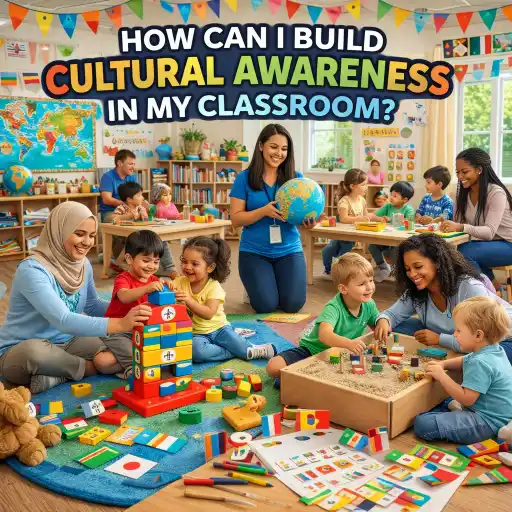
Families are the experts on their children. Strong partnerships make cultural awareness real and respectful. Use clear, kind steps to invite families in.
- 🤝 Build trust first: greet families warmly and listen.
- ✉️ Use simple messages and offer translation when needed. See tips on family engagement.
- 📅 Invite families to one short event: a story session, a songs exchange, or a shared snack. Keep it optional and low‑pressure.
- 🍲 Offer flexible ways to share: a photo, a short video, or a recipe card sent by email.
- 📚 Ask families what books, songs, or words are important at home. Add those into daily routines.
Partnering helps you understand routines like sleep, food, and greetings. When you and families agree on small plans, children feel steady and safe. If you need training, ChildCareEd offers family connection courses such as Connecting With Families. Also remember: state requirements vary - check your state licensing agency for family visit or volunteering rules.
What common mistakes do programs make and how do we check progress?
Many programs try to celebrate culture with a single event like a “culture day.” That can feel shallow. True cultural awareness is daily, respectful, and family-led. Here are common mistakes and how to avoid them.
- ❌ Mistake: Stereotype displays (only one song, costume, or food).
✅ Fix: Use many everyday materials that reflect people’s lives. See multicultural activities. - ❌ Mistake: Doing things without family permission.
✅ Fix: Ask families what they want to share and how. - ❌ Mistake: Assuming one child represents an entire culture.
✅ Fix: Learn about family traditions, not just generalizations. - ❌ Mistake: Waiting for a problem before learning.
✅ Fix: Take small trainings, reflect monthly, and practice active listening. See Cultural Sensitivity.
How to check progress (quick self-check):
- Do classroom books and posters show many cultures and abilities?
- Do children hear their names said correctly?
- Are families invited in simple ways each term?
- Do teachers reflect on biases and make small changes monthly?
For assessment ideas that include culture and family input, see Culture, Communication, and Collaboration in Assessment.
Conclusion and FAQ
Building cultural awareness is practical and powerful. Small steps add up. Use everyday items, partner with families, and reflect often. Training and community resources make a big difference.
Quick FAQ
- Q: How do I start if my classroom is busy?
A: Pick one small change: add 3 diverse books or label one shelf in another language. - Q: Can I ask families about culture?
A: Yes—ask one respectful question like, “What should we know to support your child?” - Q: Do I need special training?
A: Training helps. Short courses and peer conversations are useful. ChildCareEd has many short modules. - Q: Who enforces rules about cultural displays?
A: Programs set their policies, and state licensing may have rules. state requirements vary - check your state licensing agency.
Thank you for doing this important work. Small choices every day help children feel proud and included. Keep asking families, learning, and celebrating the many ways children belong.
Start small. You do not need a big rewrite of your program. Use things children see every day. The goal is to show respect and to reflect families in the room. Here are simple steps you can do this week.Children learn best when they feel they belong. Cultural awareness helps children build confidence and a strong sense of self. It also helps classmates learn to be kind and curious about others. Research and expert guidance say inclusive classrooms support learning, reduce bias, and build social skills. For a high-level view, the OECD explains how inclusion boosts child well‑being and fairness in early learning: Supporting inclusion in ECEC.- 45 Hour Child Growth and Development
- 45 Hour Preschool Methods and Materials
- From Play to Planning: Building Culturally Competent, Child-Centered Curriculum
- CDA Family Child Care Credential with Portfolio Review
- Pediatric RSV First Aid & CPR/AED
- 45 Hour School Age Methods and Materials
- Texas Director Credential Renewal
- Texas Director Credential
- Wellness in Action: Teaching Healthy Habits to Children
- Cultivating Literacy, Language, and Cultural Awareness: The Hanukkah Minibook in Early Childhood Education
- 👶 ¿Cuáles son las proporciones y grupos requeridos en Dakota del Norte? 🏫
- 10 Ejemplos de Cómo la Cultura Influye en el Desarrollo Infantil
- How can I build cultural awareness in my classroom?
- How can New York childcare workers help children build a strong sense of identity in a big city?
- Celebrando la amistad en el cuidado infantil durante el Día de los Mejores Amigos
- How can I integrate the World Cup into my daycare program in an inclusive, safe, and developmentally appropriate way?
- How can we host a Costume & Character Day that truly builds imagination and learning?
- How can childcare programs meaningfully explore Japanese culture with young children?
- How can I create classroom traditions that children remember for years?
- How can we create classrooms where every child feels represented?
- How can child care programs use culturally responsive activities to support young children?
- How Can I Celebrate Lunar New Year Respectfully and Effectively in My Classroom?
- Is My Preschooler Ready for Kindergarten? Milestones Beyond ABCs and 123s
- How Can Child Care Programs Build Meaningful School Readiness?
- How Can Picture Task Cards Support Emerging Readers?
- How Can Bilingual Printables Help Spanish-Speaking Families Feel Included?
- How Can Families and Educators Connect Early Literacy With STEM, Art, Music, and Creativity at Home?
