Every day you welcome a mix of curious, busy, and quiet little people. Some children need extra help to learn, play, and feel safe. This article gives simple, practical steps for child care providers and directors to support children with special needs. Read each section and try one idea this week. Remember: state requirements vary - check your state licensing agency.
What is inclusion and why does it matter?
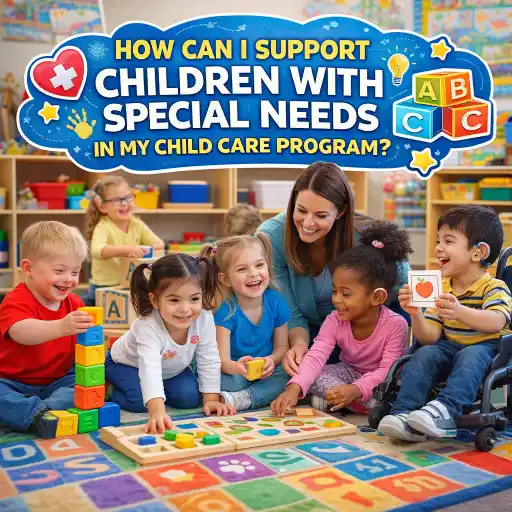
Inclusion means every child belongs in the same classroom and gets the supports they need to join in. Inclusion helps children feel safe, builds friendships, and teaches all children kindness. Research and practice show inclusion works best when programs plan for it and train staff, as explained by the Supporting diverse learners and special needs guide.
- ✅ Children with supports learn skills faster and feel more confident.
- ✅ Peers learn empathy and cooperation.
- ✅ Programs that include everyone better meet licensing and legal expectations (see Access for All: Inclusion and the ADA
 Buy Now $16.00).
Practical note: inclusion is about changing the room or routine, not the child. For more on how inclusion helps, see the CSEFEL inclusion brief and the OECD discussion on inclusive early childhood practice at OECD.
How can I adapt my #classroom and activities so every child can join?
Use three quick ideas: Space, Stuff, Steps. Small changes often let a child join right away. ChildCareEd explains many simple adaptations in Adapting Activities for Children with Developmental Delays.
- Space:
- 🔹 Move noisy centers away from circle time.
- 🔹 Create a cozy corner with soft light and a rug so a child can calm down.
- Stuff:
- 🔸 Offer thick crayons, dot markers, or trays to keep toys contained.
- 🔸 Provide sensory bins, fidgets, or headphones for children with strong #sensory needs (see What should child care providers watch for with sensory needs?).
- Steps:
- 🔹 Break tasks into 2–3 clear steps and use pictures for routines (picture schedules help many learners).
- 🔹 Model, do together, then let the child try.
Communication supports: try simple picture boards or Augmentative and Alternative Communication (AAC) tools. The Adaptation Station has helpful AAC tips. For short, safe strategies you can use now, see ChildCareEd's free resources page at Supporting Skill Development resources.
Common mistakes to avoid:
- Labeling a behavior as "bad" instead of asking "what does the child need?"
- Waiting too long to try small changes — start with one change this week.
- Not asking families what works at home.
How do I work with families, IEPs, IFSPs, and referrals?
Families are the experts on their child. Begin with listening and daily notes. If you think a child needs more supports, document clear examples and share them kindly with the family. ChildCareEd’s training Special Needs: From Referral to Inclusion Buy Now $24.00 explains referral, IEP, and IFSP basics for programs.
- Observe and record: write dates, times, what happened, and how the child reacted. Use objective notes — facts, not labels.
- Talk with the family:
- 🙂 Ask: "Do you see this at home? What helps?"
- 🙂 Share strengths first, then concerns.
- Consider screening and referral:
- 🔎 Use validated screens when possible (the AAFP notes many screening tools in Developmental Delay: When and How to Screen).
- 🔎 If delays appear across settings, suggest the family talk with their pediatrician or local early intervention (IFSP) or school district (IEP). You can also share targeted early intervention resources that explain local services, eligibility, and how families can begin the referral process.
- Partner with specialists: speech therapists, occupational therapists, or AAC teams (examples: Stanford AAC services at Stanford).
Keep families informed and involved. Share small wins and be honest about next steps. ChildCareEd’s free resources (like the Observing and Recording guide) are great tools for conversations and notes: Free Resources.
How do I create behavior and communication supports that really help?
Effective supports teach new skills and change the environment so challenging behavior is less likely. Positive Behavior Support (PBS) and functional assessment are proven steps. See CSEFEL's PBS guidance at What Works Brief #10 and ChildCareEd’s article on creating behavior plans at Supporting the Individual.
- Understand function:
- 🔍 Watch what happens before and after the behavior. Is the child avoiding something or getting attention?
- Prevent and teach:
- 🔸 Change triggers (clear routines, visual schedules).
- 🔸 Teach the skill you want (how to ask for help, take turns).
- Use simple supports for communication:
- 🔹 Model AAC and give wait time (Adaptation Station shows how to model and prompt).
- 🔹 Use first-then boards, choice boards, and picture schedules to lower frustration.
- Be consistent and team-based:
- 🔸 Share the plan with all staff and the family. Regularly review what works.
Training helps staff feel confident. ChildCareEd courses like CDA: Special Needs: Understanding the Whole Child Buy Now $24.00 and Inclusive Care Strategies give practical ideas and skill practice. Keep learning — better-trained caregivers and lower ratios improve outcomes, as RAND explains at Proven Benefits of Early Childhood Interventions.
Conclusion: What can I do this week?
Small steps make big differences. Try one item from this short plan and build from there.
- 🔸 Pick one adaptation: add a cozy corner or a picture schedule.
- 🔹 Start objective notes: one line each day for one child you’re watching.
- 🔸 Call or text a family with one positive observation this week.
- 🔹 Try a short training or read one ChildCareEd article (see How to Support Children with Special Needs in Child Care).
Quick FAQ:
- Q: "Do I need a diagnosis to help a child?" A: No. Try classroom supports first and document patterns.
- Q: "Who makes referrals?" A: Families or providers can ask the pediatrician or local early intervention/school district.
- Q: "Where can I learn more?" A: ChildCareEd course catalog and free resources at Free Resources.
- Q: "What five things are most important?" A: #inclusion, #children, #classroom, #sensory, #IEP.
You already care deeply. With a few changes, teamwork, and steady notes, your program can welcome every child and help them grow. For more tools and downloads, visit ChildCareEd's course pages and free resources linked above.
- Stay Alert! Steps for Emergency Prep
- Bienvenido! Welcoming All Families
- Tracking Progress, Shaping Futures: Observation & Assessment Skills
- CDA Bridge Bundle: Family Child Care
- CDA Bridge Bundle: Family Child Care without Portfolio Review
- CDA Bridge Bundle: Infant/Toddler without Portfolio Review
- CDA Bridge Bundle: Preschool without Portfolio Review
- Equity in Action with Head Start
- Texas Director Credential Renewal
- Texas Director Credential
- How Does the Americans with Disability Act ( ADA) apply to child care centers
- Supporting children with special needs: partnering with early intervention
- Specialized Child Care for Special Needs
- CDA Certification en Español: Recursos y Consejos para Educadores Bilingües
- 💛🧩 ¿Cómo puedo hacer que mi enseñanza sea inclusiva para los niños con autismo?
- 👶 ¿Cuáles son las proporciones y grupos requeridos en Dakota del Norte? 🏫
- ¿Cómo incluir a niños con necesidades especiales en cuidado infantil? Guía práctica y sencilla
- Cómo Empezar una Guardería en Casa: Requisitos y Pasos
- Lista para Guardería en Casa en Illinois: Cómo Iniciar una Guardería en el Hogar
- Apoyo en Preescolar para Retrasos del Habla: Estrategias Simples que Ayudan
- The American Dream of Child Care Ownership
- How can childcare programs support children with special needs?
- How can I support children with special needs in my child care program?
- Celebrando la amistad en el cuidado infantil durante el Día de los Mejores Amigos
- How Many Kids Can You Babysit in Your Home Without a License?
- Cómo simplificar la capacitación para sus empleados de daycare
- How can my program find its niche as 2‑K and 3‑K grow in New York?
- How Can My Child Care Program Better Support Children with Special Needs?
- How do I build an effective emergency preparedness plan for my Kansas child care program?
- Can You Open a Daycare Just for Children With Special Needs? Licensing, Training, and Staffing Explained
