Looking for a practical way to strengthen children’s decision-making, resilience, and creative thinking in your classroom? Process art — open-ended, choice-driven making — gives children time and materials to experiment, solve problems, and express ideas; to go deeper, consider ChildCareEd’s Open Heart, Open Art  Buy Now $16.00, a short course that helps staff translate process-based practice into classroom routines and satisfies CDA Subject Area 3 learning goals. If you want hands-on activities and a ready toolkit for preschool teams, Art from the Heart for Preschoolers Buy Now $35.00 shows how open invitations build self-esteem and usable lesson ideas your staff can implement tomorrow.
1) What exactly is process art and how does it differ from product-focused crafts?
Process art prioritizes exploration, choice, and the making experience over a predetermined finished object. In contrast, product art gives a model and steps that often lead to similar final pieces. Use #process invitations to emphasize decision-making, experimentation, and sensory discovery; use product activities selectively to teach sequencing, cutting skills, or to create family keepsakes. For a clear comparison and practical framing, see Process Art or Product Art: Which Should Early Childhood Programs Choose? on ChildCareEd. Why this matters for practice: when the classroom regularly offers open-ended invitations, children learn to plan, revise, and justify choices — foundational habits of artistic and cognitive thinking. State requirements vary - check your state licensing agency when choosing materials and documenting practice.
2) How does process art support development and why does it matter for classroom outcomes?
Process art connects cognitive, motor, language, and social-emotional domains. As children mix paint, manipulate clay, or experiment with loose parts they practice fine motor control, spatial reasoning, cause-and-effect, and expressive language. Observational talk — describing children’s choices rather than evaluating the finished piece — boosts vocabulary and supports self-regulation. Research and field guidance show that open-ended art nurtures creative thinking and persistence: these are transferable skills teachers can intentionally scaffold during centers and documentation. For practical benefits and activity ideas, review Why Open-Ended Art Matters in Early Childhood. Why it matters: programs that foreground process art produce learners who experiment without fear of failure, negotiate materials with peers, and can articulate decisions — all essential to high-quality, play-based learning. To connect children's creative choices with a stronger sense of competence, explore strategies for supporting children's self-esteem.
3) How do you set up materials, space, and routines so process art works in a busy program?
Systems make process art manageable. Key elements include low, labeled shelves with reachable bins; one predictable messy zone per session; simple clean-up routines; and a rotating set of provocations so materials stay fresh. Use visual labels and photos so children choose independently. Practical setup checklist:
- 📌 Low shelves with clear bins and picture labels for independence.
- 🎨 One messy table or tray for paints/clay; alternate low-mess invitations like collage or markers for other groups.
- 🕒 Timed rotations (10–20 minutes for toddlers/preschoolers), with transitions taught and practiced.
- 🧽 A 3-step clean-up routine (tools away, wipe surface, wash hands) taught and reinforced.
- 📂 Drying racks and a photo station for documentation and drying storage.
- 🔁 Rotate loose parts and found materials every 2–6 weeks to rekindle interest.
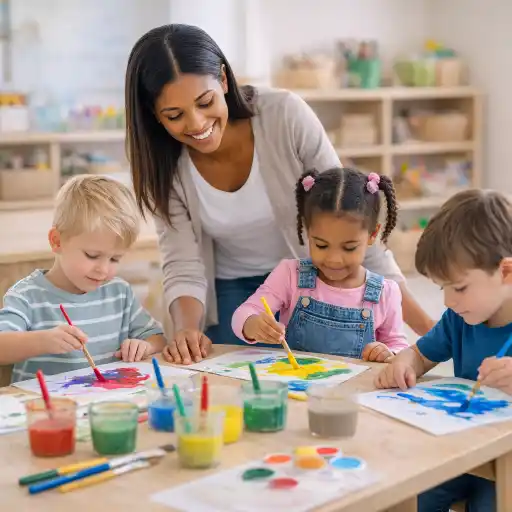
Safety and accessibility: choose age-appropriate, non-toxic materials and adapt tools (grip aids, larger tools, vertical easels) for diverse learners. For classroom-ready invitations and low-cost ideas, see Open-Ended Art Activities That Build Confidence in Preschoolers on ChildCareEd. Remember: state requirements vary - check your state licensing agency for storage, labeling, and supervision rules.
4) How should teachers document, assess, and communicate the learning that happens during process art?
Documentation makes the learning visible to staff, families, and licensing reviewers. Use a simple evidence loop: photograph the making, record a child quote (one sentence), and add a short teacher note linking the work to a learning aim (language, fine motor, persistence). Practical assessment tips:
- Keep a rolling portfolio: one photo + one child quote per child per week.
- Track 1–2 short goals (new words, tool use, turn-taking) over 2–4 week cycles.
- Use anecdotal notes in staff huddles to plan differentiated invitations.
- Share one process photo weekly with families and a 1-line learning note to shift expectations about “pretty” crafts.
Examples of teacher language to support learning: describe what you see ("I notice you used lots of dots") and ask open questions ("Tell me about your plan"). These practices align with approaches described in ChildCareEd resources and boost family understanding of why art may look messy but is rich in learning. Consider short staff training so everyone documents consistently — courses like Power of Art Buy Now $35.00 include strategies for using art to support social-emotional goals.
5) How do we balance process and product art and avoid common mistakes?
Balance offers children both freedom and skill-building. A practical recipe: prioritize open-ended #creativity daily or 1–2 deeper sessions weekly, and schedule 1–2 teacher-directed product activities monthly for specific skills or holidays. Common pitfalls and fixes:
- ❌ Mistake: Expecting identical results from every child. ✅ Fix: Offer a sample idea only as inspiration and let children choose materials and steps.
- 🛑 Mistake: Over-helping or finishing a child’s work. ✅ Fix: Use coaching language and scaffold one step at a time.
- ⚠️ Mistake: Overloading shelves with materials. ✅ Fix: Rotate to 1–2 invitations at a time to reduce overwhelm.
- ❗ Mistake: Not communicating goals to families. ✅ Fix: Send a weekly photo with a learning-focused caption explaining the skills practiced.
When staff and families understand the purpose of process work, programs can keep #art central while also teaching technique when needed. For team-level planning and community strategies, ChildCareEd’s training such as Supporting Social Learning: Creating Classrooms that Care Buy Now $35.00 helps align documentation, social goals, and classroom culture.
Conclusion
Process art is a high-return strategy: it builds #children’s fine motor control, language, problem-solving, and emotional regulation while nurturing authentic #creativity. Start small: replace one product craft with a simple open-ended invitation this week, set clear access and clean-up routines, photograph the process, and share a brief note with families. If you want guided next steps, consider these ChildCareEd courses for staff development and practical tools: Open Heart, Open Art Buy Now $16.00, Art from the Heart for Preschoolers Buy Now $35.00, Power of Art Buy Now $35.00, Supporting Social Learning Buy Now $35.00, and CDA Subject Area 2 Buy Now $80.00.
FAQ (quick):
- Q: How often should process art happen? A: Aim for daily short invitations plus 1–2 deeper open-ended sessions weekly.
- Q: Will families accept messy-looking work? A: Many will with documentation — send a photo and one learning sentence.
- Q: How do we measure growth? A: Photo + child quote snapshots over time show increasing tool independence, vocabulary, and persistence.
- Q: Where to learn more? A: The linked ChildCareEd courses above offer practical activities, documentation strategies, and PD hours. State requirements vary - check your state licensing agency.
Five key words: #process #creativity #art #children #preschoolers
- CDA Home Visitor Subject Area 3 Part 3 Birth to 5
- Many Colors, One Canvas: MD ECE Conference
- CDA Home Visitor Subject Area 2 Part 3 Birth to 5
- Open Heart, Open Art
- Power of Art: Bldg Self-Esteem & Positive Behavior for ALL Abilities
- Birth to Five CDA Credential with Portfolio Review
- Art from the Heart for Preschoolers: Open Ended Art Projects that Build Self-Esteem
- 45-Hour Infant and Toddler Curriculum
- CDA: Stand With Respect and Professionalism
- Montessori Cultural Activities: Exploring the World Through Play and Learning
- CDA Certification en Español: Recursos y Consejos para Educadores Bilingües
- Why Open-Ended Art Matters in Early Childhood
- How Do Art Activities Support Cognitive Growth in North Dakota Preschoolers?
- How can New York child care providers use art and creativity to help young children learn?
- Crayon Activities for Preschoolers: Color, Creativity, and Fine Motor Skills
- Art Exploration for Kids: Colors, Textures, and Creativity
- Can doodling and drawing build fine motor skills and creativity?
- How can child care programs support creativity through open-ended art?
- Why Should Children’s Artwork Not All Look the Same?
- How Can Early Childhood Programs Support Creativity Through Process Art?
- How Can I Create a Classroom Where Creativity Is Valued?
- Who Qualifies for a Crayola Donation Request? A Guide for Child Care Programs
- Open-Ended Art Activities for Preschoolers: 15 “What Can You Make?” Invitations
- Field Trips for Elementary Students: 15 Adventures That Bring Learning to Life
- How Can Families and Educators Connect Early Literacy With STEM, Art, Music, and Creativity at Home?
- How Can Open-Ended Summer Art Encourage Planning and Creativity?
- How Can You Plan Patriotic Crafts Without Limiting Children’s Creativity?
- How Can Child Care Programs Celebrate Juneteenth Through Respectful, Child-Centered Art?
- How Can AI Help Child Care Teachers Get Unstuck When Creativity Runs Dry?
