Children build literacy through far more than worksheets: they talk, sing, investigate, draw, build, and tell stories with the people they love. For more playful ideas to support early reading in everyday routines, explore ways to spark early reading through everyday fun. For providers ready to strengthen these home-school connections, Supporting Families and Caregivers in Language and Literacy  Buy Now $16.00 offers practical strategies for sharing meaningful literacy experiences and can support professional learning hours. Educators may also deepen their practice through CDA Subject Area 2 Buy Now $80.00, which connects language, literacy, science, mathematics, the arts, music, and technology.
Why does a home-school literacy partnership matter?
Early literacy begins in relationships and everyday experiences. A caregiver who listens to a child describe a drawing, sings a family song, or talks about what happens while cooking is supporting oral language, vocabulary, memory, sequencing, and meaning-making. These experiences prepare children for later reading and writing without turning home life into a second classroom.
Research summarized by the Center for Parent Information and Resources links family support for language and literacy with vocabulary, conceptual development, reading acquisition, and literacy achievement. The Head Start PFCE Framework likewise describes engagement as a reciprocal process: educators and families work with, rather than do things to or for, one another.
This strengths-based perspective matters because families already possess valuable knowledge, traditions, languages, and routines. Providers do not need to “fix” home practices. Instead, they can notice what families do well and help extend those practices into playful opportunities for #children, #language, #literacy, #creativity, and #partnership.
How can educators honor families’ existing literacy practices?
Begin with curiosity rather than assumptions. A family may not describe storytelling, singing, recipe reading, texting, or helping a child sort laundry as literacy, yet each can develop language, symbols, print awareness, and problem-solving. The research on home literacy environments emphasizes that children’s earliest learning is shaped by family routines, cultural practices, multilingual communication, and child-led experiences.
Invite families to share what literacy looks like in their home. Use questions such as:
- What songs, stories, or sayings does your child enjoy?
- Which languages does your child hear and use with family members?
- What does your child like to draw, build, pretend, or investigate?
- Which routines create relaxed opportunities for conversation?
Home-language use is an asset, not a barrier. Families can tell stories, sing, label objects, and discuss ideas in the language most comfortable for them.
Offer materials that reflect families’ identities: bilingual books, culturally relevant images, family photographs, familiar songs, and opportunities for children to dictate stories. Avoid treating culture as a once-a-year celebration. When children see their homes represented regularly, belonging and engagement become part of the literacy environment.
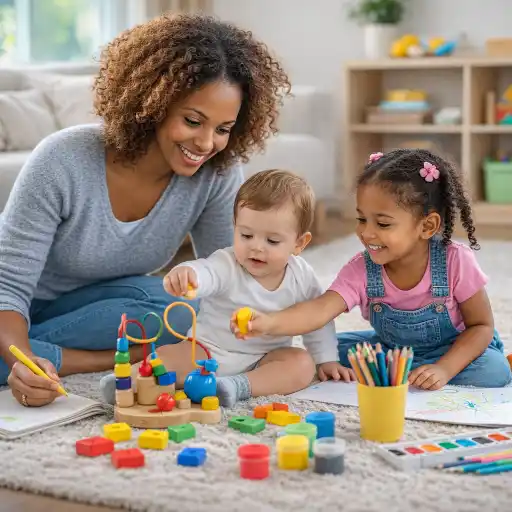
What literacy-rich activities can families do through STEM?
STEM and literacy naturally reinforce one another. Children need language to predict, compare, explain, question, and communicate what they discover.
Providers can send home one simple invitation connected to classroom learning:
- 🔎 Sink or float: Invite children to predict what will happen, test safe household objects, and explain the results.
- Cooking talk: Compare full and empty, count ingredients, describe textures, and discuss how food changes.
- Nature collection: Sort leaves, rocks, or shells by color, shape, size, or texture; encourage children to name their categories.
- Building challenge: Use boxes or blocks to build a bridge for a toy. Ask, “What could make it stronger?”
- Weather journal: Draw the sky, dictate an observation, and revisit the page over several days.
These activities develop vocabulary and narrative structure while strengthening early scientific reasoning.
Keep the communication brief and inviting. A note might say, “Ask your child what they noticed, not whether they got the right answer.” This positions families as co-investigators and makes learning enjoyable.
How can art, music, and creativity extend early literacy?
Art and music give children additional ways to represent ideas before conventional writing is established. Drawing, painting, collage, movement, dramatic play, and rhythm all encourage children to make choices, organize experiences, express emotions, and communicate meaning. NAEYC explains that literacy includes speaking, listening, reading, writing, playing, and making meaning through everyday experiences.
Share open-ended invitations rather than models that every child must copy:
- Story art: After a read-aloud, invite children to draw a favorite event and dictate a caption.
- Family sound map: Children listen for sounds at home, represent them with marks or pictures, and describe what they heard.
- Song variations: Families sing a familiar song in a home language, change a word, or invent a new verse.
- Prop-based storytelling: Use recycled materials to create puppets, then act out a family story.
- Process art: Offer paper, fabric, natural materials, and drawing tools so children can experiment without a predetermined product.
Music supports patterns, memory, listening, vocabulary, and phonological awareness. Clapping syllables in names, repeating rhymes, or creating a rhythm for a story can be playful and culturally responsive. For professional learning, Mind’s Medicine: Music in Early Childhood Buy Now $16.00 explores developmentally appropriate musical experiences, while Art from the Heart for Preschoolers Buy Now $35.00 focuses on open-ended creativity and children’s confidence. Educators can also explore how Montessori principles connect with music and rhythm to support young children’s learning.
How can programs make family participation practical and equitable?
Family engagement is strongest when participation is flexible, respectful, and connected to families’ goals. A lengthy take-home packet may feel like homework, while a single conversation prompt attached to a familiar routine is more manageable. The ChildCareEd guidance on family engagement recommends multiple communication methods, shared decision-making, cultural responsiveness, and empathy.
Directors and providers can build a sustainable system:
- Ask families how they prefer to receive ideas: text, paper, email, video, or conversation.
- Offer materials that require little or no cost, such as boxes, paper, household objects, songs, and stories.
- Provide bilingual or translated communication when possible, and invite families to contribute home-language words.
- Share observations about children’s thinking, not only completed products.
- Invite family feedback: “Which activity felt natural?” and “What would you change?”
- Protect privacy and obtain permission before sharing photographs or recordings.
Common mistakes include presenting one “correct” way to read, assuming every family has the same schedule or book access, and asking families to complete teacher-designed assignments without discussion. Avoid these pitfalls by offering choices, affirming oral traditions, using libraries and community resources, and focusing on connection rather than compliance. State requirements vary - check your state licensing agency.
Professional development can help teams translate these principles into practice. Consider Bridging Cultures: Family Communication & Collaboration Buy Now $55.00 for culturally and linguistically responsive communication strategies, or Building Bridges for Dual Language Learners Buy Now $16.00 for approaches that connect home-language strengths with classroom learning.
How can educators document and strengthen the partnership?
Documentation should make children’s thinking and family contributions visible. A short note can capture the child’s words, the strategy used, and a possible next step. For example: “Maya predicted the ice would melt faster in the sun. At home, her family noticed that a metal spoon felt colder than a wooden spoon. We will compare materials tomorrow.” This kind of documentation honors family knowledge while guiding curriculum planning.
Use a simple cycle:
- Listen: Ask families what they notice and value.
- Observe: Record children’s language, questions, representations, and problem-solving.
- Connect: Relate home experiences to classroom books, songs, investigations, and art.
- Extend: Offer one optional activity that builds on the child’s interest.
- Reflect: Ask whether the invitation was accessible, enjoyable, and culturally meaningful.
Assessment should remain responsive rather than deficit-focused. The Assessment of Language and Literacy Skills Buy Now $24.00 course can help providers use objective observations and meaningful learning goals. Evidence might include a child using new vocabulary, retelling an event, explaining a prediction, creating a symbol, sustaining a musical pattern, or collaborating on a design.
Directors can review partnership efforts during staff meetings: Which families’ voices are represented? Who may be experiencing barriers? Are home activities varied enough to include oral storytelling, movement, music, drawing, STEM exploration, and pretend play? This ongoing reflection supports equity and prevents family engagement from becoming a one-time event.
Conclusion: What is the central goal of home-school literacy partnership?
The goal is not to send schoolwork home. It is to create a connected learning ecosystem in which children’s everyday relationships, languages, interests, and cultural practices are recognized as foundations for literacy. Families can support early reading and writing through conversation, storytelling, songs, drawing, dramatic play, cooking, building, sorting, and investigation.
Effective providers listen first, communicate flexibly, share practical invitations, and treat families as knowledgeable partners. STEM supplies questions and discovery; art provides representation; music strengthens rhythm and memory; creativity gives children agency. Together, these experiences help children become confident communicators and meaning-makers.
Start with one manageable step this week: ask a family to share a favorite song, send home a prediction prompt, or invite a child to dictate a story about a family experience. Small, respectful connections can grow into powerful #home-school learning partnerships.
- Reading Aloud and Storytelling
- Language and Literacy Foundations in Pre-K
- Letter & Number Planning in Child Care
- Classroom Tools for Emergent Literacy
- CDA Home Visitor Credential Birth to 5
- Texas Director Credential
- Montessori Cultural Activities: Exploring the World Through Play and Learning
- Classroom Tools for Emergent Literacy
- Building Vocabulary
- Supporting Families and Caregivers in Language and Literacy
- "Junk" Art
- Cultivating Literacy, Language, and Cultural Awareness: The Hanukkah Minibook in Early Childhood Education
- How Can Childcare Educators Thrive in the Big Apple?
- Tiny Hands, Big Dreams: Fostering Creativity in Preschoolers
- CDA Certification en Español: Recursos y Consejos para Educadores Bilingües
- How Do Art Activities Support Cognitive Growth in North Dakota Preschoolers?
- School-Age Program Ideas: Games, Projects, and Group Activities
- School-Age Lesson Plan Ideas: STEM, Art, Movement, Reading, and More
- Rainy Fall Day? 12 Indoor Activities Preschoolers Won’t Want to Stop
- Why Do Bilingual Classroom Activities Matter for Dual Language Learners?
- After School Activities for Elementary Kids Who Finish Homework Early
- Rosh Hashanah Kindergarten Lesson Plans: 5 Days of Apples, Kindness, and New Beginnings
- How Can Recycled Materials Create Engaging Learning Centers?
- How Can Child Care Programs Celebrate Hispanic Heritage Month Meaningfully?
- How Can Families and Educators Connect Early Literacy With STEM, Art, Music, and Creativity at Home?
- How Can Child Care Programs Celebrate Juneteenth Through Respectful, Child-Centered Art?
