Young children often enter the classroom eager to scribble, doodle, and experiment with making marks. When educators guide these experiences intentionally, everyday #doodling and #drawing can strengthen hand muscles, improve hand-eye coordination, refine #finemotor control, and encourage imaginative thinking. This article helps child care providers and directors turn simple art experiences into purposeful learning opportunities for #preschoolers that support #creativity and development. Readers will find research-informed explanations, practical activities, safety considerations, documentation ideas, and simple adaptations for children with diverse abilities and learning needs. Educators can deepen this work through ChildCareEd’s self-paced online course Power of Art: Building Self-Esteem and Positive Behavior for All Abilities  Buy Now $24.00, which explores how the arts can support children’s development, confidence, social skills, and positive behavior in inclusive learning environments.
Why it matters:
Doodling can reduce mind-wandering and improve recall in low-stimulation tasks a finding summarized from Andrade’s study (see Andrade (doodling)) and reported in mainstream media (CNN summary).
How does casual mark-making translate into measurable fine motor gains?
1. Perception-action loop: Choosing colors, planning a shape, and adjusting force are cognitive tasks that pair perception with motor output; development literature outlines predictable drawing stages from scribble to schematic to realistic (Child Art stages review, Preschematic stage summary).
2. Attention regulation: Low-effort mark-making (doodling) can stabilize arousal and reduce off-task daydreaming, improving memory for concurrent auditory content — Andrade’s lab work showed ~29% better recall in doodlers (Andrade).
3. Creativity scaffold: Open-ended drawing invitations let children make decisions and tell stories; see process-art approaches at Open-Ended Art Activities.
What simple, classroom-ready doodling and drawing activities work best?
1. ✍️ DIY scratch art: Layer crayon colors, paint black, then scratch details with a stylus — great for pressure modulation and controlled strokes (DIY Scratch Art). For a ready-to-use recipe and step-by-step photos you can print for centers, see the Kids Scratch Art Activity.
2. 🎨 Open-ended drawing invitations: Offer a prompt such as “Draw something that makes you proud” to encourage decision-making and language; guidance at Open-Ended Art Activities.
3. 🧩 Integrated routines: 1) Label-making for cubbies, 2) snack cup drawings, 3) name tags practice — bring fine-motor practice into everyday tasks (daily integration ideas).
4. 🧵 Fine-motor trays: Threading beads, sticker-peeling, clothespin boards, and sensory bottle filling for bilateral coordination and pincer control (Make Your Own Sensory Bottles Buy Now $0.00).
Simple paper-and-pencil maze tasks and hands-on DIY mazes also target visual-motor coordination and early problem-solving; see a collection of maze and visual-logic activities you can add to fine-motor trays and centers.
How should you set up centers, routines, and safety for drawing-based learning?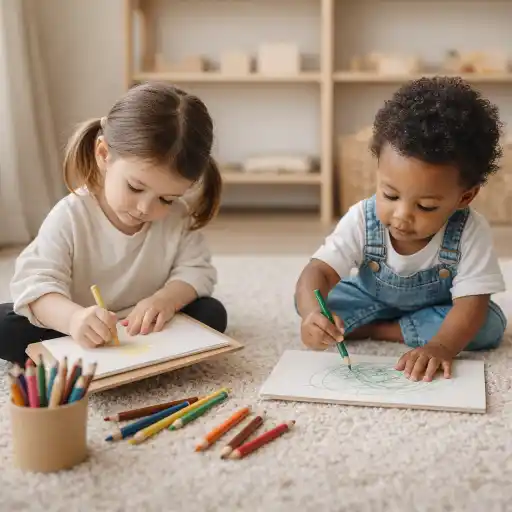
- Zones and labeling (3–4 stations): Number and picture-label tubs: (1) Free Drawing, (2) Scratch Art, (3) Fine Motor Jobs, (4) Collage/Loose Parts. ChildCareEd center ideas help plan displays: Crayon activities.
- ✅ Routines: Enumerate steps — 1) Invite, 2) Work (12–20 min rotations), 3) Share/Gallery, 4) Clean-up. Teaching the tidy routine builds motor sequencing and responsibility.
- 🧯 Materials safety: Use non-toxic, ASTM/ACMI-labeled materials and store solvents/sharp tools away. For chemical and material safety guidance, see Health Canada’s art safety notes (Information for Art Class Teachers). Also remember: state requirements vary - check your state licensing agency.
- 🔒 Supervision: Model one brief demo, circulate for targeted feedback, and keep tools sized to the child’s ability. For ideas on safe activities across age groups, explore ChildCareEd resources like the gingerbread fine motor PDF (Gingerbread Person activity Buy Now $0.00).
How do we track progress, adapt for diverse learners, and avoid common pitfalls?
1. Quick tracking (enumerate):
- Grip snapshot: fisted → radial cross-thumb → tripod.
- Pressure control: heavy vs light strokes.
- Tool independence: requires adult vs independent use.
- Language: child describes drawing with increasing vocabulary.
2. 🛠️ Adaptations:
- 🔸 Weighted crayons or grip aids for tactile support.
- 🔸 Vertical surfaces (easels) for shoulder stability and wrist extension.
- 🔸 Larger paper and chunky tools for emerging users.
3. Common mistakes and fixes (enumerate):
- 🛑 Mistake: Over-directing art (product-only). Fix: Use process prompts — see Open-Ended Art Activities.
- ⚠️ Mistake: One-size tasks. Fix: Offer parallel choices (same goal, graded tools).
- ❗ Mistake: Sparse documentation. Fix: 1 photo + 1 child quote weekly per child is manageable and powerful.
4. FAQ (quick):
- Q: How often? A: Daily short invitations + 1–2 extended process-art sessions weekly.
- Q: What about messy families? A: Communicate learning goals and send process photos — ChildCareEd recommends documentation strategies (documentation tips).
- Q: Doodling vs directed drawing — which to prioritize? A: Mostly open-ended (process) with occasional skill-focused lessons.
- Q: Is doodling just “silly scribbles”? A: No — developmental stages show scribbling is a motor and symbolic milestone (Child Art stages).
What does the research say — and how can providers use those findings now?
1. Andrade’s lab evidence indicates that low-effort doodling can aid attention and recall in boring tasks; that suggests structured doodle time supports learning readiness (Andrade, summarized in CNN).
2. Developmental frameworks describe predictable drawing stages: scribble → schematic → realistic. Use stage-appropriate invitations and expectations (Child Art review, Preschematic notes).
3. Practical research-translation steps for your program (enumerate):
- Embed 5–10 minute mark-making invitations into daily routines.
- Use varied tools and vertical surfaces to progress grip and wrist control.
- Document one small change per child per week (photo + note).
- Share the process with families to connect play to skill growth.
For further classroom activities and templates, ChildCareEd offers many downloadable resources and trainings on process art and fine motor integration (examples: DIY Scratch Art, Crayon Activities).
Conclusion
Doodling and drawing are low-cost, high-return practices: they build the #finemotor foundation children need for independence and early literacy while nurturing #creativity and attention. 2. Start small: add daily brief invitations, label centers, use graded materials, and document one observation weekly. 3. Keep safety and licensing in view — state requirements vary - check your state licensing agency — and choose certified non-toxic supplies (material safety guidance).
Try this 3-step experiment this week:
- Set up a 10-minute doodle station with 2 crayon types and large paper.
- Observe one child’s grip and pressure — note baseline.
- Repeat in two weeks and compare — you’ll see little but real progress.
Keep the process playful and visible — small marks, big learning for your #preschoolers.
1. 🖍️ Crayon stations: Short, daily 5–10 minute invitations with varied crayon sizes (half-stubs, thick, thin) to encourage tripod grasp. See ideas at Crayon Activities for Preschoolers.
2. Fine motor competence underpins self-help skills (dressing, fastening), early writing, and classroom independence. See practical integrations at How to Incorporate Fine Motor Skills Practice Into Daily Activities.
3. Motor pathway practice: Repeated grasping, pressure changes, and wrist movement during scribbling, shaping, and controlled lines build the small-muscle coordination needed for the tripod pencil grasp (see ChildCareEd fine motor guide).
- Pencil and Paper Activiites
- Creativity & Logic Activities
- How to boost fine motor skills: Holiday Edition
- Increasing Fine Motor Skills in the Early Childhood Education Classroom
- How motor skills shape child development and creative ways educators can foster them.
- CDA Certification en Español: Recursos y Consejos para Educadores Bilingües
- 🔍 ¿Qué ves cuando observas a un niño aprender?
- Cuáles Son las Señales de Alerta en el Desarrollo Infantil que Todo Educador Debe Conocer?
- 👶 ¿Cuáles son las proporciones y grupos requeridos en Dakota del Norte? 🏫
- Celebra El Cumpleaños de Dr. Seuss En Tu Guardería Con Actividades Fáciles y Divertidas!
- Proporciones de Cuidado Infantil y Tamaños de Grupo por Edad en Virginia (Guía Rápida para Centros y Hogares)
- Actividades de Otoño Fáciles para Preescolares esta Temporada
- How Do Art Activities Support Cognitive Growth in North Dakota Preschoolers?
- Why Do Kids Like Coloring? Crayons, Creativity, and Learning
- Crayon Activities for Preschoolers: Color, Creativity, and Fine Motor Skills
- Celebrando la amistad en el cuidado infantil durante el Día de los Mejores Amigos
- Canciones, juegos y preguntas de círculo para niños
- Cómo simplificar la capacitación para sus empleados de daycare
- Can doodling and drawing build fine motor skills and creativity?
- How Can Child Care Providers Strengthen Fine Motor Development Through Play and Daily Routines?
