What if a summer art invitation could help children plan, experiment, and express original ideas without requiring identical results? Open-ended experiences give providers practical ways to strengthen creativity, language, fine-motor development, and problem solving; Beautiful Junk: Using Recycled Materials in the Classroom  Buy Now $16.00 adds classroom-ready strategies for turning everyday materials into engaging learning tools and professional-development learning.
Why does open-ended summer art matter?
Summer offers natural opportunities for art that is sensory, active, and connected to children’s experiences. Outdoor spaces, water, sand, sunlight, natural objects, and recycled materials invite children to explore change and possibility. Rather than asking every child to reproduce a model, providers can offer materials and time for children to make decisions about color, texture, movement, arrangement, and meaning.
Process art emphasizes the experience of creating rather than a predetermined product. This does not mean that teachers abandon planning. Instead, educators intentionally design the environment, select developmentally appropriate materials, anticipate safety needs, and observe how children use the invitation. Children then contribute the direction of the work.
This approach supports #creativity because children can test ideas without the pressure of being “right.” It also supports planning: a child may decide what to make, gather materials, sequence actions, revise a design, and explain the result. Those habits transfer naturally to construction, dramatic play, early writing, and science investigations.
- Children practice decision-making and flexible thinking.
- Children strengthen hand control through painting, tearing, squeezing, arranging, and gluing.
- Children use descriptive language to explain intentions and discoveries.
- Teachers gain authentic opportunities to observe persistence, collaboration, and problem solving.
How can providers distinguish process art from product-focused crafts?
Product-focused crafts generally have a fixed sequence and a target appearance. They can be useful for practicing a particular technique, following directions, or making a shared classroom display. However, when every child is expected to produce the same beach scene or identical paper fish, the adult’s design can replace the child’s thinking.
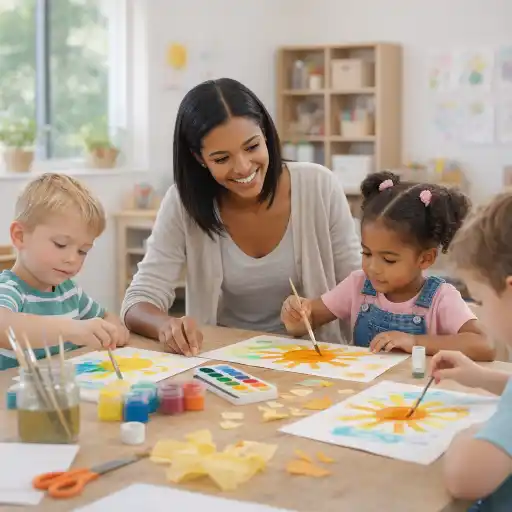
Open-ended art begins with a flexible invitation. A provider might place large paper, washable paint, brushes, sponges, shells, cardboard shapes, and fabric scraps on a table and say, “What could you design for a summer place?” Children may create a beach, a boat, an imaginary creature, or an abstract pattern. Each response is valid because the purpose is exploration and communication.
Teachers can preserve structure while protecting choice by establishing clear boundaries:
- Define the available space and materials.
- Model safe tool use without demonstrating one “correct” image.
- Offer a short prompt rather than a template.
- Invite children to select, combine, and change materials.
- Discuss the process through descriptive language.
For example, the sellable Design Your Own Beach Towel resource can become an open-ended design experience when children choose symbols, colors, patterns, and imaginary uses for their towels. The resource provides a helpful starting structure, while the children’s decisions keep the work personal. Providers can ask, “Who might use this towel?” or “What pattern would help someone find it at the beach?”
How can a beach-towel design invitation build planning skills?
Designing a beach towel is an accessible way to connect art with intentional planning. Begin by presenting the resource as a design challenge rather than a coloring assignment. Invite children to think about the towel’s purpose, audience, size, colors, symbols, and patterns. A short conversation or sketch can help children externalize their plans before they begin.
- Imagine: Ask children what a beach towel might show or communicate.
- Choose: Offer crayons, markers, paint, collage pieces, stamps, or recycled fabric textures.
- Plan: Encourage a quick drawing, verbal explanation, or arrangement of materials.
- Create: Allow children to work at their own pace and modify the design.
- Reflect: Invite each child to describe one decision and one change they made.
The goal is not artistic realism. A child may design a towel covered in suns, a map of an imaginary island, family symbols, or a pattern made from repeated shapes. These choices reveal emerging concepts of representation, sequence, symmetry, and visual communication.
To extend the invitation, add clean cardboard, paper tubes, fabric scraps, large lids, and packaging pieces for printing or collage. Recycled materials create additional design possibilities while encouraging children to see objects as flexible resources. This approach is often called junk art, and it can support children’s creativity and fine-motor development as they transform everyday materials. Adults can document the work with a photograph and a child’s words: “I put the blue lines together because they are waves.”
Which summer materials and techniques invite experimentation?
Varied materials help children investigate cause and effect. Summer art can include wet chalk, frozen paint, ice painting, bubble prints, nature brushes, splatter painting, or large outdoor canvases. Each technique changes how children control movement and anticipate results.
- 🧊 Ice painting: Children use colored ice to observe melting, dripping, and color mixing.
- Wet chalk: Chalk changes texture and intensity when dipped in water.
- Nature printing: Leaves, flowers, or grasses create varied marks and textures.
- Bubble printing: Children explore air, bubbles, and accidental patterns.
- Recycled stamping: Bottle caps, cardboard tubes, lids, and packaging produce unexpected shapes.
- Large-scale painting: Brushes, sponges, rollers, and hands support whole-body movement.
Offer a manageable number of choices so the table remains inviting rather than overwhelming. Three to six materials can provide substantial variety. Rotate tools when interest changes, and place examples of textures or techniques nearby without displaying a model that children must copy.
Safety remains part of thoughtful planning. Use clean, non-toxic, age-appropriate materials; inspect recyclables for sharp edges; supervise water and messy play closely; and adjust small-part access for younger children. State requirements vary - check your state licensing agency. Prepare smocks, washable surfaces, shade, and a predictable cleanup routine so children can focus on investigation.
How can teachers support creativity without taking over?
The educator’s role is to prepare, observe, listen, and extend. During open-ended art, resist the understandable urge to improve a child’s design or guess what it represents. Instead, describe what you notice: “You pressed the lid three times,” or “You placed the green pieces around the edge.” Descriptive language validates effort and encourages children to explain their thinking.
Open-ended questions should be brief and purposeful:
- “What are you planning to try?”
- “What changed when you added water?”
- “How could you make another pattern?”
- “What might this recycled piece become?”
- “Would you like to keep your design the same or change it?”
Wait after asking a question. Children need time to formulate a response, demonstrate an idea, or decide that they do not want to answer verbally. Accept drawings, gestures, home languages, and demonstrations as meaningful communication.
Teachers can also scaffold without directing by adding one relevant tool. If children are making beach-towel patterns, add a ruler for lines, a stamp for repetition, or a basket of textured fabric. If children are struggling to begin, offer a choice between two materials rather than supplying a finished example.
Documentation should capture planning and revision, not only the final artwork. Record children’s predictions, quotes, collaborations, and changes. These observations help providers plan follow-up invitations and communicate the learning value of art to families.
How can programs avoid common pitfalls and extend learning?
Open-ended art works best when the environment is thoughtfully limited and adults share consistent expectations. Several common mistakes are easy to prevent:
- Too many materials: Rotate a focused selection so children can make meaningful choices.
- A single sample: Use technique demonstrations, not models that imply one correct result.
- Adult correction: Ask about the child’s intention before offering assistance.
- Cleanup as an afterthought: Label baskets and make returning tools part of the routine.
- Only displaying finished work: Include photographs, child quotes, and process notes.
Directors can support quality by creating a shared materials policy, scheduling regular safety inspections, and giving staff time to reflect on invitations. Teams might ask: Which children participated? Which materials sustained attention? What adaptations increased access? What new question emerged?
Learning can extend beyond the art table. Children can compare towel patterns, count repeated shapes, dictate a description, create a pretend beach shop, or design a container that protects artwork outdoors. Families can be invited to discuss patterns and symbols from home without requiring donations or expensive supplies.
For additional professional learning, Art from the Heart for Preschoolers Buy Now $35.00 explores how free-form art supports confidence and decision-making, while Open Heart, Open Art Buy Now $16.00 connects open-ended expression with social-emotional development. Lesson Planning for Preschoolers Buy Now $24.00 can help providers connect creative invitations with developmentally appropriate planning, and Classroom Setup for Child Care Buy Now $24.00 offers guidance for arranging welcoming spaces and accessible materials.
Conclusion
How can open-ended summer art encourage planning and creativity? It does so when providers create intentional invitations, offer varied and safe materials, protect children’s decision-making, and document the thinking that unfolds. A beach-towel design can be more than a seasonal craft: it can invite children to imagine, plan, choose, revise, communicate, and take pride in an original idea.
Start with one small invitation this week. Provide the Design Your Own Beach Towel resource, add a few open-ended art tools and recycled materials, ask one thoughtful question, and observe what children do. When the process matters as much as the product, summer art becomes a joyful context for #planning, #problem-solving, language, independence, and creative expression.
- CDA Home Visitor Subject Area 3 Part 3 Birth to 5
- CDA Home Visitor Subject Area 2 Part 3 Birth to 5
- CDA Infants/Toddlers: Lesson Planning Made Easy
- From Play to Planning: Building Culturally Competent, Child-Centered Curriculum
- Open Heart, Open Art
- CDA Infants/Toddlers: Health and Safety
- Art from the Heart for Preschoolers: Open Ended Art Projects that Build Self-Esteem
- Texas Director Credential
- Montessori Cultural Activities: Exploring the World Through Play and Learning
- Supporting Families and Caregivers in Language and Literacy
- Supporting Children's Self-Esteem
- CDA Certification en Español: Recursos y Consejos para Educadores Bilingües
- 10 Ejemplos de Cómo la Cultura Influye en el Desarrollo Infantil
- Cómo Empezar una Guardería en Casa: Requisitos y Pasos
- Regulaciones de Cuidado Infantil en Maryland para Centros y Hogares de Cuidado Infantil Familiar
- Proporciones de Cuidado Infantil y Tamaños de Grupo por Edad en Maryland (Guía Rápida para Centros y Hogares)
- Proporciones de Cuidado Infantil y Tamaños de Grupo por Edad en Nueva Jersey (Guía Rápida para Centros y Hogares)
- Proporciones de Cuidado Infantil y Tamaños de Grupo por Edad en Virginia (Guía Rápida para Centros y Hogares)
- Lista para Abrir una Guardería en Casa en Dakota del Norte: Cómo Empezar
- Las Mejores Ideas de Excursiones para Guarderías en Dakota del Norte
- Summer Field Trips for Daycares in Illinois
- Labor Day Makers: Creative Projects That Get Pre-K Kids Thinking and Building
- How Can Recycled Materials Create Engaging Learning Centers?
- How Can Open-Ended Summer Art Encourage Planning and Creativity?
- How Can Flag Design Help Children Explore Symbols, Patterns, and Individual Expression?
- How Can You Plan Patriotic Crafts Without Limiting Children’s Creativity?
- How Do Cut-and-Paste Activities Build Fine-Motor Control and Planning?
- How Can a Simple Watermelon Craft Build Fine-Motor and Language Skills?
- How Can You Set Up Learning Centers in a Preschool Classroom?
- How Can Educators Respond When a Child Says Their Drawing Is “Nothing”?
