Meaningful Juneteenth art experiences can help children explore freedom, belonging, and community without reducing the holiday to a decoration or a party theme. Pair a thoughtful classroom plan with Strength in Differences: Cultural Diversity  Buy Now $24.00 to deepen staff knowledge about cultural competency and inclusive practice while earning a three-hour online training certificate, subject to your program and state requirements.
For educators who want additional support with process art, Art from the Heart for Preschoolers Buy Now $35.00 offers strategies for using open-ended creativity to strengthen children’s confidence, agency, and self-expression.
Why does respectful Juneteenth art matter in early childhood?
Juneteenth commemorates June 19, 1865, when news of emancipation reached enslaved people in Galveston, Texas. For young children, the goal is not to present graphic or overwhelming historical detail. The goal is to introduce truthful, accessible ideas about freedom, fairness, resilience, and community while honoring Black history and joy.
Art is especially valuable because children can communicate through color, movement, texture, symbols, and collaborative work before they have the language to explain complex historical concepts. A child may not define emancipation, but they can discuss what it means to feel free, cared for, included, or able to make choices.
Respectful planning also protects children from stereotypes and tokenism. Juneteenth should not be treated as a one-day “culture activity” disconnected from the rest of the curriculum. Instead, it can become one part of an ongoing commitment to representation, anti-bias practice, family partnership, and culturally responsive teaching. For a broader perspective on introducing cultural observances in early childhood settings, see this overview of Shavuot, Eid al-Adha, and Juneteenth.
- Center Black voices, contributions, creativity, and joy.
- Use accurate, age-appropriate language.
- Prioritize children’s ideas over identical finished products.
- Connect art to relationships, literacy, music, and community.
How can providers introduce Juneteenth through child-centered language?
Begin with a brief explanation that is honest, hopeful, and concrete. You might say, “Juneteenth is a day we remember freedom. Long ago, some people were not treated fairly and were forced to work without freedom. On June 19, 1865, many enslaved people in Texas learned they were free. Today, people remember, learn, and celebrate freedom and community.” Adapt the wording to the children’s age and prior knowledge.
Children may ask why people were enslaved, why the news arrived late, or whether unfairness still happens. Avoid dismissing questions or offering more detail than the group can process. Acknowledge the question, answer briefly, and return to a meaningful classroom value: “That was unfair. People worked and hoped for freedom. We can practice fairness by including others, taking turns, and using kind words.”
Pair conversation with a picture book, photograph of a community celebration, song, or artwork by a Black artist. Ask open-ended questions rather than testing historical recall:
- “What do you notice?”
- “How are people showing joy or care?”
- “What helps a community feel welcoming?”
- “What would you like to create?”
Children who prefer not to speak can point, draw, move, or dictate their ideas. This flexibility supports toddlers, preschoolers, dual language learners, and children with communication differences.
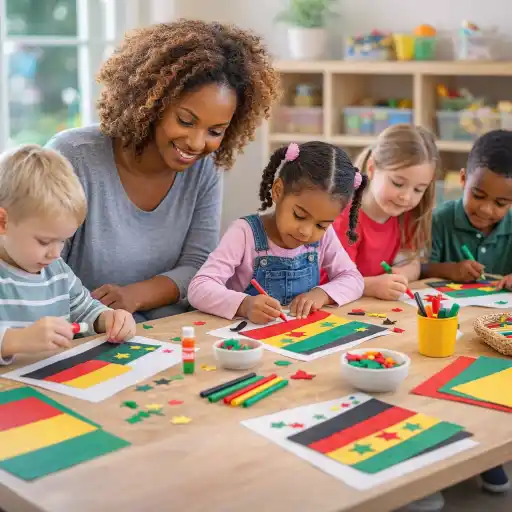
How can a Juneteenth Crown become a meaningful art experience?
The Juneteenth Crown can be used as an invitation to explore identity, freedom, and community—not as a costume that imitates or caricatures a culture. Present the crown as a creative symbol children may personalize with colors, shapes, words, or images that represent joy, hope, family, or belonging.
Before beginning, show a simple example without requiring children to copy it. Invite children to choose from paper strips, crayons, markers, collage materials, stickers, fabric scraps, and safe natural materials. If using Juneteenth colors or flag-inspired elements, explain that colors and symbols can carry meaning while emphasizing that children may also make personal choices.
- Measure a paper band gently around each child’s head and secure it with tape or staples kept away from children.
- Invite children to decorate the band using open-ended materials.
- Ask each child whether they want to name or dictate an idea for the crown.
- Display the crowns with captions such as “I added stars because my family celebrates together.”
Never require children to wear the crown. Offer a tabletop display, puppet prop, or collaborative mural as alternatives. Avoid describing crowns as traditional Juneteenth clothing unless a family or community source specifically provides that context. The learning is in children’s agency and reflection, not in producing a supposedly authentic object.
🖍️ A helpful prompt is: “Decorate your crown with something that helps people feel proud, free, loved, or connected.”
How can programs extend the crown into process art and curriculum?
The crown can launch a broader inquiry rather than functioning as an isolated craft. Invite children to compare shapes, count decorations, identify patterns, and describe textures. These extensions support fine-motor development, early mathematics, vocabulary, narrative language, and social-emotional learning.
- Community crown mural: Children design paper “crown jewels” representing family strengths or classroom promises. Combine them into one group display.
- Freedom collage: Children add drawings of choices they value, such as learning, playing, singing, or spending time with family.
- Joy gallery: Pair artwork with children’s dictated statements about music, food, movement, friendship, and celebration.
- Story and art center: Read a carefully selected picture book, then invite children to create a scene showing welcome, reunion, or hope.
- Music connection: Use a simple call-and-response about fairness and community, followed by drawing or movement.
Keep the emphasis on process. Children’s crowns will not look alike, and that is a strength. Comment on decisions rather than judging products: “You chose many textures,” “You worked carefully to attach that shape,” or “Tell me about this part.” Avoid correcting children’s interpretations unless safety, accuracy, or respect requires it.
Document learning with photographs, brief observations, and children’s words. Directors can use these notes to show how a cultural experience connected to developmental goals without turning the celebration into a worksheet-driven lesson.
How can educators avoid common mistakes when planning Juneteenth art?
Even well-intentioned activities can become uncomfortable when they rely on stereotypes, flatten history, or prioritize appearance over meaning. A reflective planning process helps staff identify concerns before children enter the experience.
- Tokenism: Avoid presenting Juneteenth as the only time Black history or Black creativity appears. Add representative books, artists, music, and family perspectives throughout the year.
- Party without context: Balance joyful art with a short, truthful explanation of freedom and fairness.
- Mandatory participation: Offer choices for children who do not want to wear a crown, discuss family history, or participate in a public display.
- Imitation without explanation: Do not ask children to copy hairstyles, clothing, accents, or cultural practices as pretend play.
- Product-centered teaching: Avoid templates that make every crown identical. Open-ended materials better support agency and authentic expression.
- Assuming family experiences: Invite participation without suggesting that every Black family celebrates Juneteenth in the same way.
Before sharing photographs, obtain permission and consider whether children or families want their work publicly displayed. Use respectful language in newsletters and avoid claiming that one activity represents an entire culture. If staff feel uncertain, consult reliable educational resources and seek guidance from families or community partners rather than asking one Black colleague to carry the responsibility alone.
Food, visitors, and public events require additional planning. State requirements vary - check your state licensing agency, follow allergy and supervision procedures, and apply your program’s consent policies.
How can families and staff become partners in the experience?
Family engagement makes Juneteenth learning more authentic and helps programs avoid assumptions. Send a short, optional invitation asking whether families would like to recommend a book, song, artist, family tradition, or community event. Make it clear that families may participate in any way—or not participate at all.
Use children’s home languages whenever possible. A family might contribute a word for freedom, joy, family, or welcome. Staff can display the word beside the child’s artwork and invite the child to teach its pronunciation. These small practices affirm that cultural knowledge belongs in the classroom.
Staff preparation should include more than assembling materials. A brief team conversation can address:
- What do we want children to understand?
- What language will we use if children ask difficult questions?
- How will we offer participation choices?
- Whose perspectives are represented in our books and materials?
- How will we respond if a child makes a biased or hurtful comment?
Consider pairing the Juneteenth Crown with Equity-Centered Communication in ECE Buy Now $55.00, which focuses on culturally responsive communication, listening to children, and partnering with linguistically diverse families. Programs seeking deeper family collaboration may also explore Bridging Cultures: Family Communication & Collaboration Buy Now $55.00.
Keep the family message concise: explain the learning purpose, list materials, describe participation choices, and provide a contact person for questions. Trust grows when families see that the program welcomes feedback and does not expect personal stories or unpaid cultural labor.
What should providers remember when celebrating Juneteenth through art?
Respectful Juneteenth art begins with a clear purpose: help children encounter freedom, fairness, Black history, joy, and community in developmentally appropriate ways. The Juneteenth Crown can be a strong sellable resource when it is presented as an open-ended invitation rather than a required costume or a promise of cultural authenticity.
Choose accurate language, use high-quality books and images, invite family knowledge, and allow children multiple ways to participate. Connect the crown to storytelling, music, movement, mathematics, and children’s own ideas. Most importantly, evaluate whether the experience increases belonging and curiosity rather than simply producing a seasonal display.
- Teach the meaning of Juneteenth before introducing the art activity.
- Center children’s choices, voices, and comfort.
- Represent Black culture throughout the year, not only on one holiday.
- Use process-focused feedback instead of judging appearance.
- Invite families as partners while respecting boundaries and differences.
- Use professional learning to strengthen staff confidence and reflection.
When thoughtfully planned, a crown becomes more than paper and decorations. It becomes a prompt for children to express what freedom, pride, welcome, and community can look and feel like—and a practical opportunity for educators to build a more inclusive early learning environment.
Which ChildCareEd courses can support this work?
- Strength in Differences: Cultural Diversity Buy Now $24.00 — explores cultural competency, acceptance, diverse perspectives, and inclusive child care environments.
- Art from the Heart for Preschoolers Buy Now $35.00 — supports open-ended art, confidence, decision-making, and process-focused practice.
- Equity-Centered Communication in ECE Buy Now $55.00 — develops culturally responsive listening and collaboration with children, families, and colleagues.
- Bridging Cultures: Family Communication & Collaboration Buy Now $55.00 — offers strategies for culturally and linguistically responsive family partnerships.
- From Play to Planning: Building Culturally Competent, Child-Centered Curriculum Buy Now $55.00 — connects emergent curriculum, play, anti-bias materials, and culturally responsive planning.
Course eligibility, training hours, and licensing acceptance depend on your state, registry, role, and employer. Confirm details with the appropriate licensing or workforce agency before relying on a course for a formal requirement.
Conclusion: How can a Juneteenth Crown support respectful learning?
A Juneteenth Crown can support meaningful early learning when it is embedded in truthful conversation, open-ended art, family partnership, and ongoing representation. Keep the experience joyful without erasing history, and keep it child-centered without asking children to perform culture. With thoughtful preparation, educators can help children explore freedom, fairness, identity, and belonging in ways that are creative, accessible, and respectful.
- Many Colors, One Canvas: MD ECE Conference
- From Play to Planning: Building Culturally Competent, Child-Centered Curriculum
- Power of Art: Bldg Self-Esteem & Positive Behavior for ALL Abilities
- Children at the Wheel: Emergent Curriculum
- CDA Bridge Bundle: Family Child Care without Portfolio Review
- Art from the Heart for Preschoolers: Open Ended Art Projects that Build Self-Esteem
- CDA Bridge Bundle: Infant/Toddler without Portfolio Review
- Creating Engaging and Meaningful Learning Experiences
- Texas Director Credential
- Montessori Cultural Activities: Exploring the World Through Play and Learning
- Juneteenth History and Activities
- Celebrate Juneteenth in Baltimore
- What is Shavuot, Eid al Adha & Juneteenth
- CDA Certification en Español: Recursos y Consejos para Educadores Bilingües
- Cómo Abrir Una Quardería En Casa Sin Dinero?
- Celebrate Juneteenth with Kids: Songs, Stories, and Art
- Normas de Licenciamiento de Cuidado Infantil en Virginia para Centros Diurnos Infantiles y Hogares Diurnos Familiares
- Proporciones de Cuidado Infantil y Tamaños de Grupo por Edad en Virginia (Guía Rápida para Centros y Hogares)
- Teaching Kids About Juneteenth Through Activities and Crafts
- Juneteenth Activities for Kids: Crafts, Books, and Learning Ideas
- Celebrando la amistad en el cuidado infantil durante el Día de los Mejores Amigos
- Cómo simplificar la capacitación para sus empleados de daycare
- How can child care programs honor Juneteenth in age-appropriate, respectful ways?
- Mawlid Around the World: How Kids Can Explore Different Traditions and Celebrations
- How Can Early Childhood Programs Introduce Juneteenth in Developmentally Appropriate Ways?
- How Can Child Care Programs Celebrate Juneteenth Through Respectful, Child-Centered Art?
- How Can Coloring Pages Spark Meaningful Historical Conversations About Juneteenth?
- How Can Juneteenth Symbols Build Visual Memory in Young Children?
- How Can Meaningful Juneteenth Vocabulary Support Early Writers?
- How Can Drawing and Dictation Help Children Respond to Juneteenth?
