Do you ever walk past a bulletin board and feel the same shaped penguin, tree, or handprint repeating across the room—and wonder what the children actually learned? When every child’s work is made to match a model, programs lose opportunities to build decision-making, fine motor growth, and identity. For a practical next step, consider ChildCareEd’s Open Heart, Open Art  Buy Now $16.00 or the hands-on workshop Art from the Heart for Preschoolers Buy Now $35.00, both designed to help staff shift from identical crafts to developmentally rich, open-ended practice while documenting social-emotional gains and earning training hours.
What happens when children’s artwork all looks the same?
When classroom art is primarily teacher-directed and tightly modeled, the immediate visual effect may be tidy and parent-pleasing—but the learning behind the surface can be shallow. Reproducing identical products emphasizes following steps over exploring materials, and it narrows opportunities for children to make choices, develop #fineMotor control, and practice expressive language. Children who repeat a template miss practice with cause-and-effect (what happens if I mix two colors?), iterative problem solving (how do I fix it if the glue slides?), and symbolic development (how do I show feelings with color or texture?).
From a program perspective, the risks include diminished evidence of individualized learning and weaker documentation for curriculum planning. Teachers may unintentionally teach that there’s a single “right” answer, which can suppress risk-taking and reduce confidence. For responsive practice, mix modeled technique lessons with open invitations so children get both skill instruction and creative practice. This is a key idea explained in ChildCareEd’s overview of Process Art or Product Art.
Why it matters: children develop as thinkers and communicators when their work reflects choices, not copies; diverse outcomes show learning trajectories rather than conformity.
Why does variety in children’s art matter for development?
Open-ended creation supports multiple domains at once. When children select tools and decide how to use them, they exercise fine motor coordination, bilateral hand use, and the wrist/finger adjustments necessary for later writing. Choosing colors and materials sparks language: children describe plans, negotiate with peers, and narrate meaning. From an emotional lens, original work validates a child’s voice—seeing a unique piece displayed communicates: your ideas matter.
Research and practical guidance show that process-focused activities strengthen flexible thinking and persistence. For example, children experimenting with paint mixing are engaging in informal science (prediction, observation, iteration). Artist-development literature and early childhood frameworks describe predictable stages of mark-making (scribble → schematic → representational). Respecting those stages means offering invitations that match children’s capacities rather than imposing adult models (see Marvin Bartel’s review of developmental stages and classroom examples in the references).
Practical benefits for programs: variety helps you individualize assessment, plan next steps, and create authentic portfolios. Use documentation (photos, child quotes) to show families how a messy table equals meaningful learning—state requirements vary - check your state licensing agency.
How can teachers set up a classroom so art outcomes are naturally diverse?
Intentional environment design makes open-ended art manageable in busy programs. Start with zones and systems: low shelves with labeled bins, one predictable "messy" table, drying racks, and a documentation station. ChildCareEd’s Classroom Setup for Child Care Buy Now $24.00 course offers concrete ideas for arranging materials so children can access them independently and staff can supervise without interrupting creative flow.
- Offer 1–2 invitations at a time to reduce overwhelm.
- Rotate loose parts and media every 2–6 weeks to renew curiosity.
- Teach a short clean-up routine as part of the art experience.
- Design a photo/documentation flow: photograph process, note a child quote, and file for portfolios.
- 🎨 Use trays or simple prompts (e.g., "Make a sound-picture") rather than step-by-step templates.
Staff routines matter: plan a short demonstration of a technique (scissor control, how to press clay) and then step back. Offer scaffolded language starters like, "I notice you used lots of blue — tell me about that," so teachers extend thinking without taking over the product. For programs seeking a course that links art to social-emotional learning and behavior strategies, Power of Art: Building Self-Esteem Buy Now $35.00 shows how art invitations can be adapted for diverse abilities while supporting positive behavior.
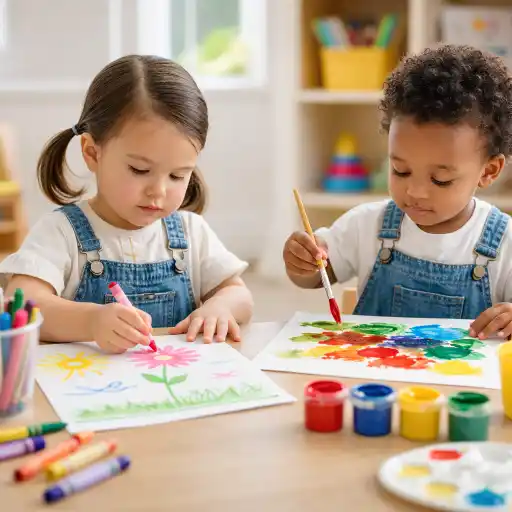
How do we balance product projects and open-ended process without creating chaos?
Balancing is practical, not ideological. Children benefit from both teacher-directed practice (for fine-motor drills and sequencing) and frequent open invitations (for choice and creativity). A simple program rhythm could be: primarily process-based centers during free-choice time, one focused skill-building session per week (teacher-led), and occasional product-style projects for family events.
Common mistakes and how to avoid them:
- 🛑 Forcing uniform results — instead, offer a sample idea and multiple material options.
- ⚠️ Over-helping or finishing children’s work — instead, ask one open question and model a technique briefly.
- ❗Not communicating goals with families — instead, send photos and a one-line learning caption.
Try these staff strategies: co-plan product projects so they include choice points (color, pattern, attachment method), set expectations with families before holiday crafts, and use documentation to show the learning behind both product and process pieces. For communication skills that support these conversations, ChildCareEd’s Open Ears: Listening in Child Care Buy Now $16.00 provides frameworks for discussing curriculum choices with families respectfully and clearly.
How should programs measure impact, involve families, and handle common questions?
Measuring impact doesn’t require heavy paperwork. Use short, repeatable documentation: a photo, a child quote, and one observed skill (e.g., used tongs independently, used a new color word). Track 1–2 goals per child for 2–4 weeks and use that evidence in staff reflections and family notes.
Family involvement strategies:
- Share one process-photo each week with a one-sentence caption about what the child practiced.
- Host a short demonstration night where families experience an open-ended invitation.
- Provide a one-page handout explaining the difference between process and product art and why both matter.
FAQ (quick):
- Q: "Will parents reject messy work?" A: Some may. Use photos and captions to reframe the value as learning evidence.
- Q: "How often should open-ended art happen?" A: Aim for 1–2 substantial process invitations weekly and brief daily invitations when possible.
- Q: "How do we keep small parts safe?" A: Use age-appropriate materials, labeled bins, and follow your safety checks—state requirements vary - check your state licensing agency.
- Q: "Where can staff learn more?" A: Courses like Art from the Heart for Preschoolers Buy Now $35.00 and Open Heart, Open Art Buy Now $16.00 provide practical invitations, documentation methods, and strategies to strengthen children’s #creativity and #confidence.
Conclusion
When children’s artwork is allowed to vary, classrooms become evidence-rich spaces where decisions, language, and motor skills are visible. Cookie-cutter crafts may look uniform and tidy, but they substitute conformity for creative growth. Small shifts—designing accessible materials, offering one open invitation at a time, documenting process, and communicating with families—yield strong returns in children’s #creativity, #confidence, and classroom engagement. Consider staff training to support the change: Open Heart, Open Art Buy Now $16.00, Art from the Heart Buy Now $35.00, Classroom Setup for Child Care Buy Now $24.00, Power of Art Buy Now $35.00, and Open Ears Buy Now $16.00 are practical next steps. Keep experimenting, document what children do, and celebrate every unique creation—your program and the children will be stronger for it.
- 🌙 ¿Cómo afecta el tiempo frente a las pantallas el sueño y el comportamiento infantil? 😴
- 🩺 Cumplimiento de Salud e Inmunización en Cuidado Infantil de Nevada ✔️
- Open-Ended Art Activities That Build Confidence in Preschoolers
- Lista para Guardería en Casa en Illinois: Cómo Iniciar una Guardería en el Hogar
- Cómo Ser Maestra de Preescolar en Illinois
- Why Should Children’s Artwork Not All Look the Same?
- Open-Ended Art Activities for Preschoolers: 15 “What Can You Make?” Invitations
- Crayon Colors Meaning: Favorite Color, Feeling, or Just the Crayon They Grabbed?
- Should I Teach My Blind Child Colors? Why Do Color Words Still Matter?
- How Can Child Care Programs Celebrate Juneteenth Through Respectful, Child-Centered Art?
- How Can Juneteenth Symbols Build Visual Memory in Young Children?
- How Can Child Care Providers Introduce Reptiles Through Art, Observation, and Conversation?
- How Can Dinosaur Coloring Become a Science and Language Experience?
- How Can Ocean Art Build Marine Vocabulary and Curiosity in Young Children?
- What Should You Do When a Child Wants to Remove Their Contribution from Group Artwork?
- How Can Educators Respond When a Child Says Their Drawing Is “Nothing”?
- Should You Ask Children’s Permission Before Displaying Their Artwork?
- How Can One Preschool Activity Offer Three Meaningful Ways to Participate?
- When Rain Erases the Chalk, How Can Disappearing Art Become a Science Investigation?
