Patriotic celebrations can invite meaningful exploration without turning every child’s artwork into an identical red, white, and blue product. Pair a flexible resource such as the 4th of July Crown Craft Buy Now $0.25 with open-ended choices, and consider Art from the Heart for Preschoolers: Open Ended Art Projects that Build Self-Esteem Buy Now $35.00 to strengthen your classroom practice through focused professional learning about process art, decision-making, and children’s confidence.
Why does the balance between structure and freedom matter?
Holiday crafts can be joyful, efficient, and developmentally useful, yet they can also unintentionally communicate that there is only one acceptable way to create. When adults preassemble materials, demonstrate an exact model, and correct children’s choices, the finished display may look polished while children practice compliance more than #creativity.
A stronger approach treats the holiday theme as an invitation rather than a restriction. Children may explore colors, symbols, patterns, movement, and personal meaning while adults provide safe materials, thoughtful questions, and enough time. NAEYC describes process art as an experience in which children investigate materials without working toward a predetermined product; this supports expressive language, social-emotional development, and thinking skills.
This balance also respects the realities of child care. Directors need manageable plans, families may appreciate a seasonal keepsake, and educators must supervise tools and transitions. A planned craft can supply a useful starting structure, while open choices preserve children’s agency. The goal is not to eliminate teacher-guided projects, but to use them selectively and avoid confusing uniformity with learning.
How can you use the 4th of July Crown Craft as an open invitation?
The 4th of July Crown Craft Buy Now $0.25 offers a clear sequence—color, cut, assemble, and wear—that can support fine-motor practice and a celebratory classroom experience. The printable does not need to determine the final appearance. Present it as one possible foundation for children’s ideas.
- Offer crayons, markers, paint, stickers, collage scraps, and large decorative shapes.
- Invite children to select colors and decide whether to emphasize stars, stripes, patterns, names, or invented symbols.
- Provide the template, blank paper strips, and recycled materials so children can modify the shape or create a companion design.
- Let children choose whether to wear the crown, display it, or incorporate it into dramatic play.
- Ask, “What would you like your crown to show?” rather than, “What color goes here?”
For younger children, prepare some cutting or assembly steps while preserving meaningful choices. Older preschoolers may cut, combine materials, and redesign the band. The resource can therefore function as a scaffold rather than a script.
Children’s responses may range from a traditional flag-inspired crown to an imaginative celebration crown filled with invented marks. Both outcomes are valid when the learning emphasis remains on exploration, communication, and ownership.
What learning goals can patriotic crafts support?
A patriotic craft becomes more meaningful when educators identify the developmental processes beneath the theme. Cutting, coloring, arranging, and fastening can support hand strength, bilateral coordination, visual-motor integration, and planning. Talking about choices builds vocabulary and gives children a reason to explain, compare, and listen.
- 🖍️ Fine motor: Children may squeeze glue, manipulate stickers, make controlled marks, and practice scissor skills.
- Language: Invite descriptions of texture, color, sequence, and personal meaning.
- Early math: Count stars, compare lengths, notice patterns, or measure a paper band for fit.
- Social-emotional growth: Children practice decision-making, persistence, flexible thinking, and pride in their own work.
- Social studies: Discuss community celebrations and symbols in developmentally appropriate, inclusive ways.
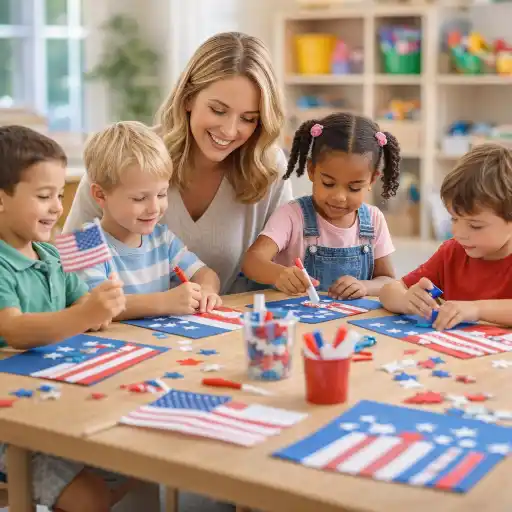
Keep the conversation open and avoid presenting national symbols as a test of loyalty or a single family experience. Families have varied histories, identities, and relationships to patriotic holidays. Children can participate through color, design, movement, or storytelling without being required to recite beliefs or share personal experiences.
Documentation should capture the process. A photograph, child quote, and brief observation—such as “Jordan tested three adhesives before choosing tape”—can show more learning than a row of identical crowns.
How can you preserve creativity while maintaining classroom routines?
Open-ended art does not require unlimited materials or an unstructured room. Predictable systems make freedom possible. Set up a small invitation with accessible supplies, a defined work area, and a simple cleanup routine. Choose two or three material options at a time rather than placing every supply on the table.
Consider a sequence such as:
- Introduce the celebration and name the available materials in less than five minutes.
- State one or two boundaries, such as “Glue stays on the paper” and “Scissors remain at the table.”
- Demonstrate tool use without demonstrating one correct finished product.
- Allow sustained work time and observe before intervening.
- Invite children to photograph, describe, display, or revise their creations.
- Teach cleanup as part of the artistic process.
Small-group rotations can reduce crowding and allow adults to support children who need assistance. A quiet alternative—drawing, arranging loose parts, or observing peers—can help children who do not enjoy messy textures or busy celebrations. Adapt tools with larger handles, nonslip surfaces, or pre-cut pieces when appropriate.
Safety remains nonnegotiable. Use age-appropriate, washable, non-toxic materials; supervise scissors and small parts; check adhesives and decorations for hazards; and follow program policies. State requirements vary - check your state licensing agency. The U.S. Consumer Product Safety Commission and ACMI provide additional guidance for selecting and labeling art materials.
Which teacher practices protect children’s ownership?
Adult language can either expand or narrow a child’s creative possibilities. Descriptive, process-focused comments communicate that the child’s thinking matters. Try “I notice you layered three textures” or “You changed your plan when the paper tore.” These statements recognize effort and strategy without ranking the result.
Open questions can extend thinking:
- “What are you noticing?”
- “How did you decide where to place that shape?”
- “What might you try next?”
- “Would you like help, or would you like more time?”
Avoid drawing on children’s work, moving pieces without permission, or finishing difficult steps simply to make the display look complete. If a child asks for help, offer the smallest useful scaffold: hold the paper steady, model one cut on scrap paper, or provide an alternative attachment method. This supports access while preserving authorship.
Be cautious with praise that evaluates appearance, such as “That is the prettiest crown.” Specific feedback is more equitable because it notices process rather than comparing children. It also supports children who may use adapted tools, nontraditional colors, or unconventional designs.
Directors can reinforce this practice through staff reflection. Ask educators to review photographs and discuss where children made decisions, persisted, collaborated, or communicated. The goal is a shared culture in which displays represent children’s thinking—not adult precision.
How can you avoid common mistakes in patriotic craft planning?
Even experienced providers can feel pressure to produce a coordinated holiday display. A few planning adjustments protect both efficiency and creativity. For New York City educators balancing family expectations with holiday-care demands, this guide to surviving the holiday season as a childcare educator offers additional strategies for support and work-life balance.
- Mistake: Showing a completed sample for children to copy. Better: Show tools and techniques, or display several possibilities without labeling one as correct.
- Mistake: Offering every material at once. Better: Curate a small selection and rotate materials as interest develops.
- Mistake: Completing children’s cutting or gluing to save time. Better: Prepare components in advance and let children make the decisions that remain.
- Mistake: Assuming every family celebrates the holiday in the same way. Better: Use inclusive language, invite optional participation, and connect the activity to community, symbols, and children’s own ideas.
- Mistake: Treating a craft as the entire lesson. Better: Pair it with books, music, movement, dramatic play, counting, or a conversation about community.
The 4th of July Crown Craft Buy Now $0.25 works especially well when paired with a “design your own” extension, such as adding a personal pattern, creating a parade prop, or inventing a crown for a pretend community celebration. For deeper staff learning, Open Heart, Open Art  Buy Now $16.00 examines how open-ended art supports social-emotional development; Power of Art: Building Self-Esteem and Positive Behavior for All Abilities ONLINE Buy Now $24.00 connects art processes with confidence, guidance, and inclusion; and Inclusive Lessons for Preschoolers Buy Now $16.00 offers strategies for adapting activities for diverse learners.
Conclusion: What is the best way to plan patriotic crafts?
The best patriotic craft plan provides enough structure to make participation accessible while leaving meaningful room for children’s decisions. Use a printable such as the 4th of July Crown Craft as a starting point, not a required final product. Offer carefully selected materials, invite children to design and revise, use descriptive language, document the process, and adapt tools for individual needs.
When educators protect children’s ownership, a holiday activity can support fine-motor development, language, early math, social-emotional growth, and community learning without sacrificing imagination. A classroom display may be less uniform, but it will communicate something more valuable: children are capable thinkers whose ideas deserve space.
Quick FAQ
- Can a teacher-directed craft still be developmentally appropriate? Yes. It can teach sequencing, tool use, or cultural symbols when children retain choices and adults avoid overcorrecting.
- How long should a patriotic craft take? Plan approximately 10–20 minutes for young children, with flexibility for children who want to continue or revisit the invitation.
- What if a child does not want to make a crown? Offer an alternative such as drawing, collage, movement, or designing a different celebration object.
- How should directors explain non-identical artwork to families? Share a process photograph and a short learning note describing the decisions, skills, and language children practiced.
- What should programs verify before using materials? Review age recommendations, supervision needs, allergies, choking hazards, product labels, and applicable licensing guidance.
Five key ideas are woven throughout this article: #creativity, #choice, #process, #selfesteem, and #inclusion.
- From Play to Planning: Building Culturally Competent, Child-Centered Curriculum
- The Montessori Assistant's Toolkit
- Pediatric RSV First Aid & CPR/AED
- CDA Bridge Bundle: Family Child Care
- CDA Bridge Bundle: Family Child Care without Portfolio Review
- Art from the Heart for Preschoolers: Open Ended Art Projects that Build Self-Esteem
- CDA Bridge Bundle: Infant/Toddler without Portfolio Review
- CDA Bridge Bundle: Preschool without Portfolio Review
- Texas Director Credential
- CDA Certification en Español: Recursos y Consejos para Educadores Bilingües
- 💛🧩 ¿Cómo puedo hacer que mi enseñanza sea inclusiva para los niños con autismo?
- 🚌 ¿Qué Significan las Regulaciones de Transporte de Illinois para las Excursiones Infantiles? 🚦
- 10 Ejemplos de Cómo la Cultura Influye en el Desarrollo Infantil
- Requisitos de Cuidado Infantil en Nueva Jersey para Centros y Proveedores de Cuidado Infantil Familiar
- Proporciones de Cuidado Infantil y Tamaños de Grupo por Edad en Maryland (Guía Rápida para Centros y Hogares)
- Proporciones de Cuidado Infantil y Tamaños de Grupo por Edad en Nueva Jersey (Guía Rápida para Centros y Hogares)
- Proporciones de Cuidado Infantil y Tamaños de Grupo por Edad en Virginia (Guía Rápida para Centros y Hogares)
- ¿Cuál es la Diferencia Entre la Crianza Respetuosa y la Crianza Permisiva?
- Actividades de Otoño Fáciles para Preescolares esta Temporada
- Lista para Guardería en Casa en Illinois: Cómo Iniciar una Guardería en el Hogar
- Cómo Trabajar en el Cuidado Infantil en Carolina del Norte: Requisitos y Pasos
- Cómo Trabajar en el Cuidado Infantil en California: Requisitos y Pasos
- Celebrando la amistad en el cuidado infantil durante el Día de los Mejores Amigos
- How can North Dakota providers celebrate America’s 250th in age-appropriate ways?
- Canciones, juegos y preguntas de círculo para niños
- Cómo simplificar la capacitación para sus empleados de daycare
- How Can You Plan Patriotic Crafts Without Limiting Children’s Creativity?
- How Do Wearable Crafts Support Fine-Motor Skills and Classroom Celebration?
