Fall art can celebrate the season without turning every child’s work into the same pumpkin, leaf, or turkey. With open-ended invitations, children explore materials, make choices, and bring their own observations and stories to the table. For practical support in designing developmentally appropriate experiences, explore ChildCareEd’s Lesson Planning for Preschoolers  Buy Now $24.00; it can help you plan purposeful activities that respond to children’s interests and learning needs.
Why does open-ended fall art matter?
Seasonal themes are an easy way to connect classroom experiences with what children notice outdoors: changing leaves, cooler air, seed pods, pumpkins, and shifting light. But when an art activity has a fixed model and every child is expected to reproduce it, children may focus more on getting the “right” result than on exploring their own ideas. Open-ended art shifts the emphasis to the experience: choosing, testing, revising, and expressing.
NAEYC describes process-focused art as child-directed exploration without a sample to copy or a single correct outcome. Children can work with the same materials and create entirely different things. This freedom can make art a meaningful context for #creativity, fine-motor practice, language, planning, and problem-solving. A child rubbing a leaf may notice its veins; another may turn the rubbing into a map, an animal, or a pattern.
That doesn’t mean every adult-led project has to disappear. Children may also benefit from learning a specific technique or following a short sequence. The practical shift is to protect regular time when children’s decisions shape the work. Their artwork does not need to look like a pumpkin to show seasonal thinking.
How can you prepare invitations that welcome children’s ideas?
An invitation is a carefully arranged set of materials and a brief prompt—not a craft recipe. A useful setup is manageable, inviting, and flexible. Start with a few materials children can see and reach, then add more if their exploration calls for it. This keeps the table from feeling overwhelming and makes it easier for staff to supervise and support independent choices.
- Offer fall materials such as leaves, paper, washable paint, crayons, play dough, cardboard, fabric scraps, or large seed pods.
- Provide tools with varied effects: brushes, sponges, rollers, droppers, and safe natural objects.
- Use a simple boundary, such as “Paint stays on the paper,” rather than detailed directions about what to make.
- Set out trays, smocks, drying space, and a predictable cleanup routine before children begin.
- Adapt tools and surfaces—such as larger handles or vertical paper—to support different abilities and ways of participating.
Try a short invitation: “Here are some leaves, paint, and paper. What might you discover?” Or place clay beside safe, large nature objects and ask, “What could these materials do together?” The prompt offers a starting point without deciding the destination.
Inspect natural materials and consider children’s ages, abilities, supervision needs, allergies, and program policies. Avoid sharp, moldy, unknown, or choking-hazard items. State requirements vary - check your state licensing agency.
What open-ended fall art ideas can you try?
Fall process art can use familiar materials in surprising ways. The important element is not novelty for its own sake; it is leaving children room to decide how materials will be used. You can offer one invitation for several days and observe how children’s plans change.
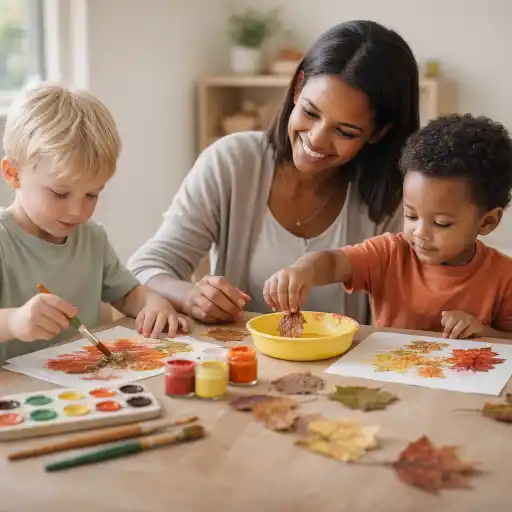
- 🍂 Leaf mark-making: Set out leaves, washable paint, paper, and brushes. Children may paint leaves, press them for prints, drag them through paint, or use them as tools.
- Color-drop exploration: Offer tinted water, droppers, and absorbent paper. Invite children to notice where colors travel, overlap, and blend.
- Fall collage studio: Provide paper, cardboard, glue, fabric, and fallen leaves. Children can tear, layer, arrange, or leave parts unattached.
- Play-dough landscape: Pair dough with large, safe natural materials and let children build a scene, pattern, creature, or something they choose to explain later.
- Rolling-mark investigation: Place paper in a shallow tray with washable paint and suitable rolling objects, then let children tilt the tray and observe the marks.
Use fall colors as an option, not a rule. A child may choose blue for a leaf or use brown to represent a sound or feeling. When children repeat an action—pressing, rolling, or mixing—give them time. Repetition can be the heart of their investigation, not a sign that they need a new instruction.
How can teachers support the process without taking over?
In open-ended art, the teacher’s role is active but not controlling: prepare access, observe closely, and offer support when it extends children’s thinking or participation. Before stepping in, pause and notice what a child is attempting. They may be experimenting, telling a story, or simply exploring a sensation.
Descriptive comments help children connect actions with results without judging their artwork. Try: “You pressed the leaf gently, and the paint made a light mark,” or “You tried the roller after the sponge.” Open questions can invite more thinking: “What are you noticing?” “What could you try next?” or “Would you like more time?”
Avoid drawing on a child’s work, correcting a placement, or finishing a difficult part without permission. If help is requested, offer the smallest useful support: steady the paper, demonstrate how a tool works, or provide an easier-to-grip option. This balance protects agency while making the experience accessible.
Document learning through a photo, a child’s words, and a brief observation. A caption such as “Jordan tested three objects and compared the marks each one made” helps families see the thinking behind a creation that may not look like a recognizable fall object. The focus remains on the child’s #ideas and process, not an adult’s preferred result.
How can you plan, assess, and avoid common pitfalls?
Open-ended art fits naturally into intentional lesson planning. Begin with a broad learning purpose—such as exploring texture, strengthening hand control, using descriptive language, or practicing collaboration—then select materials and prompts that can support it. The learning goal guides your preparation; it does not require every child to make the same thing.
After the activity, reflect on what children actually did. Did they compare colors, try different tools, explain a plan, or negotiate access to shared materials? Use those observations to decide whether to repeat the invitation, change one material, or offer a related experience outdoors. A simple planning note can include the purpose, materials, safety considerations, open question, and one possible follow-up.
Common pitfalls are often fixable with small changes:
- Showing a finished sample: Describe the materials and possibilities instead, so children are not asked to copy.
- Putting out too much at once: Start with a focused selection and add materials in response to children’s exploration.
- Praising only the finished product: Notice choices, persistence, and experimentation, not just whether it looks “pretty.”
- Rushing cleanup or ending the work: Give children time to return, revise, and share their thinking when the schedule allows.
- Assuming all children will participate in the same way: Make room for watching, talking, pointing, working alongside a peer, or using adapted tools.
For further professional learning, ChildCareEd also offers Open Heart, Open Art Buy Now $16.00, focused on open-ended art and social-emotional development; DAP for Preschool Buy Now $24.00, about developmentally appropriate practice; Inclusive Lessons for Preschoolers Buy Now $16.00, with strategies for adapting learning experiences; and Children at the Wheel: Emergent Curriculum Buy Now $25.00, which connects children’s interests with planning.
Conclusion: How can fall art leave room for children’s ideas?
Fall art can celebrate the season without requiring a classroom full of matching pumpkins. Offer accessible materials, a simple invitation, enough time, and supportive language; then let children decide what their work becomes. When educators observe and document the process, they can see how art supports choice, communication, experimentation, motor practice, and problem-solving.
Start with one small change this week: replace a sample to copy with a few fall materials and an open question. The result may be a leaf print, a story, a pattern, or something you never expected—and that is precisely the point. Meaningful seasonal art makes space for children’s own #expression and helps providers plan responsive, engaging classroom experiences.
References
- 19 Fall Process Art Activities for Preschool, Pre-K, and Kindergarten
- How Process-Focused Art Experiences Support Preschoolers
- Open-Ended Art Activities for Preschoolers
- Process Art or Product Art: Which Should Early Childhood Programs Choose?
- Fall Process Art Ideas for Early Childhood Classrooms Inside and Outside
- Process versus Product: Art Experiences in Early Childhood
- How Can Child Care Programs Support Creativity Through Open-Ended Art?
- Art Exploration for Kids: Colors, Textures, and Creativity
- Fall Leaves Play Dough Invitation
- Fall Newspaper Collage Art Project for Kids
- Leaf Painting
- Outdoor Art Activities for Your Preschool Curriculum
- Can You Build It With Fall? Nature-Based Building Challenges for Preschoolers
- Pumpkins, Pinecones, and Leaves: Autumn-Themed STEM Projects
- Art from the Heart for Preschoolers: Resources
- Art from the Heart for Preschoolers: Filtered Resources
- Daily Preschool Lesson Planner: Learning Goals & Observation Forms Buy Now $0.00
- Process Art vs. Product Art: Which Is Better?
- Free Choice Art Activities for Preschoolers
- Free Pre-K & Preschool Classroom Art Lessons & Activities
- CDA Home Visitor Subject Area 3 Part 3 Birth to 5
- Power of Art: Bldg Self-Esteem & Positive Behavior for ALL Abilities
- Birth to Five CDA Credential with Portfolio Review
- CDA Bridge Bundle: Family Child Care without Portfolio Review
- Art from the Heart for Preschoolers: Open Ended Art Projects that Build Self-Esteem
- Emergent Learning & Development
- Creating Environments that Nurture Growth and Community
- Texas Director Credential
- 45-Hour Infant and Toddler Curriculum
- Every Moment Matters: Schedules and Transitions
- Pumpkin Spice and Sensory Delight: Easy Autumn Sensory Bins for Early Learners
- CDA Certification en Español: Recursos y Consejos para Educadores Bilingües
- Apoyo en Español para Capacitaciones Grupales Presenciales y por Zoom en Cursos Selectos
- 10 Ejemplos de Cómo la Cultura Influye en el Desarrollo Infantil
- Proporciones de Cuidado Infantil y Tamaños de Grupo por Edad en Nueva Jersey (Guía Rápida para Centros y Hogares)
- Proporciones de Cuidado Infantil y Tamaños de Grupo por Edad en Virginia (Guía Rápida para Centros y Hogares)
- Actividades de Otoño Fáciles para Preescolares esta Temporada
- Cómo Trabajar en el Cuidado Infantil en Carolina del Norte: Requisitos y Pasos
- Cute Fall Picture Ideas Teachers Can Try in the Classroom
- Fall Sensory Activities for Toddlers and Preschoolers
- Fall Circle Time Ideas for Preschool and Daycare
- Celebrando la amistad en el cuidado infantil durante el Día de los Mejores Amigos
- Canciones, juegos y preguntas de círculo para niños
- Rainy Fall Day? 12 Indoor Activities Preschoolers Won’t Want to Stop
- Pumpkin Math Without the Worksheets: Hands-On Pre-K Learning
- Count It, Sort It, Find It! Fall Math Games for Preschoolers
- Fall Detectives: 10 Questions Pre-K Kids Can Investigate This Season
- How Can You Plan an Engaging Fall Curriculum for Preschoolers?
- How Can Fall Art Leave Room for Children’s Ideas Beyond Matching Pumpkins?
- How Can Child Care Providers Teach Fall in Warm Climates Without Red Leaves or Cold Weather?
