Matching games may look simple, but they help children strengthen important skills like visual discrimination, attention, comparison, and early problem-solving. In this article, we’ll explore why visual matching matters for preschool development, with support from Early Mathematics Through Play Buy Now $24.00 and the Flip-Flop Matching: Summer Visual Matching Activity Buy Now $1.49.
Why do visual matching games matter in early childhood?
Matching is one of the earliest ways children make sense of relationships. When a preschooler pairs two identical pictures, finds the sock that belongs with another sock, or connects an emotion face with a feeling word, the child is comparing information and deciding that two items are the same or related. These actions build a foundation for #thinking that later supports classification, pattern recognition, reading, mathematics, and problem solving.
Visual matching is also accessible. Children can participate by pointing, touching, moving a card, naming an object, signing, or using an alternative communication system. Because the activity is concrete and playful, educators can adjust the number of choices, image complexity, pace, and response method without changing the central learning goal.
Playful repetition matters because preschool development is gradual. A child may first match identical, high-contrast pictures and later match objects by function, category, or multiple attributes. These small steps deserve recognition; they show children are learning to attend, compare, organize, and explain.
- Strengthens visual attention and noticing details.
- Builds memory through repeated observation and recall.
- Introduces classification, patterns, and early mathematical reasoning.
- Creates natural opportunities for vocabulary and conversation.
- Supports persistence, confidence, and flexible problem solving.
Which cognitive skills do matching games develop?
Matching games exercise several related cognitive processes. Visual discrimination helps children notice differences in color, shape, size, orientation, and detail. Working memory allows a child to hold an image or location in mind long enough to find its partner. Attention helps the child ignore distractions and stay with the task, while cognitive flexibility supports changing strategies when the first choice is not correct.
Memory versions of matching games add an important challenge. Children turn over two face-down cards, remember what they saw, and decide whether the cards belong together. The goal is not to make the game difficult for its own sake. Instead, providers should increase complexity gradually so children experience productive challenge rather than repeated frustration.
Try this progression:
- Begin with two or three pairs face up.
- Add more pairs once children understand the matching rule.
- Turn cards face down to introduce memory.
- Use similar but nonidentical images to encourage careful comparison.
- Invite children to match by category, function, or attribute.
NAEYC’s discussion of playful executive-function games explains that children strengthen working memory, inhibitory control, and cognitive flexibility through active, meaningful play. Matching games are one practical example: children remember a goal, pause before choosing, and revise their strategy after an unsuccessful attempt.
How do matching games support language and early mathematics?
A matching game becomes richer when adults talk with children about what they see. Instead of saying only, “Find the match,” describe attributes and relationships: “You found two animals with stripes,” or “These shapes both have three sides.” This language helps children learn words such as same, different, pair, beside, above, larger, smaller, alike, and unlike.
Providers can also invite children to explain their reasoning. Ask, “How did you know these belong together?” or “What do these pictures have in common?” A child’s answer may be verbal, gestural, or demonstrated through arranging materials. Accepting multiple forms of communication supports inclusion while revealing how the child is thinking.
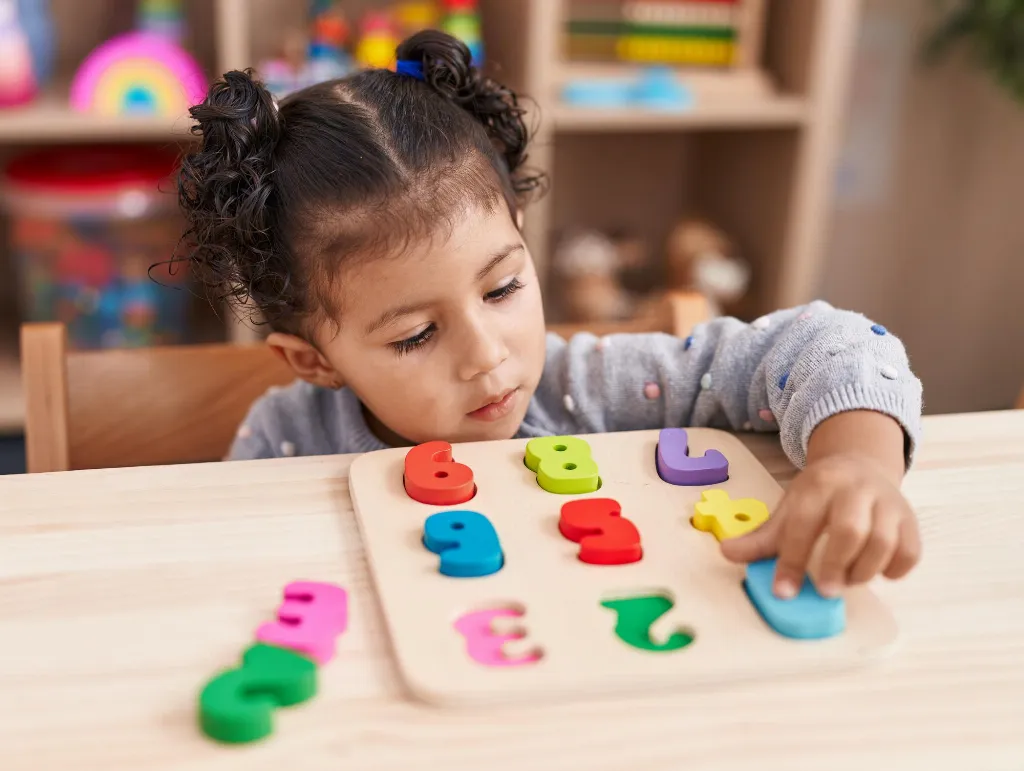
Matching also introduces early mathematics. Children compare quantities, identify attributes, recognize patterns, and create groups. For example, children might match numeral cards to collections of objects, pair shapes with corresponding outlines, or match a pattern card to a block design. These experiences connect abstract concepts to physical materials.
- Match objects to numeral cards to practice quantity.
- Pair shapes with outlines to develop geometry vocabulary.
- Match beginning sounds with picture cards during oral language play.
- Pair animals with habitats to combine classification and science.
- Match emotion faces with feeling words to support social-emotional learning.
The references on sorting and matching emphasize that classification and comparison support later literacy, mathematics, and logical reasoning. For additional professional learning about language growth, Building Vocabulary  Buy Now $16.00 can help providers create more intentional conversations during play.
How can providers plan developmentally appropriate matching activities?
Begin with the child, not the game. Observe interests, current skills, sensory preferences, language access, and motor abilities. A child fascinated by construction vehicles may engage more deeply with vehicle cards than with an unrelated commercial set. Familiar images can reduce unnecessary cognitive demands and create opportunities for meaningful conversation.
Choose clear, uncluttered materials. Realistic photographs, simple illustrations, tactile symbols, or actual objects may be appropriate depending on the goal. Avoid presenting too many cards at once. Preschoolers often learn more from a short, focused round than from a crowded activity that overwhelms visual attention.
Use a gradual progression:
- Identical objects: two matching blocks or toy animals.
- Identical pictures: clear picture-card pairs.
- Related objects: toothbrush and toothpaste, cup and spoon.
- Category matching: animals, foods, clothing, or vehicles.
- Attribute matching: objects that are the same color, shape, or size.
- Memory matching: face-down cards with a small number of pairs.
Model the process without taking over. Say, “I am looking carefully at the shape. This one has four sides, so I will compare it with the other squares.” Then allow children time to try. A mistake is useful information, not a reason to rush in with the answer.
Coursework such as DAP for Preschool Buy Now $24.00 can support providers in connecting materials, expectations, and teaching strategies to preschoolers’ developmental needs.
How can visual matching games be inclusive and socially supportive?
Inclusive matching preserves the learning objective while varying how children access and demonstrate understanding. A child may point rather than speak, use a larger card, select from two choices, or work with a peer. Children with visual differences may need high-contrast materials, larger images, improved lighting, or tactile cues. Children with motor differences may benefit from oversized cards, nonslip surfaces, or a partner who helps move materials.
Avoid relying on one feature alone. For example, pair color with shape, pattern, texture, or a picture so that children who do not distinguish colors easily can still participate. Use home-language labels, gestures, and real objects for children developing more than one language.
Matching games can also build social-emotional skills. In partner play, children practice #communication, shared attention, turn-taking, waiting, and requesting help. Cooperative formats reduce pressure: the group can work together to find every pair rather than competing for the most cards.
Helpful adaptations include:
- 🧩 Offer a smaller set of cards and increase choices gradually.
- Use a visual sequence: look, compare, choose, check, and return.
- Provide seated, standing, or floor-based options.
- Allow children to match with a peer or adult partner.
- Offer quiet space or movement breaks when needed.
- Celebrate persistence and careful observation rather than speed.
For additional guidance on adapting activities, explore Inclusive Lessons for Preschoolers Buy Now $16.00. State requirements vary - check your state licensing agency when determining whether related professional development meets local expectations.
How should educators observe learning and avoid common mistakes?
Matching games provide valuable opportunities for informal observation, but they should not become high-pressure tests. Watch how children approach the task: Do they scan the materials systematically? Do they remember a card’s location? Do they explain a match? Do they persist after an error? These observations are more informative than simply recording whether the child completed the game.
Use brief, objective notes such as, “Jordan matched four identical pictures independently and used the word same twice,” or “Amara matched objects by color but needed a visual model to match by shape.” Such notes can guide the next invitation and support communication with families.
Common mistakes include:
- Introducing too many cards before children understand the rule.
- Making the game a race, which rewards guessing instead of careful observation.
- Correcting every error immediately rather than allowing reflection.
- Using culturally unfamiliar or visually confusing images.
- Confusing success with one game for evidence of a fully generalized skill.
- Using worksheets as a substitute for hands-on exploration.
To extend learning, connect the game to real experiences. After matching animal cards, read a related book or visit the animal center. After matching classroom objects, invite children to sort the room. After matching emotions, use puppets to act out a friendship problem. These extensions help children transfer concepts beyond the game.
For deeper support with documentation and individualized planning, consider Preschool Assessments & Observations Buy Now $24.00. The course can strengthen objective observation and help educators use children’s strengths to plan responsive experiences.
Conclusion: Why do visual matching games matter for preschool development?
Visual matching games matter because they transform comparison, memory, classification, language, and social interaction into an engaging preschool experience. Their value comes not from the cards alone, but from thoughtful design: developmentally appropriate challenge, meaningful conversation, inclusive materials, and responsive adult support.
When providers begin with simple matches and gradually add memory, categories, attributes, and cooperative problem solving, children gain repeated opportunities to notice details and explain relationships. The most important outcome is not finishing first. It is children becoming more attentive, confident, flexible, communicative, and persistent learners through joyful play.
References
- NAEYC: Building Executive Function Skills Through Games
- 7 Reasons Matching Games Are Brilliant for Child Development
- Foundational Picture Card Matching Games
- Matching and Sorting for Preschoolers
- Why Sorting and Matching Is Important
- Memory Games for Preschoolers
- Memory and Concentration Activities
- Executive Function Games
- Preschool Visual Discrimination Activities
- Visual Perception Activities
- Emotion Matching Game
- Social-Emotional Learning in Preschool
- Skills Preschoolers Can Build Through Bingo
- Color Bingo, Vocabulary, and Visual Discrimination
- Screen-Free Board and Movement Games
- Cut, Sort, and Glue Activities
- Printable Activities for Preschool Classrooms
- Summer Time Memory Game Buy Now $0.50
- CDA Preschool Credential
- Lesson Planning for Preschoolers
- Professional Presence in Early Childhood
- Family Voices Matter: Tools for Meaningful Collaboration
- CDA Bridge Bundle: Family Child Care without Portfolio Review
- CDA Bridge Bundle: Infant/Toddler without Portfolio Review
- CDA Bridge Bundle: Preschool without Portfolio Review
- Creating Environments that Nurture Growth and Community
- Matchmaking for Mentors
- Family Child Care: Building, Premises, and Outdoor Safety
- ⏰ Cómo puedo facilitar las transiciones y las rutinas diarias en mi aula?
- Retraso del Habla en la Guardería: Cómo Pueden Ayudar los Proveedores
- Celebrando la amistad en el cuidado infantil durante el Día de los Mejores Amigos
- How Do Clip Cards Build Fine Motor Strength and Focus?
- Why Is Upper- versus Lowercase Sorting Great for Letter Recognition?
- How Can Children Connect Multiplication Facts to Visual Patterns?
- How Do Memory and Matching Games Support Visual Discrimination?
- How Can Juneteenth Symbols Build Visual Memory in Young Children?
- How Can a Fourth of July Activity Pack Blend Literacy and Math?
- How Do Color-Matching Activities Support Early Classification Skills?
- How Can Dot Markers Make Number Recognition Practice More Meaningful?
- How Can Holiday Word Games Strengthen Visual Scanning and Spelling?
- How Can Listening and Movement Games Build Children’s Shape Recognition?
- Why Can a Child Compare Two Piles but Struggle with Greater-Than Symbols?
- How Can You Choose the Right Level of Challenge in a Preschool Matching Game?
- How Can One Shape Exploration Engage a Mixed-Age Montessori Group?
- Why Can a Child Match a Shape but Struggle to Rebuild It with Pieces?
- When Does a Classroom Picture Mean Something Different to a Child?
- Why Might a Child Recognize a Real Object but Not Its Photograph?
- How Can Montessori Shape Activities Welcome Different Learners?
