When preschoolers can touch, move, and compare real objects, “more,” “fewer,” and “equal” become ideas they can see and explain—not just words to repeat. Use fall leaves to build children’s number sense, mathematical language, and confidence through playful classroom routines; No Such Thing as Boring Math  Buy Now $24.00 offers providers deeper guidance on connecting planned play, child development, and early math. For a ready-to-use activity, explore Colorful Fall Leaves: More, Fewer, or the Same Buy Now $1.49, a printable comparison resource with scenes, vocabulary cards, a reusable mat, and educator guidance.
Why are more, fewer, and equal worth teaching through play?
Quantity comparison is more than identifying which group looks bigger. Children develop a foundation for later number concepts when they count objects, match items one-to-one, and reason about how two collections relate. Fall materials make those relationships tangible: a child can move leaves into rows, pair them, and notice when one group has leftovers.
These moments also build language and reasoning. A prompt such as “Which group has fewer leaves? How can we check?” invites children to make a claim and support it with an action. This fits the view of preschoolers as active mathematical thinkers, explored in NAEYC’s guidance on preschoolers as natural mathematicians. The Head Start Early Learning Outcomes Framework likewise provides a broad developmental context for supporting learning from birth through age five.
Fall comparisons are useful because they can be short, joyful, and adaptable. Children can practice in a small group, during a nature walk, or while sorting materials at cleanup. The goal is not speed or a single correct phrase; it is helping children notice quantities and communicate their thinking.
- Build #numberSense by connecting counted objects with total quantities.
- Strengthen #counting and one-to-one correspondence through matching and moving.
- Encourage #mathTalk as children describe and justify comparisons.
- Support #preschoolers in seeing themselves as capable mathematical thinkers.
How can you set up a safe and inviting fall comparison activity?
Start with a small collection of leaves or leaf counters, two trays or sections of a mat, and a few visual comparison cards. The ChildCareEd printable Colorful Fall Leaves: More, Fewer, or the Same Buy Now $1.49 includes eight autumn comparison scenes, vocabulary cards, a reusable comparison mat, and educator guidance for children ages three to five. It can be used in a center, a small group, or a teacher-supported activity.
If using natural leaves, inspect them for mold, sharp stems, insects, or other hazards and follow your program’s sanitation practices. Consider large paper or fabric leaves when natural materials are unsuitable. Avoid small loose parts for children who mouth objects, and provide active supervision. State requirements vary - check your state licensing agency.
Keep the setup uncluttered so the comparison remains visible. Put each group in a defined space, and let children move pieces themselves. Begin with a small quantity—perhaps one to five objects—and expand the range as children show readiness.
- Offer real or oversized artificial leaves, trays, and a mat with two clear spaces.
- Use picture or word cards for “more,” “fewer,” and “the same.”
- Pair objects with dot cards or numerals when these representations support the child.
- 🍂 Invite children to choose colors or collect leaves outdoors, then bring their collections to compare.
How do you model more, fewer, and equal with leaves?
Make comparison visible by placing two collections in parallel rows. Count each set together, touching or moving one leaf for each number word. Then match one leaf from the first group with one from the second. If a leaf remains unmatched in one row, children can see which group has more and which has fewer. If every leaf has a partner, the sets have the same amount.
Use precise language and model the terms in complete, natural sentences: “This group has more leaves. This group has fewer. These groups have the same number.” Avoid relying only on visual size; spread-out objects can look like more even when the quantities are equal. Matching one-to-one helps children check appearances with evidence.
Ask open questions that encourage children to explain their strategy:
- “How could we find out which group has more?”
- “What do you notice when we match one leaf from each group?”
- “Can you make the groups have the same number?”
- “What would happen if we added one leaf here?”
Accept gestures, home-language responses, pointing, and demonstrations as meaningful participation. Children do not need to master every word at once; repeated experiences with objects and language help make the relationships understandable.
How can you adapt the activity for different learners?
Children in the same preschool group may be developing different parts of the comparison process. One child may be learning to count each object once; another may count both groups accurately but need help interpreting the totals. A third may be ready to adjust a set so the groups are equal. Keep the shared activity, and vary the quantity, tools, and question.
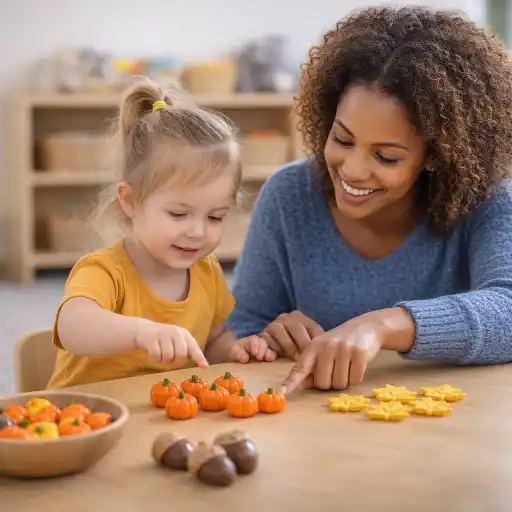
- Beginning comparers: Start with one to three large leaves in each group. Model pairing objects and use gestures alongside comparison words.
- Developing counters: Offer quantities up to five or ten and invite children to count each set before comparing.
- Ready for more: Ask children to make one group have one more or one fewer, or to explain how many must be added or removed to make the sets equal.
- Children who benefit from visual or motor support: Use high-contrast cards, larger pieces, trays with clear boundaries, or pointing and verbal-response options.
- Dual-language learners: Pair words with visuals and gestures, welcome home-language explanations, and model the English terms without requiring children to abandon familiar language.
Offer encouragement that names the thinking: “You matched each leaf to check,” or “You noticed that one group needed another leaf.” This recognizes strategy and persistence rather than labeling a child as “good” or “bad” at math.
How can you extend fall comparisons and notice learning?
Once children are comfortable comparing two sets, reuse the same structure in new contexts. Sort leaves by color, then compare the color groups. Make a class graph of leaf colors and ask which column has more, fewer, or the same number. At snack, compare two small collections of safe items or count how many children chose each activity. Familiar routines make comparison relevant beyond a single seasonal center.
Document learning as it happens. Notice whether a child counts objects with one-to-one correspondence, recognizes the last number counted as the total, uses comparison vocabulary, or checks a visual guess by matching. A brief note can guide the next activity: “Jordan counted four leaves in each row, then matched them to show the groups were equal; next, offer a set with one extra leaf.”
Common pitfalls are easy to avoid: do not make the game a race, correct children before hearing their reasoning, or use worksheets as the only evidence of learning. Keep the activity hands-on and conversational. For professional development that connects intentional play with early math and child development, consider No Such Thing as Boring Math Buy Now $24.00. You can also explore the activity’s reusable printable materials in Colorful Fall Leaves: More, Fewer, or the Same Buy Now $1.49.
Conclusion: What makes fall quantity comparison meaningful?
Hands-on fall math teaches “more,” “fewer,” and “equal” most effectively when children can handle objects, compare groups, and explain what they notice. Set up two visible collections, model accurate counting and one-to-one matching, and use open questions that make children’s reasoning—not speed—the focus.
Keep the experience flexible: adjust quantities and materials, welcome different ways of communicating, and observe children’s strategies to plan the next step. A tray of leaves can become a practical lesson in counting, comparison, vocabulary, and confidence. With intentional guidance and playful repetition, children begin to see that math is something they can explore and make sense of every day.
Helpful ChildCareEd courses
- 45 Hour Child Growth and Development
- Early Mathematics Through Play
- CDA Home Visitor Subject Area 3 Part 3 Birth to 5
- CDA Home Visitor Subject Area 2 Part 3 Birth to 5
- CDA Bridge Bundle: Preschool
- Art from the Heart for Preschoolers: Open Ended Art Projects that Build Self-Esteem
- Texas Director Credential
- Supporting Families and Caregivers in Language and Literacy
- Theories on How I Grow
- CDA Certification en Español: Recursos y Consejos para Educadores Bilingües
- Normas de Licenciamiento de Cuidado Infantil en Virginia para Centros Diurnos Infantiles y Hogares Diurnos Familiares
- Proporciones de Cuidado Infantil y Tamaños de Grupo por Edad en Maryland (Guía Rápida para Centros y Hogares)
- Proporciones de Cuidado Infantil y Tamaños de Grupo por Edad en Nueva Jersey (Guía Rápida para Centros y Hogares)
- Proporciones de Cuidado Infantil y Tamaños de Grupo por Edad en Virginia (Guía Rápida para Centros y Hogares)
- Cómo Trabajar en el Cuidado Infantil en Carolina del Norte: Requisitos y Pasos
- Canciones, juegos y preguntas de círculo para niños
- Count It, Sort It, Find It! Fall Math Games for Preschoolers
- How Can Preschool Math Become Meaningful, Playful, and Part of Every Day?
- How Can You Create Easy Preschool Math Centers with Print, Prep, and Start Learning?
- How Does Counting Shapes Build Early Number Sense Through Play?
- How Can Visual Feedback Support Multiplication Fluency?
- ¿Cómo puede la retroalimentación visual apoyar la fluidez en la multiplicación?
- Why Can a Child Compare Two Piles but Struggle with Greater-Than Symbols?
- How Can Preschoolers Build Towers of the Same Height with Different Numbers of Blocks?
- How Can Hands-On Fall Math Teach Children More, Fewer, and Equal?
- How Can Hands-On Fall Math Teach More, Fewer, and Equal?
- How Can Preschoolers Learn More, Fewer, and Equal Without Rushing Into Numbers?
- How Can Fair Sharing Build Early Math Skills Beyond “Take Turns”?
