When children match a red apple to a red card or group familiar pictures by color, they are practicing more than color recognition—they are learning how to notice, compare, and organize information. The Color Match Activity Buy Now $0.49 offers an easy, print-and-go way to introduce these ideas in centers or small groups, while No Such Thing as Boring Math  Buy Now $24.00 can deepen your understanding of play-based math and help you plan more intentional classroom experiences. Explore the activity and course as practical next steps for making early classification visible, engaging, and developmentally appropriate.
Why does color matching matter for early classification?
Classification begins when a child notices that objects share a feature and decides that they belong together. A color-matching activity gives children a clear, visible attribute to investigate: the color of a familiar object. As they compare a picture with a color cue, children practice observing similarities and differences, attending to a selected feature, and making a decision about where an item belongs.
These are foundational mathematical habits, not isolated “color skills.” The University of Nevada, Reno Extension identifies classification and matching as meaningful parts of preschool mathematics, alongside seriation and patterning. Color matching can introduce children to grouping and sets, which later support sorting, patterning, comparing quantities, and organizing information across math, science, and everyday routines.
There is also a language opportunity in each match. Providers can model words such as same, different, color, group, match, and category while inviting children to describe what they see. Keep the interaction playful: the goal is not simply to finish a page correctly, but to help children explain and explore their thinking. A warm, low-pressure invitation can build both confidence and #reasoning.
How does matching develop into classification?
Matching and classification are related but distinct. Matching usually asks a child to pair two items that are alike in a particular way. Classification extends that thinking by placing several items into a group according to a shared attribute. In a color activity, a child may first match one picture to a color cue, then gather or identify several pictures that share that color.
Children’s progress is not always linear, and a single activity cannot establish what a child “should” be able to do by a specific age. Some children may identify a match without naming the color; others may know color words but need more practice comparing objects. Focus on what the child is noticing and the kind of support that helps them participate.
- Start with two clearly contrasting colors and a few familiar pictures.
- Model one match aloud: “This picture is a banana. The banana is yellow, so I’ll match it with yellow.”
- When the child is ready, add more choices or invite them to find multiple examples of one color.
- Offer another attribute—such as shape or function—only after the basic matching idea is familiar.
Color is one attribute among many. Making that distinction explicit helps children learn that objects can be grouped in different ways, rather than assuming there is only one permanent category for each item.
How can providers make a color-match activity purposeful?
A purposeful activity has a clear learning focus and enough room for child-led exploration. The ChildCareEd Color Match Activity Buy Now $0.49 connects familiar pictures to matching colors and is designed for centers, small groups, quiet time, or early learning lessons. Use it as one short, focused experience within a broader collection of hands-on math opportunities—not as a substitute for play with real objects.
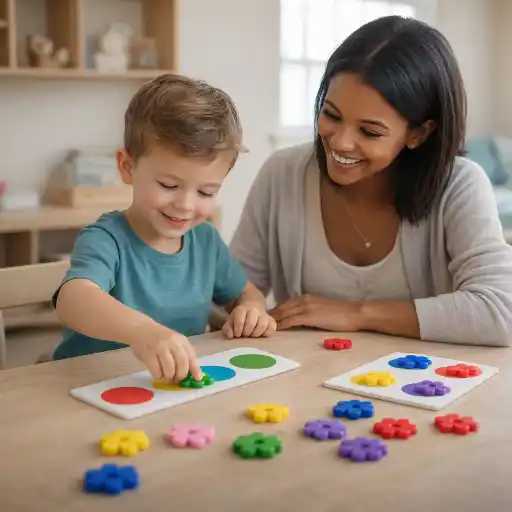
Before children begin, make the materials easy to see and handle. Demonstrate one example, then invite children to take a turn. Narrate their actions without turning the interaction into a quiz: “You found a picture that matches the blue card.” If a child chooses a different match, pause and ask what they noticed before offering help.
- Invite children to find a classroom object that matches one of the activity colors.
- Ask, “What else could go in this group?” or “How did you decide these belong together?”
- Let children sort the same pictures in a new way, such as by object type or where an item is used.
- Use the activity at a center, then revisit the concept during cleanup or a color-themed book.
These extensions help children connect a matching cue to objects beyond the page. They also turn a brief resource into meaningful practice with #classification and flexible thinking.
How can you adapt the activity for different learners?
Children bring different experiences with color words, visual attention, motor control, communication, and print-based tasks. Adjust the activity so each child can engage with the same central idea—comparing an attribute and making a match—without requiring everyone to respond in exactly the same way.
For a child who is beginning, offer only two high-contrast choices and model the first match. A child who is ready for a greater challenge might match across a larger set, explain a choice, or sort the pictures by a second rule after the initial color grouping. Keep directions brief and provide time for children to look, point, handle materials, and reconsider.
- Use large, uncluttered images and reduce the number of choices if the display feels overwhelming.
- Pair color with another cue, such as a picture, word, shape, or pattern; do not rely on color alone.
- Allow children to point, gesture, use a communication device, or respond in a home language.
- Offer accessible positioning, adapted materials, or a partner to handle pieces when needed.
For children who are color-blind or have low vision, color-only matching may create an unnecessary barrier. Add symbols or labels and check that the images have clear contrast. Inclusive adjustments preserve the thinking goal while communicating that every child’s participation matters.
What should educators observe—and what pitfalls should they avoid?
Observe the process, not only whether a child places each picture in the expected spot. Notice whether the child scans the choices, attends to color, compares two items, maintains a matching rule, asks for help, or changes a decision after looking again. A child’s explanation can reveal thoughtful classification even if it differs from the adult’s first interpretation.
Brief notes can guide your next step: “Matched familiar pictures to two colors with a model,” or “Found several blue objects and explained that they matched the blue cue.” Revisit observations across different materials before drawing conclusions; success with one set of pictures does not necessarily show how a child will approach other objects or attributes.
- ⚠️ Avoid rushing to correct: ask, “What did you notice?” and give the child time to explain.
- Avoid presenting the activity as a race or a test; keep the focus on exploration and conversation.
- Avoid introducing many colors and multiple sorting rules at once.
- Avoid assuming that naming a color and matching by color are the same skill.
State requirements vary - check your state licensing agency when connecting classroom documentation or professional learning to local expectations. For additional professional learning, Early Mathematics Through Play Buy Now $24.00, Math Foundations in Early Childhood Buy Now $16.00, and Letter & Number Planning in Child Care Buy Now $24.00 offer relevant perspectives on making early math playful and intentional.
How can color matching strengthen early classification skills?
Color matching supports early classification when providers help children notice a shared attribute, compare examples, and organize them into groups through playful, accessible experiences. The activity can strengthen visual discrimination, mathematical language, decision-making, and confidence—especially when adults treat children’s ideas as opportunities to ask, listen, and extend learning.
Begin with a small set of familiar pictures, model a match, and invite children to explain or show their thinking in a way that works for them. Then connect the experience to real objects, other sorting rules, and daily routines. The central goal is not a completed page; it is helping children become thoughtful observers who can recognize relationships and organize what they see.
For a ready-to-use starting point, try the Color Match Activity Buy Now $0.49. To expand your play-based math practice, consider No Such Thing as Boring Math Buy Now $24.00 and explore the additional courses linked above.
- CDA Home Visitor Subject Area 3 Part 3 Birth to 5
- Many Colors, One Canvas: MD ECE Conference
- CDA Home Visitor Subject Area 2 Part 3 Birth to 5
- TEAM: Together Everyone Achieves More
- Power of Art: Bldg Self-Esteem & Positive Behavior for ALL Abilities
- Birth to Five CDA Credential with Portfolio Review
- Staff Supervision, Observation & Feedback
- Texas Director Credential
- Matchmaking for Mentors
- CDA Certification en Español: Recursos y Consejos para Educadores Bilingües
- 🔍 ¿Qué ves cuando observas a un niño aprender?
- Calabazas, hojas y manzanas: actividades de otoño para preescolares
- Cómo simplificar la capacitación para sus empleados de daycare
- How can preschool programs intentionally support early math skills every day?
- Count It, Sort It, Find It! Fall Math Games for Preschoolers
- How Can Cut, Sort, and Glue Activities Strengthen Early Learners’ Development?
- How Can Fun Bingo Games Teach Colors, Shapes, and Animals to Preschoolers?
- Why Is Animal Bingo a Great Way to Introduce Habitats and Classification?
- Why Is Wild vs. Farm Animal Sorting a Favorite Preschool Activity?
- How Can Color Bingo Reinforce Vocabulary and Visual Discrimination?
- How Can Bingo Games Make Learning Feel Like Play?
- What Skills Can Preschoolers Build Through Bingo?
- How Can Sorting Activities Strengthen Early Thinking Skills?
- How Can Hands-On Sorting Support Math and Language Together?
- How Do Memory and Matching Games Support Visual Discrimination?
- How Can Ocean Animal I Spy Combine Counting, Visual Scanning, and Ocean Science?
- How Do Color-Matching Activities Support Early Classification Skills?
- How Can Toddler Classroom Jobs Build Early Math Beyond Counting?
