Screen-free gaming combines tabletop thinking with active movement, giving #preschoolers engaging opportunities to strengthen focus, language, cooperation, problem-solving, and social-emotional skills. This practical guide provides child care providers and directors with evidence-informed reasons to use cooperative #boardgames and short gross-motor activities, along with ready-to-use game ideas, inclusive adaptations, and program-level strategies for adding playful, low-tech #movement without sacrificing instructional time. Educators can deepen these practices through ChildCareEd’s The Best Promotion is Play Buy Now $35.00, which explores how meaningful play supports cognitive, language, physical, social, and executive-function development, and Brighter Futures: Social Emotional Development  Buy Now $16.00, which supports children’s emotional regulation, relationships, and positive social behavior. For hands-on, play-based activities that help preschoolers recognize and express feelings through games, stories, and simple reflection prompts, see Exploring Emotions: Fun and Educational Preschool Activities. The guide also connects readers with trusted ChildCareEd and CDC resources, including learning-focused games and gross-motor collections such as Gross Motor Games for Preschool and Kindergarten, to help children learn, move, cooperate, and regain calm throughout the day. Programs using Montessori principles can adapt these strategies for classroom flow and independence; see The Importance of Active Play in the Montessori Classroom for practical guidance on structuring active, purposeful movement that supports concentration and lifelong healthy habits.
1) What exactly is "screen-free gaming" and why does it matter?
- Tabletop and card games that teach turn-taking, counting, vocabulary, and problem-solving.
- Movement games—short, teacher-led or child-led activities that use whole-body action to practice planning, balance, and self-regulation.
Why it matters:
1) Cognitive and social benefits: Board and cooperative games support planning, inhibition, and social language; see summaries on how games support learning in Playful Learning and evidence linking movement to cognition in The Connection Between Movement and Cognitive Growth.
2) Physical and attention benefits: Short bursts of movement throughout the day meet the CDC’s guidance that young children should be active throughout the day (CDC child activity guidelines).
3) Screen trade-offs: Replacing passive screen minutes with hands-on play protects language development and sleep. For program policy tips, see What simple screen time rules should we use for young children?.
2) Which board games work best with young children, and how do they build skills?
- 🧩 Quick co-op games (no single winner): build teamwork and prosocial behavior. See cooperative ideas in Playful Learning and research on social benefits at the Child Development Clinic.
- 🎯 Matching & memory games: boost vocabulary, visual memory, and turn-taking. Great for 35-year-olds.
- 🔢 Simple math/track games (counting spaces or collecting items): practice number sense and one-to-one counting.
- 🃏 Draft & set collection card games with short rounds (e.g., Strategist's picks): teach planning and pattern recognition in short, repeatable plays.
- ♟️ Fine-motor stacking and dexterity games: support hand control needed for writing readiness.
Practical tips:
- Rotate 3–5 favorite games so children master rules.
- Use visual rule cards and a demo round—children learn by watching.
- Keep sessions short (10–20 minutes) and build in movement between rounds to reset attention.
3) What movement games (no screens) help build strength, regulation, and attention?
- 🐾 Tape stepping stones: balance + sequencing. Call out colors, letters, or numbers as kids move.
- 🎈 Balloon keep-up between turns: gentle coordination bursts for small groups.
- 🧭 Micro obstacle course (3 stations): crawl, balance beam (tape), toss—rotate in small groups to avoid lines. See low‑prep courses in Indoor and Outdoor Gross Motor Activities.
- 🎶 Freeze dance with themes (animals, emotions): self-regulation + listening.
- 🔁 Cross-lateral games (touch opposite knee): promote brain-body coordination—use these before table work to improve focus (movement + cognition).
Safety & scheduling:
1) Clear the floor, demo moves, and use stations for small groups. 2) Short, frequent bursts (1–10 minutes) fit transitions and meet activity guidelines; the CDC recommends that younger children be active throughout the day (CDC).
Note: state requirements vary - check your state licensing agency.
4) How do we include every child and adapt games for varied ages and abilities?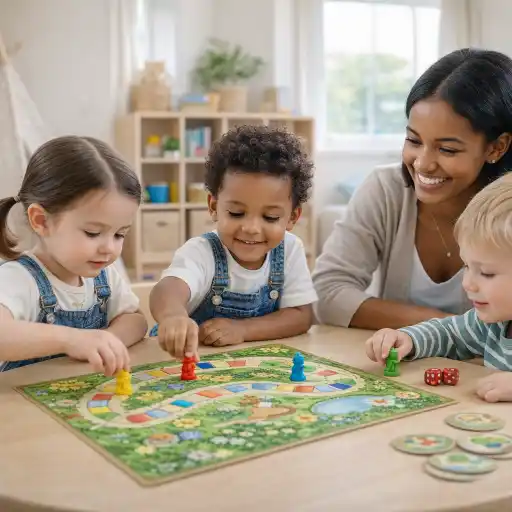
Inclusion is low-prep when you plan two-level options and use supports. ChildCareEd resources emphasize simple adaptations and routines.
- 🤝 Two-choice rules: always give an easier and a harder option (e.g., hop OR step).
- 🪑 Seated alternative: convert standing tasks into arm or hand motions for children with mobility needs.
- 🧾 Visual supports: picture cards or taped paths reduce language load and help nonreaders follow steps.
- 🔁 Peer buddies & stations: pair children for modeling and praise; rotate so waits are short.
- 🔈 Sensory supports: provide quiet zones or fidgets for children who need reduced stimulation.
Measurement & referral:
1) Track small wins with a checklist (balance for 5 sec, hop 3 times). 2) Share observations with families and follow the center referral policy if delays persist. For adaptation ideas and inclusive safety, see Indoor and Outdoor Gross Motor Activities.
5) How do we implement screen-free gaming across our program and avoid common mistakes?
Make screen-free gaming part of routines, family communications, and staff training.
- 📝 Write a short program policy: post a one-page media and play plan for families. Use tips from ChildCareEd’s screen-time guidance.
- 🎯 Schedule short, purposeful uses: 1–2 board-game sessions per week and movement breaks several times daily; keep board-game rounds brief and tied to learning goals.
- 👥 Train staff on co-facilitation: adults should co-play, model talk, and scaffold language for transfer from game to classroom learning.
- 📣 Engage families: share quick snapshots (photo with permission or a one-line note) of a child’s game win to reinforce home practice.
Common mistakes & fixes:
- ❌ Mistake: One-size rules. ✅ Fix: Offer choices and adaptations so every child can succeed.
- ❌ Mistake: Too long sessions. ✅ Fix: Use 10–20-minute board-game windows and micro-movement breaks (1–5 minutes).
- ❌ Mistake: Using screens to calm. ✅ Fix: Teach short calm-down routines (soft song, book) and use movement-to-calm transitions instead.
FAQ
- Q: How long should board-game sessions be for preschoolers? A: 10–20 minutes is ideal; shorter turns for 2–3-year-olds.
- Q: Can I use a tablet for an educational game occasionally? A: If you do, make it short, adult-led, and immediately followed by hands-on play—see ChildCareEd guidance.
- Q: What if a child refuses to join games? A: Offer a helper role, nonverbal response options, or a parallel activity that scaffolds joining.
- Q: How do we track impact? A: Use simple checklists, observation notes, and family feedback; photos/videos with permission make progress visible.
- Q: Where do I get game suggestions and printable materials? A: Start with the ChildCareEd game and gross motor collections like 10 Gross Motor Games and the play-focused articles linked above. For board-game recommendations, see curated lists like The Strategist.
Conclusion
Screen-free gaming—pairing short #boardgames with intentional #movement—gives children joyful practice in language, attention, planning, and self-regulation. Start small: rotate a few games, add micro-movement breaks, adapt for inclusion, and make a one-page family plan. Use the ChildCareEd resources cited here for ready lessons and safety tips,s and remember: state requirements vary - check your state licensing agency. With simple planning and staff modeling, low‑tech play can deliver high-impact learning in your program and help children grow physically, socially, and cognitively through everyday #play.
Screen-free gaming combines two low-techcategoriess: Movement games are brief, purposeful, and tied to learning goals. Use evidence-based movement ideas from ChildCareEd like obstacle courses and animal walks (10 Gross Motor Games, Animal Races). Choose games that match attention spans and skill goals. Prioritize: simple rules, bold pieces, cooperative options, and short rounds.
- Balancing Physically Active Play in Child Care
- Recognize, Respond, Respect: Supporting Diverse Learners
- Working Together: Teachers & Preschoolers
- CDA Bridge Bundle: Preschool without Portfolio Review
- Privacy Matters: Documentation and Observation in Early Learning
- Sensitive Periods in Montessori: Guiding Natural Learning
- Texas Director Credential
- Montessori Cultural Activities: Exploring the World Through Play and Learning
- Wellness in Action: Teaching Healthy Habits to Children
- Balancing Active Play in Child Care
- CDA Certification en Español: Recursos y Consejos para Educadores Bilingües
- How can child care programs promote mental health in early childhood?
- What are practical screen time limits for toddlers and preschoolers?
- Dopamine in Children: Signs, Effects, and Everyday Influences
- Proporciones de Cuidado Infantil y Tamaños de Grupo por Edad en Virginia (Guía Rápida para Centros y Hogares)
- How can child care programs boost physical activity for young children?
- What Social-Emotional Learning Activities Work Best for Toddlers in Minnesota Classrooms?
- Why Does Punishment Backfire With Young Children?
- Canciones, juegos y preguntas de círculo para niños
- Helping Preschoolers Manage Frustration When Told No
- How do I write a screen-time policy for my New York child care program?
- What simple screen time rules should we use for young children?
- What are practical, healthy screen-time practices for young children?
- Can Screen-Free Board and Movement Games Help Young Children Learn and Stay Calm?
- How can child care programs balance screen time, educational technology, and active-learning alternatives?
- How can we create screen-free activities that truly engage older children?
- Big Feelings, Busy Bodies: Self-Control Activities for Toddlers
- How Can Fun Bingo Games Teach Colors, Shapes, and Animals to Preschoolers?
- How Can Child Care Providers Build Healthy Habits for Young Children?
