What looks like a simple paper craft can become a rich lesson in classification, language, coordination, and independence. These cut, sort, and glue experiences give young children meaningful practice with #fineMotor control while helping educators observe emerging reasoning skills; for a broader foundation in playful mathematics, explore Early Mathematics Through Play Buy Now $24.00, which can strengthen your classroom planning and provide practical professional learning.
Sorting is a natural way for children to answer the question, “Which things belong together?” When children compare objects, identify attributes, and explain their choices, they are building early mathematical reasoning. When they cut, position, and glue materials, they are also refining hand strength, bilateral coordination, visual-motor integration, and persistence. The activities below are intentionally simple so they can be adapted for centers, small groups, or short transition-time invitations.
Why Do Hands-On Sorting Activities Matter?
Young children learn concepts most effectively when they can touch, move, compare, and revise their ideas. A worksheet may ask a child to circle matching pictures, but a hands-on activity requires the child to make decisions with real materials. That physical engagement supports classification while also creating opportunities for conversation and collaboration.
Sorting can be organized by color, shape, size, function, texture, or more than one attribute. Children may first sort buttons by color, then discover that the same buttons can be sorted by size or number of holes. This flexibility helps them understand that classification depends on a chosen rule rather than on one “correct” grouping.
Cutting and gluing add important developmental dimensions:
- Cutting strengthens hand muscles and supports scissor control.
- Picking up paper pieces encourages precision and visual tracking.
- Arranging groups promotes planning and spatial reasoning.
- Gluing develops sequencing, pressure control, and task completion.
- Explaining a rule builds vocabulary and #communication.
As the references on preschool sorting activities note, classification supports math and literacy development as well as fine-motor practice. It also connects to everyday life: children sort toys during cleanup, food during pretend play, and clothing by type or color.
How Should Providers Prepare a Cut, Sort, and Glue Invitation?
Effective preparation begins with a clear learning goal. Decide whether children will sort by one attribute, create groups independently, or compare two possible sorting rules. A focused goal keeps the activity manageable and helps staff document what children understand.
Gather materials that are safe, visually appealing, and easy to manipulate. Options include recycled magazines, construction paper, large stickers, paper shapes, fabric scraps, paper plates, glue sticks, and child-safe scissors. Avoid materials with sharp edges, toxic residues, or small loose parts when children are too young to use them safely. Supervision should remain active, especially during cutting and when small pieces are present.
Prepare containers or mats that make categories visible. For example, draw a red circle and a blue circle on a paper plate, or provide picture labels such as “animals” and “vehicles.” Visual supports benefit children who are learning English, children with communication differences, and children who need additional predictability.
Before children begin, model the process without taking over:
- “I notice these pieces are all round.”
- “I am making a group for things that can fly.”
- “I will place the pieces first, then add glue.”
- “What rule could we use for this group?”
For additional guidance on choosing materials and arranging learning areas, review Classroom Designers ONLINE  Buy Now $24.00. Thoughtful #classroom design can make materials accessible while reducing crowding and unnecessary frustration.
Which Cut, Sort, and Glue Activities Work Well in Preschool?
Begin with activities that have a visible purpose and a limited number of categories. Children can cut pictures from recycled advertisements and sort them into “food,” “clothing,” and “toys.” They can then glue each group onto a separate page to create a category book. Invite children to add a drawing or dictate a sentence explaining one group.
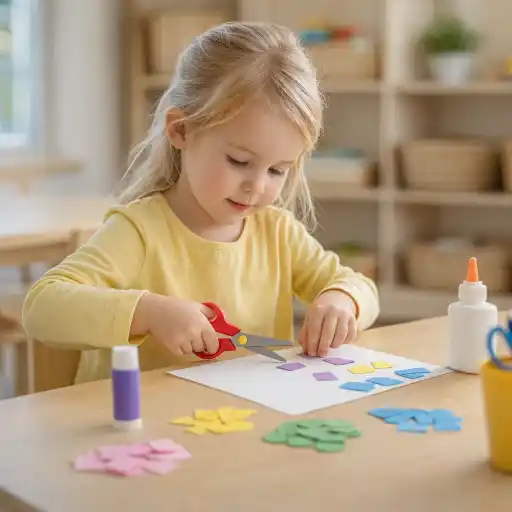 Another option is a color-and-shape collage. Provide large paper shapes in several colors and ask children to sort by color first. Later, encourage a second sort by shape. This demonstrates that the same collection can be classified in different ways.
For a nature-themed invitation, offer printed photographs or previously collected, safe natural materials such as large leaves and pinecones. Children can group items by texture, size, or whether they came from a tree. Use photographs when loose materials create safety or allergy concerns.
Try these additional variations:
- Sort fruit and vegetable pictures, then glue them into “salad” and “soup” pages.
- Sort animals into land, water, and air groups.
- Cut clothing pictures and organize them by season.
- Sort household pictures by room or function.
- Create an “odd one out” page and discuss why one picture does not belong.
- Make a pattern collage using alternating colors, shapes, or textures.
Allow children to make choices within reasonable boundaries. A process-oriented approach values thinking and explanation rather than identical finished products. If a child changes the category halfway through, treat that as evidence of developing #reasoning and ask what new rule emerged.
Short on prep time?
If gathering magazines and pre-drawing category mats isn't realistic on a busy morning, ready-made Cut, Sort & Glue printables deliver the same hands-on classification practice in a print-and-go format — each set includes a preview page, cut-out picture cards, and a labeled two-column sorting mat. They line up directly with the activities above: Fruits vs. Vegetables Buy Now $1.49 for the food-sorting invitation, Wild vs. Farm Animals Buy Now $1.49 for grouping animals, and Living vs. Non-Living Buy Now $1.49 for an "odd one out" discussion. To move into other attributes, sets like Light vs. Heavy Buy Now $1.49 and Float vs. Sink Buy Now $1.49 let children sort by a single property, while Upper Case vs. Lower Case Buy Now $1.49 connects sorting to early literacy. Laminate the mats once and reuse them all year.
How Can Educators Differentiate the Experience?
Children enter the classroom with different levels of scissor control, language, attention, and prior experience. Differentiation does not mean lowering expectations; it means changing the pathway so each child can participate meaningfully.
For beginners, offer large paper pieces with short, straight cutting lines. The adult can make a small starting snip, while the child completes the cut. Children who are ready for more challenge can cut curves, zigzags, or pictures from catalogs. Consider using thicker paper for children who need more resistance and lighter paper for those who tire quickly.
Adjust the cognitive demand as well:
- Beginning: name the categories and invite children to place pieces in the correct group.
- Developing: provide two or three categories and ask children to identify the rule.
- Extending: invite children to sort the same pieces in a second way.
- Advanced: ask children to create category labels or explain an exception.
Children with motor differences may benefit from adaptive scissors, larger handles, nonslip mats, or pre-cut pieces. Children who communicate in multiple languages may benefit from photographs, gestures, home-language labels, and peer modeling. Offer standing, seated, or floor-based workspaces when appropriate.
Use supportive language instead of correcting too quickly: “Tell me about your group,” or “I see you put this here. What do these pieces have in common?” The course Inclusive Lessons for Preschoolers Buy Now $16.00 can help providers connect material choices, accommodations, and lesson planning to the needs of diverse learners.
How Can Sorting Activities Support Assessment and Family Partnerships?
Assessment can remain brief, authentic, and embedded in play. Observe whether a child notices attributes, maintains a sorting rule, changes strategies, uses tools safely, and explains a decision. A completed collage is useful, but the child’s process and language often reveal more than the final product.
Record short anecdotal notes such as:
- “Sorted eight pictures by category with one reminder.”
- “Used both hands to rotate paper while cutting.”
- “Created a second classification based on size.”
- “Explained that the boat did not belong with land animals.”
Photographs of work samples, with appropriate permissions, can help show growth over time. Compare observations across different materials so you do not mistake familiarity with one activity for a generalized skill. Connect the experience to learning goals such as counting groups, comparing more and fewer, using positional words, or describing texture.
Family communication becomes more meaningful when it includes the child’s thinking. Rather than sending home only a product, share a comment: “Maya sorted the pictures by where animals live and then created a new group for animals that can fly.” Families can continue the idea by sorting socks, utensils, groceries, or recycling at home.
Directors can support consistency by adding a simple observation checklist to center documentation and inviting staff to share adaptations during planning meetings. If developmental concerns persist across settings, discuss observations respectfully with the family and follow program procedures for screening or referral.
What Common Mistakes Should Providers Avoid?
Even engaging activities can become less effective when adults unintentionally control the task. One common mistake is pre-cutting everything and asking children only to glue. While pre-cut materials are useful for some learners, children also need gradual opportunities to practice cutting. Another mistake is requiring every child to produce the same collage. Uniform products can shift attention away from classification, creativity, and problem solving.
Avoid introducing too many attributes at once. Sorting by color, size, shape, and function simultaneously may overwhelm a young learner. Begin with one clear rule, then increase complexity when the child is ready. Also avoid assuming that an incorrect placement reflects a lack of understanding; the child may be using a different rule than the one the adult expected.
Safety and supervision remain essential:
- Use scissors appropriate to children’s age and skill.
- Teach carrying and passing procedures.
- Monitor glue use and prevent contact with eyes or mouths.
- Remove choking hazards from areas used by younger children.
- Check for allergies when using recycled, food-related, or natural materials.
- State requirements vary - check your state licensing agency.
Finally, protect the joy of the experience. Children may need time to experiment, make a mess, and rethink a category. Calm guidance, accessible materials, and genuine curiosity from adults often produce deeper learning than repeated directions.
Conclusion: How Can Cut, Sort, and Glue Become Powerful Learning Experiences?
Cut, sort, and glue activities answer the central question by combining several developmental goals within one accessible experience. Children classify objects, compare attributes, practice early #math, strengthen fine-motor coordination, develop language, and experience the satisfaction of making decisions independently.
For immediate classroom use:
- Choose one sorting rule and prepare two or three clearly labeled categories.
- Offer a range of pre-cut and cut-your-own materials.
- Model the thinking process, then let children lead.
- Ask children to explain, revise, and compare their groupings.
- Document the process with brief notes and share meaningful observations with families.
When educators treat the collage as evidence of thinking rather than merely as a craft, ordinary paper scraps become tools for inquiry. Pair these experiences with intentional lesson planning, inclusive materials, and playful mathematical conversations to create learning that is both developmentally appropriate and genuinely enjoyable.
- Lesson Planning for Preschoolers
- Teacher-Child Interactions for Stronger CLASS® Outcomes
- CDA Home Visitor Subject Area 2 Part 3 Birth to 5
- 45 Hour Preschool Methods and Materials
- CDA Bridge Bundle: Family Child Care without Portfolio Review
- CDA Bridge Bundle: Infant/Toddler without Portfolio Review
- CDA Bridge Bundle: Preschool without Portfolio Review
- Texas Director Credential
- Montessori Cultural Activities: Exploring the World Through Play and Learning
- Supporting Families and Caregivers in Language and Literacy
- Developing Skills Through Fall Crafts in Childcare
- How to Incorporate Fine Motor Skills Practice Into Daily Activities
- CDA Certification en Español: Recursos y Consejos para Educadores Bilingües
- Actividades de Motricidad Gruesa que Desarrollan el Equilibrio, la Coordinación y la Fuerza
- 10 Ejemplos de Cómo la Cultura Influye en el Desarrollo Infantil
- Proporciones de Cuidado Infantil y Tamaños de Grupo por Edad en Virginia (Guía Rápida para Centros y Hogares)
- Retraso del Habla en la Guardería: Cómo Pueden Ayudar los Proveedores
- Cómo Trabajar en el Cuidado Infantil en Carolina del Norte: Requisitos y Pasos
- Pool Noodle Sea Creatures: A Fun Ocean Craft for Preschoolers
- Easy Pool Noodle Sea Creatures for Ocean Theme Activities
- Cómo simplificar la capacitación para sus empleados de daycare
- Easy Glitter Crafts for Toddlers and Preschoolers
- How Can Cut, Sort, and Glue Activities Strengthen Early Learners’ Development?
- Why Is Wild vs. Farm Animal Sorting a Favorite Preschool Activity?
- How Can Halloween Fine-Motor Activities Be Fun Without Being Scary?
- How Do Cut-and-Paste Activities Build Fine-Motor Control and Planning?
- How Can a Simple Watermelon Craft Build Fine-Motor and Language Skills?
- ¿Todos los niños deben participar en el tiempo de círculo?
- Teaching Syllables Through Play: What Should Preschoolers Notice?
- How Can Providers Plan Creative Sensory and Fine-Motor Activities for Young Children?
