A matching game can be delightfully easy for one preschooler and genuinely puzzling for another—which is exactly why thoughtful adjustments matter. The Play, Learn, Grow Online Version  Buy Now $16.00 offers a deeper look at development, developmentally appropriate practice, and varied learning styles; it can help you make more intentional decisions about playful activities like Flip-Flop Matching Buy Now $1.49, a printable visual-matching activity.
Why does the right level of challenge matter?
Matching patterned flip-flops may look like a simple paper activity, but children are practicing how to scan images, notice details, compare features, and decide which pictures belong together. The activity can also invite conversation about colors and patterns, attention to a task, and careful pencil movements. The goal is not to make the page harder for its own sake; it is to offer a worthwhile challenge that helps each child participate and keep learning.
A task that is too easy may lead a child to finish quickly and move on. One that is too demanding can prompt guessing, avoidance, or frustration. A child’s response is useful information—not a verdict on ability. Match the activity to the learner in front of you, and remember that readiness may vary by day, group size, fatigue, interest, and familiarity with the materials.
Visual matching can provide a playful, concrete way to explore #attention, comparison, and early problem-solving. With a relevant theme and a welcoming adult nearby, a printable can become more than a worksheet: it can be a shared opportunity to notice, explain, and try again.
How can you tell whether the game is too easy or too hard?
Observe before changing the materials. Look for engagement and the strategies children use, rather than relying only on whether they finish. A child who studies each pattern and checks a choice may be working productively, even if the task takes time. A child who completes every match instantly may be ready for an extension, while repeated random marks or visible frustration may signal that the activity needs a gentler entry point.
- Signs the challenge may fit: the child stays interested, looks between choices, makes attempts, and can continue with modest support.
- Signs to simplify: the child cannot identify where to begin, disengages, or needs repeated adult direction to make a choice.
- Signs to extend: the child finishes comfortably, explains matches, or asks for another round.
Separate the learning goal from other demands. If the goal is visual comparison, difficulty holding a pencil or understanding a lengthy direction should not prevent participation. Offer a verbal, pointing, or partner response, and give enough wait time. Use neutral prompts such as, “What do you notice about these two patterns?” The child’s approach can tell you whether the next adjustment should involve fewer choices, clearer instructions, or a new visual feature.
How can you build a gradual progression of challenge?
Increase complexity one step at a time so you can see what helps. The resource asks children to connect patterned flip-flop pairs across two printable pages. Before expecting independent completion, introduce the task in a small group or one-to-one, show how to compare a pair, and invite the child to try. Begin with a limited portion of the page if the full set feels busy.
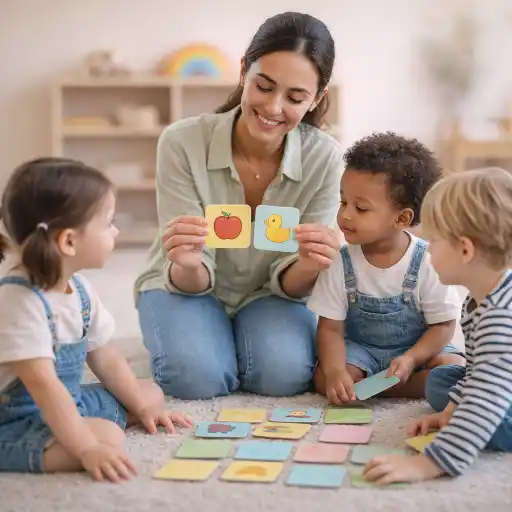
Once the matching rule is clear, adjust a single feature while keeping the rest familiar. For example, move from obvious patterns to more similar ones, or ask children to describe a detail before drawing a line. You might also use the matching pairs as a starting point for sorting or language play. This progression supports growing independence without turning each round into a test.
- Start with two or three clearly different pairs or cover part of the page.
- Model one match aloud: “I see the same stripes on both.”
- Add more pairs or visually similar patterns after the child understands the task.
- Invite children to explain a match or find a pair using a named feature.
- Extend the idea by sorting pairs by color or pattern, or finding similar designs in the room.
Keep the tone curious and playful. If a child is ready for more, increase the thinking demand—not the pressure or speed.
How can you adapt the activity so every child can participate?
Hold the learning purpose steady while varying how children access and respond to the game. Some children may draw connecting lines; others may point to matching pictures, place a counter on a pair, name a pattern, or work with a peer. These alternatives preserve the comparison goal while reducing barriers related to fine-motor coordination, language, or comfort with worksheets.
Consider the visual setup, too. Keep the page flat and well lit, reduce nearby clutter, and cover unused areas when a full page feels overwhelming. If image size or contrast is a concern, enlarge the pictures where possible or offer larger picture cards. Avoid depending on color alone when pattern or shape can also show how images relate. Familiar language, gestures, and a modeled example can make directions easier to understand.
- 🧩 Offer a small set of choices first, then add more when the child is ready.
- Allow pointing, verbal responses, counters, or a partner-assisted choice instead of drawing a line.
- Pair spoken directions with a demonstration and give processing time.
- Use a cooperative goal, such as finding every pair together, rather than a speed contest.
- Notice persistence and careful observation, not only correct answers.
These small adjustments communicate that the activity is for the children—not the other way around. A relevant next step for educators seeking broader foundations is the online Play, Learn, Grow course Buy Now $16.00, which addresses developmental stages for ages one to five, developmentally appropriate practice, and learning styles. Review local professional-development expectations as needed; state requirements vary - check your state licensing agency.
How can your prompts and observations guide the next step?
Your role is to make children’s thinking visible without taking over. Pause before giving an answer, then use a prompt that points attention back to the pictures: “What is the same?” “Which detail could you check?” or “Would you like to compare these two?” If a child remains uncertain, model one example or narrow the choices, then invite the child to continue independently. Gentle scaffolding lets a child do meaningful work while receiving support.
Observe more than the final page. Notice whether the child scans from one picture to another, identifies a pattern, remembers a location, changes a choice after checking, or communicates a reason. Keep brief, objective notes—for example, “Matched three pairs independently and described two patterns,” rather than “Good at matching.” Such documentation helps you plan a useful next step and share specific strengths with families and colleagues.
Common pitfalls are easy to avoid when the learning goal stays in view:
- Do not add many choices and harder patterns at the same time; change one variable first.
- Avoid turning the task into a race, which may reward speed over careful comparison.
- Do not correct every attempt immediately; allow time to notice and revise.
- Do not treat one worksheet as a complete assessment of a child’s development.
- Do not assume that a spoken answer or pencil response is the only evidence of understanding.
Conclusion: What is the right level of challenge?
The right level of challenge is the one that invites a child to stay engaged, make a genuine effort, and take a manageable next step—with support available but not imposed. For a preschool matching game, begin with a clear model and a small set, observe how children respond, then adjust the number or similarity of choices, the response method, or the adult prompt.
Use Flip-Flop Matching as a flexible invitation to compare, talk, and persist, rather than as a pass-or-fail worksheet. When you celebrate careful noticing and adapt the task to children’s needs, a sunny printable can support purposeful, enjoyable learning. For a fuller foundation in development and developmentally appropriate practice, explore the Play, Learn, Grow Online Version Buy Now $16.00.
- CDA Certification en Español: Recursos y Consejos para Educadores Bilingües
- 🤯 ¿Por qué este niño está teniendo un comportamiento difícil de repente?
- Recursos en Español sobre el Sueño Seguro del Bebé
- Niveles de credencial de Maryland: qué significan
- Cómo ser director de cuidado infantil en Maryland
- 10 Ejemplos de Cómo la Cultura Influye en el Desarrollo Infantil
- Proporciones de Cuidado Infantil y Tamaños de Grupo por Edad en Virginia (Guía Rápida para Centros y Hogares)
- Ejemplos de Crianza Respetuosa vs. Crianza Permisiva
- Cómo Ser Maestra de Preescolar en Illinois
- Cómo Ser Maestra de Preescolar en California
- Celebrando la amistad en el cuidado infantil durante el Día de los Mejores Amigos
- Canciones, juegos y preguntas de círculo para niños
- How Can Printable Activities Save Teachers Hours of Prep Time?
- How Can You Create Easy Preschool Math Centers with Print, Prep, and Start Learning?
- Why Is Beginning-Sound Bingo a Smart Step Toward Reading?
- How Do Memory and Matching Games Support Visual Discrimination?
- How Can Juneteenth Symbols Build Visual Memory in Young Children?
- Why Do Memory Games Support Attention and Working Memory?
- How Can Dinosaur-Themed Group Games Build Vocabulary and Turn-Taking?
- How Can You Choose the Right Level of Challenge in a Preschool Matching Game?
