Could a small, intentional collection of printables make your preschool day calmer, more inclusive, and easier to plan? The right pages support routines, independence, observation, and playful learning without replacing hands-on experiences. For deeper guidance on choosing and using developmentally appropriate materials, explore CDA: Curriculum Alignment & Materials  Buy Now $16.00; this course can strengthen professional knowledge and help you select resources that fit children’s developmental and individual needs.
Why do carefully selected printables matter?
Printables are most valuable when they solve a recurring classroom problem. A visual schedule can reduce repeated questions, a shelf label can make cleanup more independent, and an observation form can help teachers capture children’s thinking without interrupting play. Their purpose is not to fill walls or create stacks of worksheets; it is to make important information visible, accessible, and useful.
This approach reflects developmentally appropriate practice. NAEYC describes DAP as an approach grounded in knowledge of child development, individual children, and effective teaching. Similarly, playful learning research emphasizes that children learn through active engagement, meaningful choice, social interaction, and iterative thinking. Printables should therefore function as invitations, prompts, documentation tools, or environmental supports.
For directors, a shared collection also promotes consistency. Teachers, substitutes, and families can understand the same routines and expectations. When resources are organized, educators spend less time recreating forms and more time observing, scaffolding, and connecting with children.
- Printables clarify expectations without requiring lengthy verbal explanations.
- They can be adapted for different languages, abilities, and developmental levels.
- They create reusable systems for planning, documentation, and family communication.
Use the ChildCareEd guide to essential preschool printables as a companion reference when building a practical classroom collection.
Which visual routine printables should every classroom prepare first?
The highest-priority item for most preschool rooms is a visual daily schedule. It supports children who are not yet reading, children learning English, and children who benefit from predictable sequences. It also gives adults a shared reference point during busy transitions.
Include six to eight major events rather than documenting every minute:
- Arrival and choice time
- Circle or small-group learning
- Centers and exploration
- Meals and outdoor play
- Rest or quiet time
- Departure
Use photographs of the actual classroom when possible. Place the schedule at children’s eye level and attach cards with magnets, clips, or hook-and-loop fasteners. A “now” marker or finished pocket allows children to participate in checking the sequence.
Also prepare smaller routine cards:
- First–Then cards for individualized support
- Two- or three-step cleanup sequences
- Handwashing visuals
- Outdoor preparation prompts
- Calm-down choice cards
Teach children how to use each visual. A card is not automatically meaningful simply because it is posted; adults must model the language and actions connected to it. The course Every Moment Matters: Schedules and Transitions Buy Now $55.00 offers additional professional learning on designing routines, managing transitions, and creating a more organized classroom.
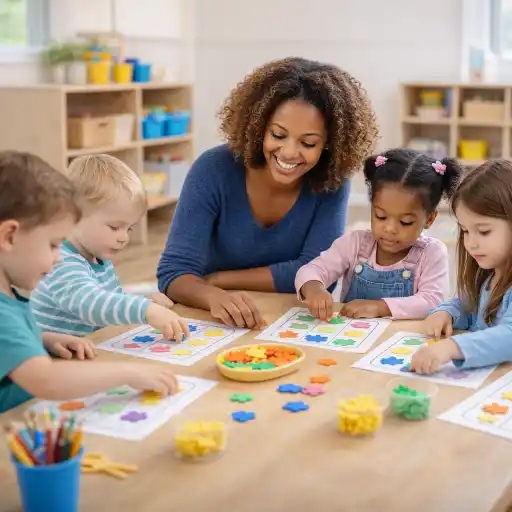 Visual supports are most effective when they are accessible, clearly displayed, and connected to children’s daily experiences.
How can center labels and play prompts strengthen independence?
Every preschool room benefits from center signs and picture labels. These materials help children locate supplies, make choices, and restore the environment without waiting for an adult. Pair a short word with a photograph, icon, or object representation.
- Block, art, library, sensory, writing, math, and dramatic-play signs
- Picture labels for shelves, baskets, and containers
- Simple cleanup cards
- Center-capacity signs
- Vocabulary cards connected to current investigations
- “Work in progress” signs for constructions children want to revisit
Labels should support agency rather than control play. A photograph identifying wooden blocks can help children return materials while leaving construction open-ended. Keep storage accessible, limit visual clutter, and update labels when the room changes.
Play prompts can extend children’s thinking without prescribing one correct result. In the block area, offer photographs of bridges or towers. In dramatic play, add menus, tickets, maps, or appointment cards. In the science area, provide picture cards showing “notice,” “predict,” and “test.”
🧩 Pair each prompt with real materials—blocks, counters, puppets, books, natural objects, or recycled materials—so children manipulate, talk, and make decisions. Spicing Up the Classroom: Learning Centers Buy Now $16.00 can help providers connect center design and materials with children’s development and growing #independence.
Which literacy, math, and creative printables deserve a place in the resource binder?
A balanced binder should contain flexible tools that can be used with real objects, conversation, movement, and social interaction. Literacy resources might include name cards, picture-word cards, story-sequencing cards, rhyming cards, letter-matching cards, and simple book-making pages.
Math resources can include number cards, dot cards, counting mats, ten frames, shape cards, pattern strips, sorting labels, and graphing pages. Creative resources may include open-ended drawing prompts, visual art invitations, puppet templates, and child-created book pages.
- Pair number cards with counters, buttons, shells, or blocks.
- Use shape cards with construction materials or classroom shape hunts.
- Invite children to retell stories with puppets and sequencing cards.
- Offer name cards during sign-in, magnetic-letter play, or writing-center work.
- Use drawing and dictation pages to record children’s ideas rather than requiring identical written products.
Worksheets may support brief, purposeful practice, but they should not become the primary curriculum. NAEYC’s discussion of playful learning emphasizes that children’s active choice and joyful engagement can coexist with intentional learning goals. A printable is strongest when it helps children do something meaningful: count objects, explain a pattern, represent an experience, or communicate an idea.
For guidance on planning short, purposeful experiences, consider Lesson Planning for Preschoolers Buy Now $24.00. The course can help teachers connect materials to developmental goals and adapt activities for individual children.
You can also check out our ready-made, budget-friendly resources that you can use in your classes
What documentation and family-communication forms are essential?
Keep a concise observation form on a clipboard in each classroom or learning area. It should prompt teachers to record the date, context, exact words or actions, relevant developmental area, and a possible next step. Objective notes such as “Maya placed six counters in a row and said, ‘I need one more’” are more useful than judgments such as “Maya is behind.”
A weekly planning template can connect observations to goals, materials, experiences, adaptations, and reflection. Documentation should support responsive planning rather than become a compliance exercise.
Family-facing printables should create partnership rather than paperwork. Keep ready:
- A weekly learning overview with songs, stories, and vocabulary
- A “What we explored today” note
- Family questionnaires about interests, languages, and traditions
- Home activity suggestions using ordinary materials
- Positive individual observation notes
Protect confidentiality, obtain permission before sharing photographs, and offer preferred-language versions whenever possible. State requirements vary - check your state licensing agency, especially for attendance, health, safety, and required documentation forms.
The course Preschool Assessments & Observations Buy Now $24.00 can deepen staff knowledge about objective observation, appropriate assessment tools, and individualized planning. These skills make a printable observation sheet more useful because teachers understand how to interpret and apply what they record.
How should directors organize and evaluate a printable collection?
Create both a digital archive and a physical grab-and-go binder. Organize files by purpose: routines, centers, literacy, math, social-emotional learning, planning, assessment, family communication, health, and safety. Use clear filenames and keep one protected master copy.
Before adopting a printable, ask:
- What specific need does this solve?
- Can children understand it with limited adult help?
- Is it developmentally appropriate and accessible?
- Does it reflect enrolled children and families respectfully?
- Will staff use it consistently?
- Does it protect privacy and follow licensing expectations?
Laminate high-use cards or place them in sheet protectors, but do not laminate everything. Writing forms may need to remain flexible for detailed notes. Check copyright and usage permissions before copying or distributing materials beyond the program.
Common mistakes include printing too much, using worksheets as the primary curriculum, posting confidential information, and failing to teach children how visuals work. Start with two or three tools, pilot them for two weeks, and ask whether children are more independent, transitions are calmer, and documentation is more useful. If not, simplify and reteach the system.
For broader guidance on selecting materials and arranging a welcoming environment, explore Classroom Setup for Child Care Buy Now $24.00. It focuses on the classroom as a “second teacher,” including intentional arrangement, inclusive materials, and spaces that support children’s participation.
Conclusion: Which printable activities belong in every preschool classroom?
The best collection is small, intentional, durable, and connected to play. Every preschool classroom should keep the following core materials available:
- A visual daily schedule, plus First–Then and transition cards.
- Center signs, picture labels, and cleanup prompts.
- Literacy and math cards that pair with manipulatives and conversation.
- Open-ended creative prompts, drawing pages, and book-making materials.
- A concise observation form and weekly planning template.
- Family communication sheets and culturally responsive home connections.
- Social-emotional visuals, including feelings and calming choices.
Printables should make the classroom more understandable—not more cluttered. When providers select a few durable tools, teach their use, adapt them for individual children, and review their impact, a single page can support #transitions, stronger #documentation, richer #play, responsive #teaching, and growing independence. The guiding question remains simple: does this printable help children participate, communicate, explore, or make meaning? If it does, it belongs in the classroom system.
Recommended ChildCareEd courses
- 45 Hour Child Growth and Development
- Lesson Planning for Preschoolers
- CDA Home Visitor Subject Area 3 Part 3 Birth to 5
- Building Equity: Inclusionary Practices in Preschool
- 45 Hour Preschool Methods and Materials
- CDA Bridge Bundle: Preschool
- CDA Bridge Bundle: Preschool without Portfolio Review
- 45-Hour Infant and Toddler Curriculum
- Every Moment Matters: Schedules and Transitions
- 📜 ¿Qué es el Título 22 en el cuidado infantil de California?
- ¿Cuáles son las mejores actividades del Día de la Tierra para niños en casa o en el aula?
- Actividades de Motricidad Gruesa que Desarrollan el Equilibrio, la Coordinación y la Fuerza
- Actividades de Fiesta para Niños de Preescolar y Primaria
- Temas y Actividades para el Día Nacional del Kindergarten para Proveedores
- A Simple Guide to Toddler and Preschool Lesson Plans
- How can we celebrate diversity and inclusion in California early childhood classrooms?
- Calabazas, hojas y manzanas: actividades de otoño para preescolares
- How can I start a small garden project with New York preschoolers?
- Preschool Team-Building Activities for Better Communication and Friendship
- Learning Through Choice: Why Do Classroom Choice Boards Work?
- How Can We Celebrate Every Family and Create a Classroom Where Everyone Is Represented?
- How Can Printable Activities Save Teachers Hours of Prep Time?
- Which Low-Cost Printables Make the Biggest Classroom Impact?
- What Are the Best Print-and-Play Activities for Substitute Teachers?
- What Printables Should Every Preschool Classroom Have on Hand?
- How Can Bilingual Printables Help Spanish-Speaking Families Feel Included?
- How Can Printable Books Help Preschoolers Fall in Love With Reading?
- Which Printable Activities Belong in Every Preschool Classroom?
- How Do Animal Classification Activities Build Early Science Thinking?
