When children decide how a collection belongs together, a simple sorting center becomes a rich exercise in reasoning, choice, and discovery. For a practical foundation in child-directed Montessori experiences, explore ChildCareEd’s Implementing the Montessori Curriculum  Buy Now $32.00; the course can help you connect independence, prepared materials, and inclusive classroom practice. Keep reading for ways to turn familiar color matching into open-ended classification that helps children think for themselves.
Why let children choose the sorting rule?
Color matching gives children a clear place to begin: they notice a shared feature and group objects accordingly. Yet when color is always the adult’s chosen rule, children may learn to follow directions without exploring how they themselves make sense of materials. Inviting a child to choose the rule shifts the activity from “find the expected answer” to “notice, decide, and explain.”
That shift matters. To invent a sorting rule, children examine attributes, compare objects, test a possible category, and decide whether each item fits. They might group buttons by color, then see a collection of large buttons, buttons with four holes, or buttons that feel smooth. The same items can form different sets depending on the question being explored. Early math guidance describes classification as a foundation for later mathematical ideas; NAEYC likewise highlights how sorting helps children notice similarities and differences across learning areas.
Child choice also supports agency and persistence. When children see their own ideas taken seriously, they have a reason to keep investigating—even when a category is surprising or needs revision. For providers, the goal is not to abandon teaching; it is to make room for children’s thinking while offering purposeful materials and responsive prompts.
- Children practice attention, comparison, memory, and decision-making.
- They encounter language such as attribute, group, category, alike, and different.
- They learn that one object may fit more than one category.
How does open-ended sorting build critical thinking and classification?
Classification is the process of organizing objects or ideas according to shared characteristics. In a child-directed sort, the child must identify a feature that matters to them, apply it consistently, and consider what belongs in the group. This is early logical reasoning: a child is not only placing objects but constructing a rule and checking it against evidence.
Start with a small, varied collection—large blocks, safe natural items, toy vehicles, fabric swatches, or picture cards. Ask, “What do you notice?” and let children handle and examine the materials. When a child begins a group, ask, “What do these have in common?” or “How did you decide?” Their explanation may reveal a rule adults did not anticipate: a child may group objects that roll, items found outdoors, or things they use during pretend cooking.
Re-sorting is a particularly valuable next step. Once a child has completed one arrangement, invite them to return the objects to a mixed collection and choose a new rule. The realization that one collection can be organized in multiple reasonable ways nurtures cognitive flexibility.
- Try “sort it your way,” then ask the child to name or show the rule.
- Offer a “mystery sort”: sort a few objects and invite children to infer the category.
- Invite children to change the rule and explain what they noticed.
How can sorting choices nurture independence?
Independence grows through meaningful opportunities to choose, act, and see the results of one’s decisions. A sorting invitation can support this when materials are accessible, the task is understandable, and the adult gives children room to proceed without directing every move. In a Montessori-inspired setting, the prepared environment matters: a limited selection of safe, appealing materials, trays or baskets, and child-height storage make it easier for children to begin and complete work independently.
Offer a brief demonstration only when useful, such as showing how to return materials to the shelf. Then step back and observe. Children may need time to explore before they settle on a rule; silence or a first attempt that differs from yours is not necessarily a sign that they are stuck. If support is needed, offer a small prompt—“I see you have a group of rough things”—rather than taking over the sorting.
Independence does not mean every child must work alone or without support. Children can sort alongside peers, decide how to share materials, and ask an adult for help while remaining active decision-makers. Adjust the number of objects, position of the materials, or response options so children with different motor, sensory, language, and attention needs can participate. ChildCareEd’s Montessori curriculum training overview offers additional context on balancing child- and teacher-directed experiences.
- Arrange materials so children can reach, use, and return them safely.
- Wait and watch before offering assistance; support should extend, not replace, the child’s decision.
- 🧺 Let children choose a collection from a small set of safe classroom materials.
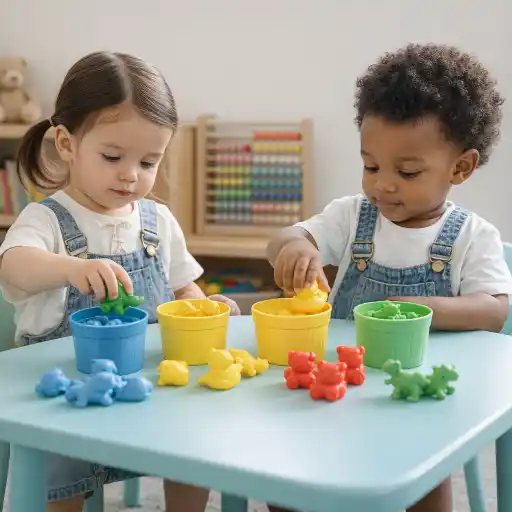
What practical sorting invitations can you offer?
Use materials that invite children to notice more than one feature. A small basket of large blocks, toy animals, leaves, or fabric pieces can lead to many sorts without elaborate preparation. Keep the collection manageable, and select items that are age-appropriate and safe under your program’s supervision practices. Avoid small loose parts when they may pose a choking risk.
For a simple launch, place the materials on a tray and say, “You can put together things that belong together. You decide how.” Avoid naming a rule at the outset; doing so turns an open invitation into a teacher-assigned task. When a child has made groups, listen for their explanation and record a short quote if it captures their thinking.
- Nature collection: Sort safe leaves or large natural objects by shape, size, texture, or where they were found.
- Vehicle basket: Group toy vehicles by where they travel, number of wheels, or whether the child has seen one in real life.
- Classroom cleanup: Invite children to decide which objects belong together, then compare their groupings with picture labels on shelves.
- Color Match Activity: Use ChildCareEd’s Color Match Activity resource as a familiar starting point. After children match pictures by color, invite them to organize the same pictures by another feature, such as object type or use.
- Mystery groups: Let one child create a group while peers guess the rule, then switch roles.
Open-ended work and focused practice can complement each other. A matching activity can introduce a clear attribute, while child-chosen sorting helps children transfer the idea beyond a page or a single expected solution.
How can providers scaffold, adapt, and observe learning?
Scaffolding means offering just enough support for a child to take the next step while preserving the child’s role in the work. Begin with the child’s idea and adjust the challenge gradually. A child who is new to sorting may benefit from a small set of familiar objects and two visible groups. A child who sorts confidently may be ready to make a second arrangement, include a more subtle attribute, or explain an exception.
Make participation accessible. Pair spoken words with objects, photographs, gestures, or labels; welcome home-language explanations; and accept pointing, signing, drawing, or communication devices as ways to show a rule. Large objects, adapted tools, nonslip trays, or a partner who moves materials at the child’s direction can reduce motor barriers. If color is part of the activity, provide symbols or labels as well, so success does not depend on color perception alone.
Observe the process, not just whether a child’s groups match your expectation. Notice whether the child identifies a feature, uses a rule consistently, revises a placement, explains a decision, or collaborates with peers. Brief notes such as “Grouped vehicles by where they travel, then changed to number of wheels” can guide the next invitation. Avoid correcting a surprising grouping before asking about the child’s reasoning. State requirements vary - check your state licensing agency when connecting documentation or training to local expectations.
- For a lighter challenge, reduce the objects and offer clear visual cues.
- For an extension, ask the child to sort the same objects a second way.
- Use the observation to plan a next step, not to label a child’s ability from one activity.
Conclusion: What is the value of letting children choose?
Letting children choose the sorting rule makes classification a meaningful act of thinking rather than a routine exercise in matching. As children observe attributes, form groups, explain decisions, and try a new rule, they practice critical thinking, flexibility, language, and emerging mathematical concepts. Their choices also strengthen independence: children experience themselves as capable participants whose ideas can guide learning.
Providers can make this approach practical with safe, accessible materials, a manageable collection, open-ended prompts, and patient observation. Begin with a familiar activity such as the ChildCareEd Color Match Activity, then invite children to reorganize the same pictures in a way they choose. For more complete professional learning about prepared Montessori experiences, inclusive practice, and child- versus teacher-directed activities, explore or purchase Implementing the Montessori Curriculum Buy Now $32.00. The central question—what happens when children choose the sorting rule?—has a powerful answer: they get to practice being thinkers, decision-makers, and learners.
Further ChildCareEd courses: Early Mathematics Through Play Buy Now $24.00; Math Foundations in Early Childhood Buy Now $16.00; Inclusive Lessons for Preschoolers Buy Now $16.00.
- Many Colors, One Canvas: MD ECE Conference
- Teacher-Child Interactions for Stronger CLASS® Outcomes
- The Montessori Classroom: Theory to Practice
- Montessori Foundations
- Emergent Learning & Development
- Sensitive Periods in Montessori: Guiding Natural Learning
- Creating Environments that Nurture Growth and Community
- Texas Director Credential Renewal
- Texas Director Credential
- Montessori Cultural Activities: Exploring the World Through Play and Learning
- ❤️ ¿Cómo ayudan los educadores a las familias a acceder a los servicios que necesitan?
- ❄️ ¿Qué actividades al aire libre funcionan bien para los niños de Illinois en cada estación? 🌷🍂
- ¿Cuáles son las mejores actividades del Día de la Tierra para niños en casa o en el aula?
- Cómo Iniciar el Proceso de Obtención de la Licencia de Cuidado Infantil
- Regulaciones de Licenciamiento de Cuidado Infantil en California para Centros y Hogares de Cuidado Infantil Familiar
- Proporciones de Cuidado Infantil y Tamaños de Grupo por Edad en Wisconsin (Guía Rápida para Centros y Hogares)
- Proporciones de Cuidado Infantil y Tamaños de Grupo por Edad en Nueva Jersey (Guía Rápida para Centros y Hogares)
- Normas de Licenciamiento de Cuidado Infantil en Illinois: Guía para Centros y Hogares de Cuidado Infantil
- Lista para Abrir una Guardería en Casa en Carolina del Norte: Cómo Empezar
- Cómo Celebrar el Día Nacional del Kindergarten
- Count It, Sort It, Find It! Fall Math Games for Preschoolers
- How Can Cut, Sort, and Glue Activities Strengthen Early Learners’ Development?
- How Can Color Bingo Reinforce Vocabulary and Visual Discrimination?
- How Can Sorting Activities Strengthen Early Thinking Skills?
- How Can Hands-On Sorting Support Math and Language Together?
- What Should Providers Put in a Classroom Waiting Basket?
- How Can a Fourth of July Activity Pack Blend Literacy and Math?
- How Do Color-Matching Activities Support Early Classification Skills?
- How Can Preschool Bingo Build Shape Reasoning Beyond Naming?
- Beyond Color Matching: Letting Children Choose the Sorting Rule
