A child who confidently matches a triangle to its outline but cannot recreate it with loose pieces is showing a meaningful difference between recognizing a shape and composing one—not a lack of ability. To turn that observation into supportive next steps, explore Early Mathematics Through Play Buy Now $24.00; this course offers practical ways to teach geometry and other early math concepts through play, routines, and hands-on exploration.
Why are matching and rebuilding different skills?
Matching asks a child to notice that two visual forms are alike. The outline provides strong clues, and the child can compare the whole shape at once. Rebuilding asks for several additional actions: identify the component pieces, decide how they relate, rotate or flip them, and keep the emerging design in mind while working. A child may know what a square looks like and still be learning how two triangles can form one.
This distinction is useful for observation. Shape recognition involves noticing and classifying; shape composition involves understanding spatial relationships and how parts combine into a whole. As children build, they may also use working memory, flexible thinking, and fine-motor coordination. These are connected skills, but they do not necessarily develop at the same pace for every child.
Spatial play deserves attention because it is part of early mathematical thinking, not simply a warm-up for number work. The OECD overview Shapes, blocks, puzzles and origami: From spatial play to STEM learning describes how manipulating objects and thinking about spatial relationships can support later STEM learning. The NCETM also emphasizes that children need experiences composing shapes, rotating them, and exploring how parts fit together.
Instead of concluding that a child “doesn’t know shapes,” consider a more precise question: Which part of the task is challenging—choosing the pieces, orienting them, joining them, or persisting through trial and error? That question points toward useful teaching rather than a label.
Why does the difference matter in a child care classroom?
Recognizing shapes is valuable, but early geometry also asks children to visualize, transform, and describe shapes. When children build, they test ideas: “Will this piece fit?” “What happens if I turn it?” “Can these two parts make a larger shape?” Those experiences support reasoning, language, and problem-solving. A failed attempt can be productive information when adults give children time to notice and revise.
Matching and construction also give providers different evidence of learning. A child may point to the correct shape but be unable to explain its features or make one independently. Another child may not name a shape yet demonstrate thoughtful spatial reasoning by rotating pieces until they fit. Observing both the answer and the strategy gives a fuller picture than a right-or-wrong check alone.
These experiences can be made accessible to children with varied strengths and needs. Larger pieces, high-contrast outlines, a stable work surface, fewer pieces at first, or extra time can reduce barriers without reducing the mathematical idea. Adults can invite children to communicate by speaking, pointing, gesturing, or demonstrating. For additional background on geometry and spatial thinking, see DREME’s overview of executive function in preschool geometry activities.
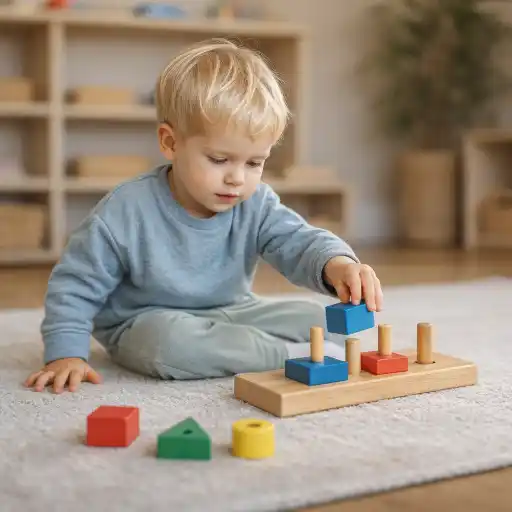
There is no need to turn a play invitation into a test. A warm, curious response—“You found a way to make the corners meet”—helps children see themselves as capable learners. Brief, repeated opportunities with #shapes, building materials, and supportive language can make mathematical thinking part of everyday classroom life.
How can providers scaffold shape building without taking over?
Start by watching. Offer a clear outline or simple model and a small selection of appropriate pieces. Notice whether the child compares the whole design, tries pieces one by one, rotates them, or asks for help. Then provide the smallest prompt that might extend the child’s thinking. A pause is often a useful scaffold: children need time to look, act, and reconsider.
- Begin with a simple design made from two or three large pieces, then add complexity when the child is ready.
- Invite children to trace the outline with a finger before choosing pieces.
- Model spatial vocabulary naturally: “turn,” “flip,” “beside,” “edge,” “corner,” and “fit.”
- Ask open questions such as, “What could you try next?” or “What do you notice when you turn it?”
- Give a clue rather than the answer: “This space has three sides. Which piece might have three sides too?”
- 🧩 Celebrate strategies and persistence, not just a finished picture: “You turned that piece and checked again.”
Use guided participation while protecting children’s agency. A teacher might demonstrate rotating one piece, then return the materials for the child to continue. Avoid moving pieces into place for the child unless the purpose is simply to model a step and the child is invited to try afterward. The goal is not a perfect product; it is the child’s growing ability to notice relationships and make decisions.
Vary shape examples and orientations. A square turned onto a point remains a square, and triangles can have different side lengths and orientations. Children benefit from seeing that shapes are defined by their properties, not only by one familiar picture. The NCETM’s Shape and Space guidance recommends opportunities to select and rotate shapes, make constructions, and discuss how forms fit together.
What activities help children move from matching to composing?
Choose activities that make the relationship between the outline and its parts visible. Begin with familiar, achievable designs and gradually invite children to create their own. Keep materials safe and appropriate for the children’s ages; small pieces can pose a choking hazard for young children and require careful selection and supervision.
- Outline-and-fill: Place a large outline on a mat and offer a few pieces that can cover it. Invite the child to rotate or reposition pieces as needed.
- Two-piece challenge: Ask, “Can two triangles make a square or a larger triangle?” Offer several sizes so children can compare possibilities.
- Copy, then change: Build a simple design together, cover the model, and invite the child to reconstruct it. Later, encourage a new version.
- Build with varied materials: Use large foam shapes, magnetic pieces, cardboard forms, or blocks. Different materials offer different ways to explore joining and arranging.
- Make a picture: Invite children to compose a house, animal, or vehicle from shapes, then describe which pieces they selected and why.
- Body and movement: Make large shapes with ropes or floor markers and let children walk around the edges before building a smaller version.
Keep the experience playful and responsive. If a task becomes frustrating, reduce the number of pieces, use a clearer model, or return to free exploration before trying again. The aim is repeated practice with a manageable challenge, not rapid progression through a set of cards.
For related classroom ideas, ChildCareEd’s article How Can I Help Children Understand Shapes and Patterns? offers play-based approaches to early geometry. Providers can also explore the Shape Matching Activity Worksheet Buy Now $0.00 as a recognition activity, then extend the same concept with physical pieces so children move from identifying to constructing.
How can providers observe progress and avoid common pitfalls?
Assessment can happen during play. Record what the child does, what support is needed, and what might be a helpful next step. A brief note such as “Matched the triangle outline; rotated two pieces independently; needed a prompt to notice the gap” is more informative than “knows triangles.” Photos of a child’s construction, paired with their explanation, can also document thinking over time.
Look for changes across opportunities rather than treating one attempt as a definitive measure. Does the child begin rotating pieces without prompting? Can they anticipate which piece might fit? Do they combine pieces to make a larger form, or explain what they are trying? These observations help educators adapt the next invitation. Developmental milestones are general guides, not fixed deadlines; the CDC’s milestone checklists should be considered alongside each child’s individual context and the family’s observations.
Common pitfalls are easy to avoid:
- Assuming matching proves construction mastery: observe both recognition and hands-on composition.
- Correcting too quickly: allow time for trial, error, and self-correction before offering a clue.
- Using only one example or orientation: include varied sizes, colors, orientations, and types of triangles and other shapes.
- Making the task harder too soon: adjust the number, size, and complexity of pieces based on what the child is doing.
When documentation or training relates to program compliance, state requirements vary - check your state licensing agency. For focused professional learning on geometry, patterns, and other early math concepts through play, providers may find No Such Thing as Boring Math  Buy Now $24.00 a helpful additional course.
Conclusion: What should providers remember?
A child can match a shape and still be learning to rebuild it because recognition and composition ask for different kinds of thinking. Matching relies on noticing a visual likeness; construction adds choosing parts, rotating them, comparing relationships, and persisting through attempts. This gap is not a reason to worry or rush. It is useful information for planning the next playful experience.
Offer clear outlines, a small range of safe materials, varied shape examples, and time to explore. Observe the child’s strategy, use precise spatial language, and provide a prompt or model only when it helps the child continue thinking. Celebrate the process as well as the finished design, and adapt materials so every child can participate meaningfully.
In short, when a child can match but not yet rebuild a shape, meet them where they are and provide repeated chances to compose, turn, compare, and explain. That is how providers support confident early mathematical learning through play Buy Now $24.00.
Further learning: Which courses can support early math practice?
- Early Mathematics Through Play Buy Now $24.00 — explores geometry, patterns, and other math ideas through hands-on classroom experiences.
- Math Foundations in Early Childhood Buy Now $16.00 — focuses on integrating early math and exploration into teaching practice.
- No Such Thing as Boring Math Buy Now $24.00 — connects intentional play with children’s mathematical exploration.
- The Best Promotion is Play Buy Now $24.00 — examines how providers can support learning through play.
- Enhancing STEM Education for Infants and Toddlers Buy Now $16.00 — addresses early math and inquiry with infants and toddlers.
- 45 Hour Child Growth and Development
- Birth to Five CDA Credential with Portfolio Review
- 45 Hour Infant and Toddler Methods and Materials
- CDA Bridge Bundle: Family Child Care without Portfolio Review
- 45-Hour Infant and Toddler Curriculum
- Texas Director Credential
- 45 Hours Director-Administration ONLINE
- 45 hour Growth and Development Birth-age 12 ONLINE
- Every Moment Matters: Schedules and Transitions
- CDA Certification en Español: Recursos y Consejos para Educadores Bilingües
- 💛🧩 ¿Cómo puedo hacer que mi enseñanza sea inclusiva para los niños con autismo?
- 👶 ¿Cuáles son las proporciones y grupos requeridos en Dakota del Norte? 🏫
- 🚨 Reporte Obligatorio en Nevada
- Cómo Abrir Una Quardería En Casa Sin Dinero?
- Proceso CDA: Entrenamiento, Portafolio, Examen y Visita de Verificació
- ¿Cómo puedo usar escenarios de juego de roles de primeros auxilios en mi aula?
- ¿Cómo afecta la dopamina a los niños: señales, efectos e influencias diarias?
- 10 Ejemplos de Cómo la Cultura Influye en el Desarrollo Infantil
- Cómo Empezar una Guardería en Casa: Requisitos y Pasos
- Proporciones de Cuidado Infantil y Tamaños de Grupo por Edad en Maryland (Guía Rápida para Centros y Hogares)
- Proporciones de Cuidado Infantil y Tamaños de Grupo por Edad en Nueva Jersey (Guía Rápida para Centros y Hogares)
- Proporciones de Cuidado Infantil y Tamaños de Grupo por Edad en Virginia (Guía Rápida para Centros y Hogares)
- Cómo Trabajar en el Cuidado Infantil en Wisconsin: Requisitos y Pasos
- Celebrando la amistad en el cuidado infantil durante el Día de los Mejores Amigos
- Cómo simplificar la capacitación para sus empleados de daycare
- How can New York child care programs teach conflict resolution and sharing?
- How Can Preschoolers Build Towers of the Same Height with Different Numbers of Blocks?
- Why Can a Child Match a Shape but Struggle to Rebuild It with Pieces?
