When children turn over cards, compare pictures, and search for pairs, they are doing far more than playing—they are practicing how to notice, remember, and interpret visual information. Explore Play, Learn, Grow Online Version  Buy Now $16.00 to strengthen your understanding of developmentally appropriate play, learning styles, and milestones, and consider The Best Promotion is Play Buy Now $24.00 for practical strategies that connect playful experiences with cognitive growth and classroom practice.
Why does visual discrimination matter in early childhood?
Visual discrimination is the ability to recognize similarities and differences among objects, pictures, shapes, colors, sizes, patterns, and orientations. It is one part of visual perception: the brain’s process of organizing and making meaning from what the eyes see. A child may have clear eyesight yet still need support interpreting visual information accurately.
This capacity develops gradually and supports everyday participation. Children use it when they locate a familiar cup among many objects, distinguish one puzzle piece from another, match socks, recognize symbols, or find a particular picture in a book. Later, related skills contribute to recognizing letters and numerals, noticing differences between similar forms, following visual patterns, and organizing information on a page. Resources on visual discrimination describe its importance for foundational literacy, numeracy, and independence.
Memory and matching games are especially useful because they combine visual comparison with recall. Children must look closely, remember where an image appeared, and decide whether two items belong together. The experience is brief, social, repeatable, and naturally motivating—qualities that make practice feel like #play rather than remediation.
- Builds visual attention and comparison.
- Strengthens visual memory and recall.
- Encourages language for describing attributes.
- Supports turn-taking, persistence, and flexible thinking.
How do memory games strengthen visual discrimination?
A traditional memory game asks children to turn over two cards and determine whether they match. Although the rules are simple, the cognitive sequence is rich: attend to the card, encode its features, remember its location, compare it with a second card, and update the mental map of the game.
Visual discrimination becomes stronger when children are encouraged to examine more than the overall image. Ask, “What makes these pictures the same?” or “Which detail is different?” Children may notice color, shape, size, orientation, pattern, facial expression, or position. These observations help them move from global recognition—“They look alike”—to more precise analysis—“Both have stripes, but one has three and the other has four.”
Working memory is also involved. Children hold a recently seen image and its location in mind while considering new information. The NAEYC discussion of games and executive function connects playful activities with working memory, inhibitory control, and cognitive flexibility. These skills are not isolated academic abilities; they help children follow routines, wait, shift attention, and persist through challenges.
Begin with a small number of pairs and identical images. As children gain confidence, introduce related-but-not-identical images, rotated forms, varied backgrounds, or attributes that require closer inspection.
How can Flip Flop Matching become a purposeful learning experience?
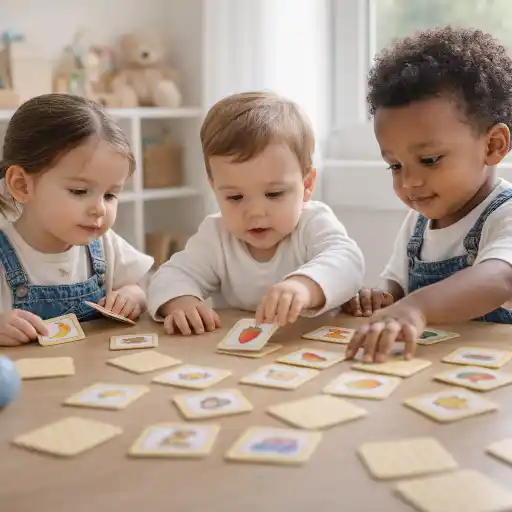
Flip Flop Matching can serve as an engaging resource for small groups, learning centers, or one-to-one practice. Its value is not simply in finding the most pairs. Educators can intentionally frame each turn as an opportunity to observe, compare, explain, and remember.
Start by modeling a calm routine: choose a card, look carefully, name what you notice, and turn over a second card. If the cards do not match, help children remember their locations without immediately solving the problem. Phrases such as “I saw that picture near the corner” or “Let’s check the color and shape again” make the thinking process visible.
- Use fewer pairs for an introductory round.
- Invite children to describe each card before flipping another.
- Place cards in consistent rows to support visual scanning.
- Ask children to predict where a match might be.
- Celebrate careful observation, not just correct answers.
After a round, extend the learning. Children can sort matched pairs by color, category, size, or pattern. They can draw a favorite pair, create a new pair with classroom materials, or explain their strategy to a peer. Connecting the game to real objects—such as matching classroom tools or natural materials—helps children transfer visual discrimination beyond the table.
Which variations increase challenge without creating frustration?
Effective differentiation changes one variable at a time. If children readily match identical pictures, keep the number of pairs manageable while changing the visual demand. For example, use the same object in different sizes, rotate a shape, vary the background, or offer pictures that share a color but differ in form.
Useful variations include:
- “Same or different?” with nearly similar images.
- Matching objects to photographs or picture symbols.
- Matching by one attribute, then by two attributes.
- Recreating a short visual pattern after viewing it briefly.
- Removing one card and asking, “What is missing?”
- Adding movement by having children walk to a matching object.
Monitor cognitive load. Too many cards, visually busy designs, tiny details, or unclear rules can shift the task from productive challenge to guessing. Short rounds with repeated success are often more beneficial than a long session. Offer a cooperative goal, such as completing one shared set, when competition increases pressure.
Remember that visual discrimination is different from visual acuity. If a child frequently squints, tilts their head, avoids visual tasks, or continues to struggle despite appropriate adaptations, document objective observations and communicate with the family. The American Academy of Ophthalmology notes that signs such as frequent squinting, head tilting, or avoiding reading warrant discussion with a health professional.
How can providers make matching games inclusive and assess learning?
Inclusive design begins with the learning goal. If the goal is comparing visual attributes, the response does not have to be verbal or depend on a particular fine-motor action. Children may point, gesture, use eye gaze, select a symbol, or work with a partner. Provide high-contrast materials, enlarged images, uncluttered backgrounds, and adequate lighting when helpful.
Do not rely on color alone. Pair color with shape, pattern, texture, photographs, or words so children with color-vision differences or varied visual processing can participate fully. For children developing more than one language, use gestures, familiar objects, home-language labels, and peer modeling. For children who need additional structure, offer a visual sequence showing “choose, look, match, return.”
Observation during play can provide meaningful assessment evidence. Note whether a child:
- scans the available choices before selecting;
- recognizes identical or related features;
- remembers card locations;
- uses descriptive vocabulary;
- persists after an unsuccessful turn;
- adjusts a strategy after receiving a prompt.
Record what the child did rather than labeling the child. A note such as “matched four identical pairs and described two as having the same shape” is more useful than “understands matching.” Use observations to plan the next step. State requirements vary - check your state licensing agency when documenting training or curriculum expectations.
What common mistakes should educators avoid?
One frequent mistake is treating a memory game as a race. Speed can reward guessing and disadvantage children who need more processing time. A slower, conversational format gives educators better information about visual strategies and supports a more affirming classroom climate.
Another mistake is increasing difficulty too quickly. Add cards only when children demonstrate readiness, and consider whether an error reflects visual confusion, memory demand, language comprehension, or difficulty handling the materials. Adjust the relevant barrier rather than assuming the child needs more repetition.
- Do not overcrowd the playing surface.
- Do not correct every response immediately.
- Do not assume all children use identical visual labels.
- Do not use one game as a complete developmental assessment.
- Do not separate the activity from conversation and follow-up.
Directors can support quality by ensuring that staff know the objective for each game, have accessible materials, and share brief observation notes during planning meetings. A matching game may target visual discrimination one week and vocabulary, classification, or social interaction the next. The materials stay familiar while the intentional teaching changes.
Conclusion: How do memory and matching games support visual discrimination?
Memory and matching games support visual discrimination by giving children repeated, meaningful opportunities to attend to detail, compare attributes, remember visual information, and explain decisions. When educators use resources such as Flip Flop Matching intentionally, they can transform a simple game into a flexible learning experience that supports cognition, language, fine-motor participation, social development, and confidence.
The strongest practice is responsive rather than rigid: begin with accessible materials, increase complexity gradually, adapt participation methods, and observe the strategies children use. Pairing playful practice with professional learning such as Play, Learn, Grow Online Version Buy Now $16.00, The Best Promotion is Play Buy Now $24.00, Role of Play in Learning Buy Now $16.00, Spicing Up the Classroom: Learning Centers Buy Now $16.00, and Preschool Assessments & Observations Buy Now $24.00 can help providers connect play, planning, inclusion, and documentation. The goal is not simply to find a pair; it is to help each child become a more confident observer and thinker.
- Moving About the Classroom: Effective Transitions for Everyday
- CDA Home Visitor Subject Area 3 Part 3 Birth to 5
- Administering Basic Health and Safety ONLINE
- From Play to Planning: Building Culturally Competent, Child-Centered Curriculum
- Money Matters in Medicine
- The Best Promotion is Play
- Play, Learn, Grow
- Texas Director Credential
- Theories on How I Grow
- CDA Certification en Español: Recursos y Consejos para Educadores Bilingües
- 🔍 ¿Qué ves cuando observas a un niño aprender?
- 💛🧩 ¿Cómo puedo hacer que mi enseñanza sea inclusiva para los niños con autismo?
- Recursos en Español sobre el Sueño Seguro del Bebé
- Actividades de Motricidad Gruesa que Desarrollan el Equilibrio, la Coordinación y la Fuerza
- Capacitación en Salud y Seguridad Preventiva en Línea para Proveedores de Cuidado Infantil
- Lista para Guardería en Casa en Illinois: Cómo Iniciar una Guardería en el Hogar
- Lista para Guardería en Casa en Texas: Cómo Iniciar una Guardería en el Hogar
- Apoyo en Preescolar para Retrasos del Habla: Estrategias Simples que Ayudan
- Capacitación Previa al Servicio para Proveedores de Cuidado Infantil en Dakota del Norte
- Canciones, juegos y preguntas de círculo para niños
- Cómo simplificar la capacitación para sus empleados de daycare
- How Can Fun Bingo Games Teach Colors, Shapes, and Animals to Preschoolers?
- How Can Sound Bingo Sharpen Listening Skills in Preschoolers?
- How Can Color Bingo Reinforce Vocabulary and Visual Discrimination?
- Why Is Upper- versus Lowercase Sorting Great for Letter Recognition?
- What Skills Can Preschoolers Build Through Bingo?
- How Do Memory and Matching Games Support Visual Discrimination?
- How Can Child Care Providers Move Children from Letter Recognition to Beginning-Sound Awareness?
- How Can Juneteenth Symbols Build Visual Memory in Young Children?
