When a child can name a letter but cannot find its lowercase partner, the missing piece is often visual flexibility—not effort or interest. The Science of Reading Foundations in the Pre-K Classroom Buy Now $16.00 course can help providers strengthen their understanding of alphabet knowledge and plan practical, print-rich experiences; explore it as a next step while considering the strategies below.
Why is recognizing a letter different from matching its two forms?
Recognizing a letter and connecting its uppercase and lowercase forms are related but distinct tasks. A preschooler may recognize a familiar capital—perhaps the first letter of their name—because they have seen it repeatedly on cubbies, labels, or signs. Matching that capital with a lowercase form requires the child to understand that two visually different shapes can share one letter identity: A and a, for example, are both forms of the letter A.
Recognition can be supported by familiarity with one particular shape. Case matching asks for more: the child must retrieve the letter identity, compare visual features, and decide that the shapes belong together. Some pairs look quite different, while others share more features. Learning to connect them takes experience and careful comparison.
It helps to distinguish several skills that adults may accidentally treat as one:
- Visual recognition: noticing or identifying a familiar letter shape.
- Letter naming: saying the letter’s name when shown a form.
- Case matching: pairing uppercase and lowercase versions of the same letter.
- Letter-sound knowledge: connecting a letter with one or more sounds.
A child’s success in one area does not guarantee equal mastery in the others. Assessment should identify what the child can do, not assume that difficulty with a matching card means the child does not know letters. The ChildCareEd article on uppercase- and lowercase sorting likewise frames sorting as an opportunity to compare and classify forms while building flexible alphabet knowledge.
What makes uppercase and lowercase matching challenging?
English readers learn 26 alphabet identities expressed through uppercase and lowercase forms, creating many visual shapes to recognize. The forms do not always resemble one another closely: uppercase G and lowercase g are quite different, while S and s are more alike. A child who has memorized one specific shape may need help broadening that memory into a category that includes both forms.
Exposure also matters. Uppercase letters often stand out in names, signs, and headings, while lowercase letters appear frequently in sentences and books. Children may have unequal experience with the two cases. Developmental differences in attention, visual discrimination, language experience, and fine-motor practice can also affect how quickly children make connections. These factors are reasons to adjust instruction—not to label a child’s ability from one activity.
Letter forms that differ by orientation, such as b and d, may add another layer of difficulty. Preschoolers are still learning that orientation can change a symbol’s identity. The Nemours resource on letter knowledge notes that young children must learn many forms and attend carefully to visual differences; reversals are common during this period.
Providers can reduce unnecessary difficulty by keeping the task focused:
- Begin with a few familiar pairs rather than presenting the whole alphabet.
- Choose examples that are clear and high contrast.
- Use consistent words: “uppercase,” “lowercase,” and “partner.”
- Allow children to point, place, or say an answer; handwriting is not required to show a visual match.
This is a demanding categorization skill, and uneven progress is ordinary. Reassuring children and offering another chance to compare can keep practice positive.
How can providers teach the connection through visual matching?
Make matching a short, playful investigation. The Monster Letter Pairs matching cards Buy Now $2.00 offer a monster-themed printable designed for brief preschool practice. Educators can start with only a few selected pairs and add more as children become comfortable. The resource can be used in a literacy center, small group, or one-to-one activity.
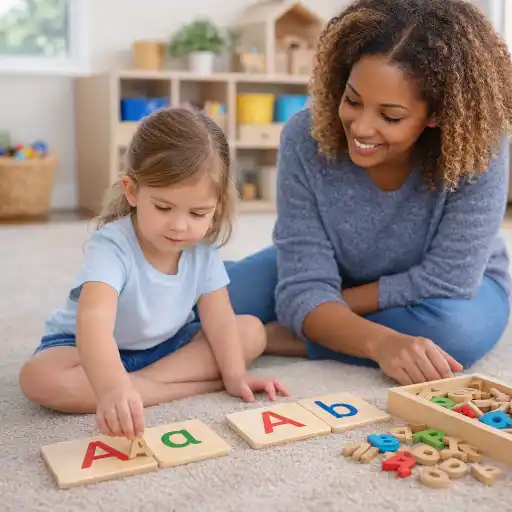
Model how to look closely before asking children to work independently. Say, “Here is uppercase M. I’m looking for its lowercase partner. I’ll compare the cards and see which one belongs with M.” Then think aloud about visible features without implying every pair will look alike. Use the sequence “I do, we do, you do”: model, match together, and then invite the child to try.
- 🔤 Lay out two or three uppercase cards and a small selection of lowercase cards; invite a child to find a partner.
- Say the letter name as each pair is matched: “Uppercase S and lowercase s are the same letter.”
- Offer a choice between two possibilities when an open-ended set feels overwhelming.
- Repeat the same pairs in a new format—cards, magnetic letters, or a matching game—so the goal stays familiar while materials vary.
Prompts should draw attention to visual evidence: “What do you notice?” or “Which card might be the partner?” Avoid turning the task into a speed test. A child who needs time to compare is still doing valuable learning. For more play-centered ideas, see how play can support distinguishing letter cases.
How can letter matching fit into meaningful, inclusive practice?
Isolated cards are useful for focused practice, but children also need to encounter letters in meaningful print. Connect a selected pair to a child’s name, a familiar book, a classroom sign, or a dramatic-play menu. For instance, after matching uppercase and lowercase M, look together for M and m on name cards or in a read-aloud. This helps children see that case forms appear in real reading and writing, not only on activity materials.
Pair visual matching with brief talk and hands-on exploration. Children can trace a form in sand, build it with play dough, or point to its partner while saying the letter name. The aim is to notice and connect forms; perfect handwriting is not a prerequisite. The Head Start guidance on alphabet knowledge and early writing describes learning letter names and forms alongside growing awareness of letter sounds and writing.
Adapt access while keeping the learning objective consistent:
- Use larger cards, strong contrast, and a clear work surface when visual access is helpful.
- Reduce the number of choices or provide a model pair for children who benefit from added structure.
- Allow pointing, eye gaze, or partner-assisted placement when handling cards is challenging.
- Use familiar words, gestures, and home-language connections when they support understanding.
Staff can coordinate by using shared vocabulary and noticing which forms children recognize independently. Families can be invited to spot letters in books or signs without assigning drills. These everyday experiences can make print meaningful and welcoming for every child.
How should providers observe progress and avoid common mistakes?
Observe the process, not just whether a child finishes the activity. Note which forms the child identifies, which pairs cause hesitation, whether the child succeeds with a model or a two-choice prompt, and whether familiar letters are easier. These observations can guide the next activity: revisit a small set, demonstrate a feature, or provide an easier entry point. A brief anecdotal note is often more useful than repeatedly testing the entire alphabet.
A few common pitfalls are easy to avoid:
- Offering too many cards at once: start with two or three pairs, then increase thoughtfully.
- Teaching cases as unrelated alphabets: consistently explain that uppercase and lowercase forms share a letter identity.
- Correcting every hesitation: model calmly, give the child time, and celebrate careful noticing.
- Relying only on worksheets: include hands-on matching, books, labels, and everyday print.
- Confusing recognition with writing: let children demonstrate matching by pointing or placing cards.
For further professional learning, Assessment of Language and Literacy Skills  Buy Now $24.00 explores objective observation and using evidence to shape learning goals. State requirements vary - check your state licensing agency for applicable training or documentation expectations. A responsive approach treats assessment as a way to understand and support a child, not as a label.
Conclusion: What helps preschoolers connect uppercase and lowercase letters?
Preschoolers may recognize letters yet struggle to match cases because identifying one familiar shape is not the same as connecting two different forms to a shared letter identity. The connection grows through repeated visual comparison, clear modeling, manageable choices, meaningful print, and playful practice. Differences in exposure and developmental experience make uneven mastery unsurprising.
Start with a few pairs, say the letter name as forms are compared, and adapt materials so children can participate in different ways. Use observations to decide what to revisit, and keep the experience encouraging rather than test-like. With patient, consistent support, case matching becomes one more engaging step in children’s developing literacy knowledge.
Relevant ChildCareEd courses
- CDA Certification en Español: Recursos y Consejos para Educadores Bilingües
- 🤝¿Cómo fomentar respeto e inclusión en el aula infantil? 🌻
- 🚨 Reporte Obligatorio en Nevada
- Actividades de Motricidad Gruesa que Desarrollan el Equilibrio, la Coordinación y la Fuerza
- Capacitación en Salud y Seguridad Preventiva en Línea para Proveedores de Cuidado Infantil
- Actividades de Otoño Fáciles para Preescolares esta Temporada
- Lista para Guardería en Casa en Illinois: Cómo Iniciar una Guardería en el Hogar
- Lista para Guardería en Casa en Texas: Cómo Iniciar una Guardería en el Hogar
- Capacitación Previa al Servicio para Proveedores de Cuidado Infantil en Dakota del Norte
- Cómo simplificar la capacitación para sus empleados de daycare
- What Are the Best Print-and-Play Activities for Substitute Teachers?
- How Can Clip Cards Prepare Little Hands for Writing?
- Why Is Upper- versus Lowercase Sorting Great for Letter Recognition?
- How Can Child Care Providers Help Children Recognize Letters Through Play?
- How Can Play Help Children Distinguish Uppercase and Lowercase Letters?
- How Can Child Care Providers Teach Beginning Sounds with Tracing, Pictures, and Repetition?
- How Can Child Care Providers Teach Less-Frequent Letters Without Relying on Worksheets Alone?
- ¿Todos los niños deben participar en el tiempo de círculo?
- Why Does MOM Look the Same Backward? Exploring Reversible Letter Patterns
- Why Do Some Preschoolers Recognize Letters but Struggle to Match Uppercase and Lowercase?
