Shape work can invite joyful discovery, but a chart or matching task may not be equally accessible to every child. With flexible materials and thoughtful choices, providers can preserve the Montessori spirit of independence while opening multiple paths into geometry; the Inclusive Montessori: Supporting Diverse Learners in the Classroom  Buy Now $16.00 course offers deeper strategies for adapting practice and strengthening professional knowledge. Read on for practical ways to turn a simple shape invitation into an experience more children can enter with confidence.
Why adapt Montessori shape activities?
Shape activities support more than naming. Children notice boundaries, compare features, build spatial reasoning, use language, and develop hand control as they trace, match, sort, and construct. Yet a single format—such as looking at a wall chart and naming each figure—can create barriers for children who have low vision, use different communication modes, find busy displays overwhelming, or have emerging fine-motor skills.
Inclusion means each child has a meaningful way to participate in a shared learning experience. The goal is not to make every child complete an identical task, but to keep the mathematical idea available while adjusting how children encounter or express it. This aligns with Universal Design for Learning: offer varied ways to represent information, engage learners, and demonstrate understanding. Head Start’s overview of Universal Design for Learning also notes that planning access in advance supports broad participation while individualized modifications remain important when needed.
Montessori practice already gives educators a helpful starting point: observation, purposeful materials, repetition, and respect for each child’s pace. A chart can serve as one visual reference, not the whole lesson. Pair it with objects to touch, shapes to move, language to hear, and choices that allow children to show what they notice. Small changes can strengthen belonging and make the activity richer for the whole group.
How can you prepare an accessible shapes chart and work area?
Begin by considering where and how each child will use the chart. Place it at a child-friendly height, in good light, and where glare or visual clutter is limited. Use clear, uncluttered images, strong contrast, generous spacing, and large labels. If a child benefits from close viewing, offer a portable copy at the work mat rather than relying on a display across the room. Perkins School for the Blind’s guidance on accessible classroom posters emphasizes that posters must be usable in practice—not simply present on the wall.
A chart becomes more useful when it connects to concrete materials. Offer a few large, sturdy shapes and matching objects, then invite children to select one item at a time. Tactile outlines, raised lines, textured borders, or shape pieces with distinct edges can provide additional information beyond color and print. Paths to Literacy offers practical suggestions for geometry resources for learners with visual impairment, including tactile matching and shape-making materials.
- Keep the work surface stable and reachable; use a non-slip mat or tray if pieces slide.
- Reduce the number of choices when a simpler visual field helps a child focus.
- Pair a printed shape name with a spoken label, gesture, object, or home-language word.
- 🧩 Let children choose whether to look, touch, listen, move a shape, or watch before joining.
Keep small parts and tools appropriate to the youngest children present, supervise their use, and maintain clear pathways and sightlines. A carefully prepared environment supports independence, while active supervision protects safety.
How can one shape invitation offer multiple ways to learn?
Choose one shape—perhaps a circle—and offer several ways to explore it. Demonstrate a short, clear presentation: trace the boundary, name what you notice, and pause. Then let children decide how to continue. One child may match a circle to an outline; another may feel its edge, find a circular lid, or roll a wheel along a path. The shared concept stays constant even as the actions differ.
Plan for different ways to receive information and communicate understanding. Say “circle,” show the shape, and offer a real object or a tactile version. Accept pointing, selecting, matching, tracing, building, gesture, speech, or communication-device responses. Give processing time after an invitation, and avoid turning exploration into a rapid-fire quiz. A child’s careful rotation of a shape can show purposeful comparison even without a spoken answer.
Try an adaptable sequence across several days:
- Notice: Find one shape on the chart, in a book, or in the room.
- Match: Pair a shape piece with its outline, duplicate, or familiar object.
- Make: Form a shape with play dough, large sticks, or a movement path.
- Extend: Compare size or orientation, count sides and corners, or combine shapes to make a design.
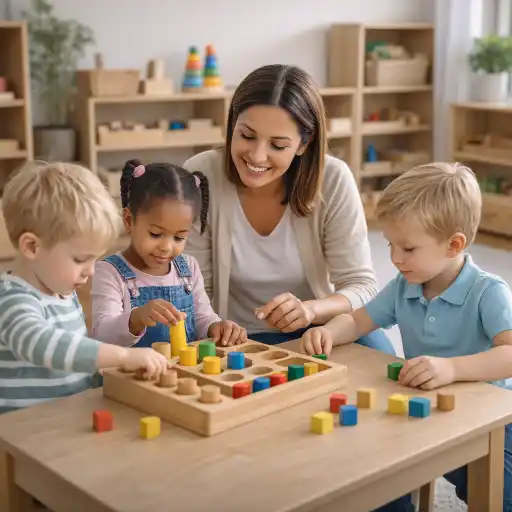
Concrete objects and tactile exploration can help children develop geometry concepts before moving toward more abstract representations. For additional ideas, see the practical approaches described in math adaptations for learners who are blind or visually impaired. Keep materials orderly and offer only the amount of adult help needed for a child to explore successfully.
How do you individualize participation without lowering expectations?
Start with observation rather than assumptions. Notice what captures a child’s attention, which parts of the task are challenging, how they communicate, and what support helps them participate. A child may understand shape properties but find a small card difficult to grasp; another may be ready to compare polygons but prefer to respond by arranging pieces instead of speaking. These are useful planning clues, not reasons to exclude a child or reduce the purpose of the activity.
Adjust the route into the learning goal. For motor access, use larger pieces, add a grip, stabilize the work, or place materials within comfortable reach. For visual access, try high contrast, fewer images, tactile boundaries, or a personal chart copy. For communication access, model vocabulary with gestures and objects, offer picture choices, and welcome home-language labels. If a child benefits from a predictable routine, present the steps in a consistent order and preview what comes next.
Keep expectations meaningful and flexible. A child can demonstrate recognition by matching, sorting, selecting, constructing, or indicating a shape. Offer added complexity to children who are ready: rotate examples, compare properties, create patterns, or combine forms. Do not assume age alone determines readiness. The mixed-age approach described in one shared shape exploration for a mixed-age Montessori group shows how a common inquiry can support varied levels of discovery.
Partner with families and relevant specialists when a child already has recommended supports or when you need guidance. Keep brief, objective notes about what the child tried and what improved access. State requirements vary - check your state licensing agency for applicable supervision and material-safety rules.
What common barriers can educators prevent?
Even a well-intended activity can become inaccessible when adults assume that every child learns through looking, speaking, or manipulating the same small pieces. Reflecting on barriers helps providers change the activity instead of asking children to overcome avoidable obstacles. A shape chart is a resource—not an assessment of a child’s worth or effort.
- Relying on color alone: Use outline, texture, position, spoken labels, and real examples so children can distinguish shapes without color being the only cue.
- Displaying information out of reach: Make a child-sized or portable copy available and check whether the child can actually see or access it.
- Offering too many shapes at once: Start with a manageable set, then add choices when children are ready.
- Demanding a verbal answer: Accept gestures, matching, movement, AAC, and other meaningful forms of response.
- Doing the task for the child: Stabilize or adapt materials, provide wait time, and offer only the support needed to sustain independence.
- Assuming one adaptation fits everyone: Observe the child’s response and revise if the support does not improve access.
Also avoid treating sensory materials as universally comfortable. Some children welcome tactile textures, while others prefer to watch first or use a tool rather than touch directly. Offer an equivalent route without pressure. Likewise, do not make older peers responsible for teaching or supervising younger classmates; peer modeling should be voluntary and supported by the educator.
When a strategy misses the mark, that is information for the next presentation. Ask: Could the child reach the material? Was the visual field clear? Did the task require a response mode the child does not use? A respectful adjustment keeps the mathematical challenge while removing unnecessary friction.
How can you reflect, extend, and build your practice?
After the activity, capture a few concise observations: what the child chose, how they explored, what response they used, and which adaptation helped. Avoid labels such as “not interested” when the child may have been waiting, watching, or encountering a barrier. Concrete notes help a team plan a useful next step and share learning with families in a strengths-based way.
Revisit the same chart with new materials or questions over time. Children might hunt for shapes in the room, make outlines with dough, compare a printed figure to a three-dimensional object, or compose a picture from several forms. These invitations support repetition without requiring a worksheet or identical finished product. The ChildCareEd Early Mathematics Through Play Buy Now $24.00 course provides broader ideas for making geometry and other early math concepts engaging through hands-on play.
For a deeper Montessori-focused study of observation and inclusive teaching strategies, consider the linked Inclusive Montessori course Buy Now $16.00. Other relevant English-language learning options include Implementing the Montessori Curriculum Buy Now $32.00, Montessori Foundations Buy Now $10.00, and Inclusive Lessons for Preschoolers Buy Now $16.00. Explore course details to decide which training best fits your learning goals; state acceptance of professional development varies, so check local requirements.
Most of all, trust the careful work you already do: noticing children, offering choices, and refining materials are central to responsive Montessori practice. An accessible chart paired with meaningful hands-on exploration can help every child find a point of entry and a reason to keep investigating.
Conclusion: How can Montessori shape activities welcome different learners?
Montessori shape activities become more accessible when educators keep the concept shared but make the pathways flexible. Prepare charts that are clear and reachable, pair images with concrete and tactile materials, and welcome varied ways of communicating understanding. Observe each child’s interests and access needs, adapt the space, materials, or steps, and offer the least assistance necessary to support independent exploration.
A shape invitation does not need to look identical for every child to be meaningful. Matching, touching, listening, pointing, building, and searching can all be authentic ways to investigate geometry. With thoughtful planning and reflection, providers can make shape work more welcoming, engaging, and rooted in the Montessori values of respect and independence.
- 45 Hour Child Growth and Development
- The Montessori Classroom: Theory to Practice
- 45 Hour Infant and Toddler Methods and Materials
- 45 Hour School Age Methods and Materials
- CDA Bridge Bundle: Family Child Care without Portfolio Review
- CDA Bridge Bundle: Infant/Toddler without Portfolio Review
- 45-Hour Infant and Toddler Curriculum
- Texas Director Credential
- The Prepared Environment: Montessori Class Design
- Juneteenth History and Activities
- Mathematical Skill Development
- ¿Cómo hacer actividades navideñas inclusivas para todas las familias?
- 10 Ejemplos de Cómo la Cultura Influye en el Desarrollo Infantil
- Actividades de Fiesta para Niños de Preescolar y Primaria
- Proporciones de Cuidado Infantil y Tamaños de Grupo por Edad en Virginia (Guía Rápida para Centros y Hogares)
- Cómo Trabajar en el Cuidado Infantil en Carolina del Norte: Requisitos y Pasos
- Celebrando la amistad en el cuidado infantil durante el Día de los Mejores Amigos
- Canciones, juegos y preguntas de círculo para niños
- Cómo simplificar la capacitación para sus empleados de daycare
- How Can I Celebrate Lunar New Year Respectfully and Effectively in My Classroom?
- How Can One Shape Exploration Engage a Mixed-Age Montessori Group?
- How Can You Explain Montessori Classroom Choices to Families Without Jargon?
- How Can Montessori Grace and Courtesy Shape More Meaningful Classroom Celebrations?
- How Can Montessori Shape Activities Welcome Different Learners?
