Could a simple bingo board become a powerful tool for building language, attention, early academic concepts, and social-emotional skills? When thoughtfully adapted, bingo gives preschoolers repeated, joyful practice with listening, matching, vocabulary, memory, self-regulation, and cooperation. For a broader foundation in playful, developmentally appropriate teaching, explore The Best Promotion is Play Buy Now $35.00, which can help you connect play experiences to children’s cognitive, physical, social, and emotional growth.
Bingo is valuable not because children race to complete a row, but because the routine creates many small opportunities to notice, decide, communicate, and participate. A provider can change the images, language, pacing, and winning conditions to align the game with children’s developmental needs and classroom goals.
Why does bingo matter in preschool?
Preschoolers learn through active participation and meaningful repetition. Bingo offers a predictable structure: children listen for a cue, search a board, match information, place a marker, and wait for the next turn. This sequence integrates several developmental domains without requiring a worksheet or extended direct instruction.
The game is also emotionally accessible. Because every child can search and mark a board at the same time, waiting periods are relatively brief. A child can participate by speaking, pointing, touching, signing, using eye gaze, or selecting a symbol. This flexibility supports inclusion while preserving the learning objective.
Play-based learning is especially effective when educators intentionally connect activity design with observation and follow-up. During bingo, providers can notice who identifies a concept independently, who needs additional processing time, and who benefits from peer or visual support. Those observations can guide the next experience rather than becoming a high-pressure judgment.
- Builds attention and listening through repeated cues.
- Strengthens matching, scanning, and visual discrimination.
- Encourages #communication and vocabulary development.
- Practices waiting, flexibility, and emotional regulation.
- Creates a shared context for cooperation and belonging.
Which cognitive and early academic skills can bingo strengthen?
Bingo can support early mathematics, literacy, science, and classification when the cards reflect a clear learning goal. Number bingo encourages numeral recognition, one-to-one matching, and counting. Shape bingo supports visual discrimination and spatial language. Color bingo reinforces descriptive vocabulary and comparison. Picture bingo can strengthen animal, food, classroom, or community vocabulary.
The activity becomes more intellectually rich when children explain their choices. Instead of calling only “circle,” describe an attribute: “Find the shape with no corners.” Rather than saying “red,” invite children to locate something in the room that matches the color. With animal cards, offer clues about movement, body coverings, or habitats.
- 🧩 Matching and classification: Children compare objects or pictures according to shared attributes.
- Memory: Children hold a spoken clue in mind while scanning the board.
- Early mathematics: Number, quantity, pattern, shape, and positional concepts can be embedded.
- Emergent literacy: Picture and beginning-sound bingo can connect oral language with print.
- Scientific thinking: Children can categorize animals, weather images, plants, or materials.
Keep the content developmentally appropriate. A three-by-three board with familiar pictures may be more productive than a crowded board containing too many choices. Increase complexity gradually by adding categories, descriptive clues, or multiple attributes.
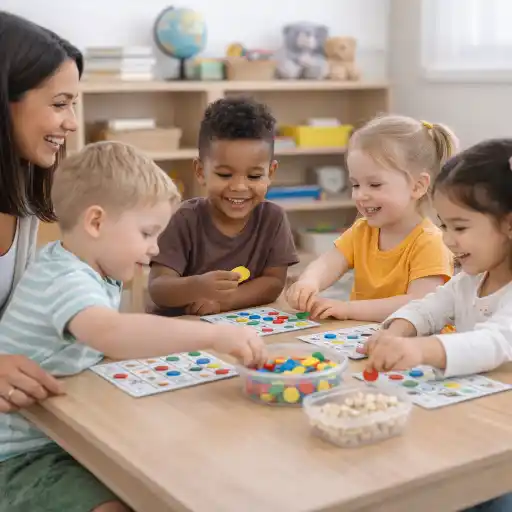
How does bingo build language and listening?
Every round of bingo can become a language experience. Children listen for a word or description, connect it with an image, and communicate a response. Providers can model precise language, expand children’s statements, and invite them to become callers once they understand the routine.
Use a progression of prompts. Begin with recognition: “Which picture matches?” Continue with naming: “What did you find?” Then invite description: “How are these two animals alike?” or “What makes this shape different?” Gentle recasting supports vocabulary without interrupting participation. For dual language learners, pair spoken words with images, gestures, objects, and home-language labels whenever possible.
- Repeat important words naturally across several rounds.
- Provide wait time before repeating or simplifying a clue.
- Invite children to explain how they checked a match.
- Use partner bingo to encourage conversation and shared problem-solving.
- Connect cards to books, songs, stories, classroom objects, and outdoor discoveries.
Beginning-sound bingo can introduce phonological awareness by asking children to identify pictures that begin with the same sound. Keep the emphasis oral and playful; children should first hear and compare words before being expected to identify a printed letter. For additional professional learning about listening, speaking, vocabulary, and emergent literacy, consider Language and Literacy Foundations in Pre-K  Buy Now $16.00.
How can bingo support social-emotional development?
Bingo creates authentic practice with #turn-taking, waiting, self-control, and responding to peers. Children must pause while another person calls, tolerate uncertainty, and manage excitement when they are close to completing a pattern. These moments are not evidence of failure when a child grabs a marker or calls out; they are opportunities for responsive coaching.
Model the routine with consistent language: “Listen, find, mark, check, and wait.” Use a turn card or caller token to make leadership visible. When another child wins, guide the group toward respectful responses such as “Good game,” applause, or a calm celebration. Cooperative bingo—where the entire group completes one board—can reduce competitive pressure while preserving the social interaction.
- Practice requesting materials: “May I have a marker?”
- Teach help-seeking: “Can you show me where to look?”
- Encourage peer recognition: “You found a difficult picture.”
- Name feelings: excitement, disappointment, surprise, pride, or worry.
- Use short rounds so children have another opportunity to participate.
Children benefit when adults celebrate careful listening, persistence, kindness, and thoughtful explanations—not only speed or winning. A predictable routine also supports children who find unstructured group interaction overwhelming. For deeper guidance on community building, problem-solving, relationships, and open dialogue, explore Supporting Social Learning: Creating Classrooms that Care Buy Now $35.00.
How should providers adapt bingo for diverse learners?
Inclusive bingo preserves the learning goal while varying the way children access and demonstrate understanding. Use large, uncluttered images, high contrast, tactile symbols, slanted boards, and chunky markers when appropriate. Do not rely on color alone; pair colors with shapes, patterns, words, or pictures. Children may respond by pointing, touching, signing, using eye gaze, communicating through AAC, or raising a signal card.
Adjust the social and sensory environment as well. Some children may need a quieter location, a visual clue instead of a spoken clue, extra processing time, movement breaks, or a partner. A child who does not want to call “Bingo” can indicate completion in another way. Participation should not depend on speech, eye contact, or a single motor response.
- Start with a smaller board and fewer choices.
- Preview the sequence using picture cards or a short demonstration.
- Offer cooperative play before introducing competition.
- Use safe, appropriately sized materials and active supervision.
- Pair peers thoughtfully and prepare both children for the roles.
- End with a predictable phrase, visual, or gentle signal.
Common mistakes include making rounds too long, rushing children, correcting every error publicly, and treating the game as a formal assessment. Instead, make one adjustment at a time and observe whether it improves access. Courses such as Play with Purpose: Supporting Children with Autism Buy Now $55.00$40.00 offer additional strategies for communication, choice, sensory regulation, and inclusive play.
How can bingo become an intentional teaching and observation tool?
Bingo is most useful when it connects to a larger sequence of experiences. Before the game, introduce the vocabulary through real objects, books, photographs, songs, or movement. During the game, provide prompts and observe children’s strategies. Afterward, extend the concept through a hunt, sort, construction activity, dramatic-play scenario, story, or art experience.
Use brief, objective notes rather than scores alone. A provider might record, “Ari matched four animal pictures independently but needed a repeated clue for habitat vocabulary,” or “Mina waited for two turns with a visual cue and then requested help.” Such documentation helps teams plan responsive next steps and communicate children’s strengths to families.
- Does the child attend to the clue?
- Can the child match an image, object, sound, or quantity?
- Does the child use target vocabulary or an alternative communication mode?
- Can the child wait briefly and rejoin the routine?
- Does the child explain a choice or classification?
- How does the child respond to success, mistakes, or disappointment?
Use patterns across multiple sessions rather than drawing conclusions from one game. State requirements vary - check your state licensing agency when determining whether related professional development meets local requirements. To strengthen objective observation and individualized planning, explore Preschool Assessments & Observations Buy Now $24.00.
Conclusion: What skills can preschoolers build through bingo?
Preschoolers can build attention, memory, visual discrimination, matching, classification, early literacy, mathematics, vocabulary, listening, communication, turn-taking, cooperation, and emotional regulation through bingo. The strongest results come from intentional design: choose a focused goal, use accessible materials, provide language-rich prompts, adjust pacing, and connect the game to children’s interests and ongoing curriculum.
Bingo is not a replacement for hands-on exploration, conversation, or open-ended play. It is one flexible tool that can make repetition meaningful and social learning authentic. When providers observe children’s strategies and respond with encouragement, each round becomes more than a game—it becomes a small, joyful rehearsal for learning with others.
- CDA Home Visitor Subject Area 3 Part 3 Birth to 5
- CDA Home Visitor Subject Area 2 Part 3 Birth to 5
- DAP for Preschool
- From Tantrums to Triumphs: Equipping Preschoolers with Self-Regulation Skills
- 24 Hour Texas Pre-Service
- Art from the Heart for Preschoolers: Open Ended Art Projects that Build Self-Esteem
- CDA Bridge Bundle: Preschool without Portfolio Review
- Texas Director Credential
- Building Vocabulary
- Supporting Families and Caregivers in Language and Literacy
- Reindeer Ready? Creative Holiday Games to Engage Preschoolers
- CDA Certification en Español: Recursos y Consejos para Educadores Bilingües
- Proporciones de Cuidado Infantil y Tamaños de Grupo por Edad en Maryland (Guía Rápida para Centros y Hogares)
- Actividades de Otoño Fáciles para Preescolares esta Temporada
- Celebrando la amistad en el cuidado infantil durante el Día de los Mejores Amigos
- How Can Task Cards Build Independent Learning Centers?
- How Can Fun Bingo Games Teach Colors, Shapes, and Animals to Preschoolers?
- How Can Sound Bingo Sharpen Listening Skills in Preschoolers?
- How Can Bingo Games Support Turn-Taking and Social Skills?
- Why Is Animal Bingo a Great Way to Introduce Habitats and Classification?
- How Can Color Bingo Reinforce Vocabulary and Visual Discrimination?
- Why Is Beginning-Sound Bingo a Smart Step Toward Reading?
- How Can Bingo Games Make Learning Feel Like Play?
- What Skills Can Preschoolers Build Through Bingo?
- How Can You Differentiate Sight-Word Bingo for Mixed-Ability Groups?
- How Can Farm-Animal Games Build Listening and Vocabulary?
- How Can Cooperative Sight-Word Games Help Early Readers Learn Together?
- How Can Interactive Group Play Build Ocean Vocabulary in Preschool?
- How Can Animal-Themed Bingo Build Descriptive Language in Preschoolers?
- How Can Listening and Movement Games Build Children’s Shape Recognition?
