Holiday word games can turn a busy December classroom into a lively place to practice careful looking, letter patterns, and spelling. Explore practical ways to use a Christmas word search and extend it into meaningful play; the one-hour Play Safe, Think Big: Literacy Through Play  Buy Now $10.00 course offers strategies for nurturing early literacy while maintaining effective supervision, and can help providers strengthen daily classroom practice.
Why are holiday word games a useful literacy activity?
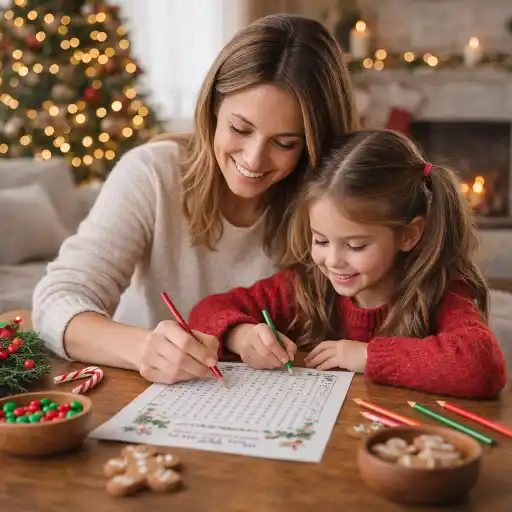
A word search asks children to hold a target word in mind, notice its letters in sequence, and scan a field of print for a match. That small routine brings together visual attention, letter recognition, spelling awareness, persistence, and fine-motor practice. The Christmas-themed Word Search - Christmas Buy Now $1.49 includes seasonal vocabulary such as SANTA, REINDEER, STOCKING, and COOKIE, making it a ready-to-use option for a holiday party, literacy center, or quieter moment.
Keep the focus on curiosity rather than speed. The goal is a positive encounter with print and a chance to talk about what children notice. A festive theme can invite participation, but children’s families may celebrate different holidays or none; present the activity as one seasonal option among many.
How does a word search exercise visual scanning and spelling?
Visual scanning means looking systematically across a visual field to locate something specific. In a word search, children can learn to check one row at a time, move across the grid, and compare each letter with a word on the list. This supports attention to direction and sequence, though it should not be presented as a direct measure of reading ability or visual skill.
Spelling practice happens when children compare a word’s correct letter sequence with the letters in the grid. Invite them to say the word, identify its first letter, and look for the next letters in order. For example, finding REINDEER lets children discuss its initial R, repeated E, and length. Younger children may simply match a few letters; older children may locate complete words independently.
- Model scanning left to right, then moving to the next row.
- Ask children to point to or name the first letter before searching.
- Encourage checking each letter rather than circling a near-match.
- Celebrate a careful search strategy, not just a completed page.
Use the puzzle as one piece of a broader literacy experience alongside read-alouds, conversations, alphabet play, and meaningful writing. Repeated exposure can support familiarity with print; no single worksheet guarantees spelling or reading gains.
How can providers adapt the puzzle for different ages and abilities?
A puzzle is most useful when it offers a manageable challenge. The resource is listed for kindergarten and fifth grade, so providers should preview it and decide whether its grid, print, and vocabulary fit the children in their group. Some preschoolers may enjoy searching for a first letter or matching a word card to a word in the grid rather than completing the full puzzle.
Make access adjustments without changing the shared goal of noticing print. For children who benefit from less visual information, cover part of the grid or present only a few target words at a time. Enlarge the print, use a high-contrast copy, or let children point while an adult marks the word. Offer a quiet space or partner search for children who find a busy table distracting.
- For beginning learners: choose two or three familiar words and search together.
- For children developing letter knowledge: name a target’s first letter and find matching letters in the grid.
- For confident readers: invite them to locate the full spelling and explain their scanning route.
- For children who do not use speech to respond: accept pointing, gestures, AAC, or selecting a matching card.
Provide tools that fit children’s motor abilities, such as chunky crayons, highlighters, or a finger-tracking option. Avoid assuming that difficulty with circling a word means a child does not recognize it. Separate the literacy goal from the fine-motor demand and notice what support enables participation.
How can educators turn a worksheet into playful learning?
Keep the puzzle connected to conversation and action. Before children begin, introduce a small set of words using pictures or objects. Ask what children already know about a reindeer, stocking, or cookie; then say each word aloud and invite children to notice its first or last sound. This warm-up makes the list meaningful instead of leaving children to puzzle over unfamiliar vocabulary.
- 🎄 Word-and-picture match: Pair each target word with an image; invite children to find the matching print.
- Letter hunt: Choose one letter from a seasonal word and search for that letter around the room or on labels.
- Build the word: After finding a word, arrange large letter cards to reproduce its spelling.
- Say, spell, use: Read the word together, name its letters, and use it in a short sentence or story.
- Partner search: One child selects and reads a target; the partner scans for it, then they switch roles.
Children can also dictate a sentence using one of the words or draw an accompanying picture. These extensions let children connect visual recognition with oral language, meaning, and early writing. Follow children’s interest: if the class wants to talk about snow, lights, or family traditions instead, use their ideas to create additional word cards.
How can providers keep the activity inclusive, safe, and low-pressure?
Holiday content is not universal. Check in with families and offer neutral alternatives, such as winter, kindness, or classroom-community vocabulary. Invite children to share words and traditions if they wish, without placing them in the role of representing a culture. Multilingual children may benefit from hearing and discussing a word in their home language as well as English; the aim is connection and participation, not testing English proficiency.
Set clear expectations for a calm, accessible activity. Use age-appropriate writing tools, supervise materials, and keep the work area comfortable and well lit. Children can work alone, with a partner, or with an adult, and they should have permission to pause or choose another activity. Avoid timed contests: speed can discourage careful thinkers and children who need additional processing time.
Observe what children do rather than judging the page as a pass-or-fail task. Brief notes might capture whether a child recognizes a target letter, follows a row systematically, checks letter order, asks for help, or connects a word to its picture. Use those observations to decide whether to simplify the next search, introduce new vocabulary, or offer a different way to respond.
When documenting training or curriculum expectations, state requirements vary - check your state licensing agency. A printable can be one element of an intentional literacy plan, but it does not replace shared reading, rich conversation, or responsive teaching.
How can providers avoid common word-game pitfalls?
The most frequent pitfall is using a puzzle as filler without a clear developmental purpose. Decide what you hope children will practice—such as noticing an initial letter, matching a word to a picture, or scanning one row at a time—and offer prompts that support that goal. If the word list or grid is too complex, reduce the number of words or complete part of the puzzle together.
Another common mistake is correcting every error immediately or turning the game into a race. Instead, allow children time to look again. Ask, “What letter are you looking for?” or “How could we check that?” Gentle prompts encourage strategy and keep the experience emotionally safe. If a child circles a similar-looking sequence, acknowledge the effort and compare the target letters together.
- Do not assume every child knows Christmas vocabulary or celebrates Christmas.
- Do not require independent completion when collaborative searching would help.
- Do not treat puzzle completion as a formal literacy assessment.
- Do not let worksheets crowd out books, pretend play, conversation, or writing.
Use the puzzle as a starting point, not the whole lesson. A few minutes of intentional talk and follow-up play can make a short printable more responsive and memorable.
Conclusion: How can holiday word games strengthen visual scanning and spelling?
Holiday word games can give children low-pressure practice noticing letters, comparing spelling patterns, and scanning print when the activity is age-appropriate, inclusive, and supported by an attentive adult. Preview the puzzle, make its vocabulary understandable, model a systematic search, and adapt the task so children can participate in different ways. Most of all, value the thinking and conversation—not speed or a perfectly completed page.
- 45 Hour Child Growth and Development
- Moving About the Classroom: Effective Transitions for Everyday
- CDA Home Visitor Subject Area 3 Part 3 Birth to 5
- Easy Steps to Resume and Interview Success
- The Subtle Teacher: Nonverbal Communication in the Classroom
- The ABCs of Behavior: Turning Challenges into Learning Opportunities
- Setting the Stage: Story Time
- Pediatric RSV First Aid & CPR/AED
- The Best Promotion is Play
- CDA Certification en Español: Recursos y Consejos para Educadores Bilingües
- 💛🧩 ¿Cómo puedo hacer que mi enseñanza sea inclusiva para los niños con autismo?
- ¿Cómo hacer actividades navideñas inclusivas para todas las familias?
- Recursos en Español sobre el Sueño Seguro del Bebé
- Actividades de Motricidad Gruesa que Desarrollan el Equilibrio, la Coordinación y la Fuerza
- 10 Ejemplos de Cómo la Cultura Influye en el Desarrollo Infantil
- Proporciones de Cuidado Infantil y Tamaños de Grupo por Edad en Maryland (Guía Rápida para Centros y Hogares)
- Proporciones de Cuidado Infantil y Tamaños de Grupo por Edad en Nueva Jersey (Guía Rápida para Centros y Hogares)
- Proporciones de Cuidado Infantil y Tamaños de Grupo por Edad en Virginia (Guía Rápida para Centros y Hogares)
- Retraso del Habla en la Guardería: Cómo Pueden Ayudar los Proveedores
- Cómo Trabajar en el Cuidado Infantil en Carolina del Norte: Requisitos y Pasos
- Celebrando la amistad en el cuidado infantil durante el Día de los Mejores Amigos
- Canciones, juegos y preguntas de círculo para niños
- Cómo simplificar la capacitación para sus empleados de daycare
- How Can You Teach Sight Words Through Games, Movement, and Play?
- How Can Kindergarten Teachers Strengthen Sight Word Recognition with Low-Prep Activities?
- How Can Child Care Providers Teach Beginning Sounds with Tracing, Pictures, and Repetition?
- How Can Holiday Word Games Strengthen Visual Scanning and Spelling?
- How Can Transportation Word Searches Build Vocabulary and Spelling Skills?
- How Can Cooperative Sight-Word Games Help Early Readers Learn Together?
