When a toddler studies two pumpkin pictures and notices what is alike—or different—a simple game becomes meaningful practice in seeing, thinking, and communicating. Adult-supported matching can help children ages 18–36 months build visual discrimination and vocabulary through playful, manageable interactions. For practical guidance on planning age-appropriate toddler experiences, explore ChildCareEd’s Playful Learning: Infant & Toddler Activities Buy Now $25.00 course, which can help you tailor activities to children’s ages and abilities.
For a broader foundation in development and milestones, consider CDA Infants/Toddlers: Stages of Development  Buy Now $24.00. Together, these courses can strengthen your classroom practice and help you make everyday play more intentional; check your state licensing agency for applicable training requirements.
Why is picture matching valuable for toddlers?
Picture matching gives toddlers a concrete reason to look carefully. When a child places one pumpkin card beside another that shows the same image, the child compares features such as shape, color, size, and position. This ability to notice visual similarities and differences is called visual discrimination. It develops over time through varied, engaging experiences—not through pressure to get every answer right.
Matching also gives adults an easy way to support early reasoning. A caregiver can model, “I see two pumpkins with curved stems,” then pause to let the child inspect the cards. The adult’s language draws attention to details without taking over the task. Purdue’s toddler sorting and matching activities similarly emphasize the concepts of “same,” “different,” and “match,” with a small number of clear picture choices.
For busy providers, this activity is practical: it can happen at a table, on the floor, or during a short one-to-one moment. Keep the goal focused on exploration and connection. A child who looks back and forth, points, or tries another card is engaging in learning, even if the match is not yet correct.
- Invite close looking and comparison.
- Build familiarity with words such as “same,” “different,” and “match.”
- Offer a calm opportunity to practice attention and decision-making.
How does matching strengthen visual discrimination?
Visual discrimination means recognizing similarities and differences in what is seen. A matching game lets toddlers practice this skill by comparing two images. They may first notice the overall subject—“pumpkin”—and gradually attend to more specific details, such as a leaf, a curved stem, or a facial expression. Childhood 101’s overview of pumpkin matching cards and visual discrimination describes how comparing image details encourages children to notice features such as size, shape, color, and position.
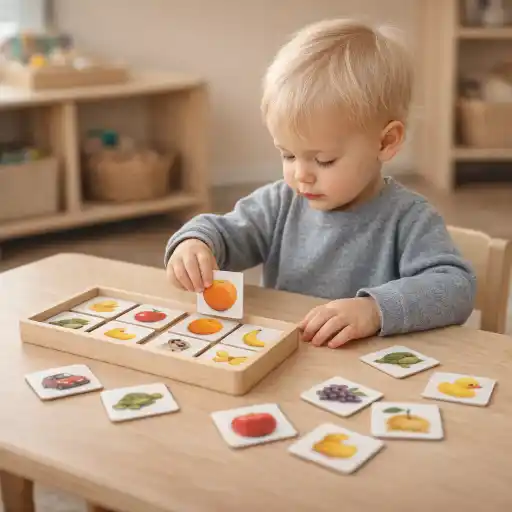
Start with identical, uncluttered cards and only two or three pairs. Place cards face up so the child can focus on comparing images rather than remembering where they were. As the child becomes comfortable, you can add a few more choices or use pictures that are related but not identical. Change one feature at a time; too many subtle differences can turn a playful invitation into a frustrating guessing task.
Observe the child’s approach, not only the result. Does the child scan the cards, look between two options, point to a detail, or return to a choice after reconsidering? These actions can show emerging comparison skills. Avoid treating one round as a formal measure of ability: familiarity, energy, interest, and the clarity of the pictures all influence participation.
- Choose large, clear images against simple backgrounds.
- Begin with a small set of identical pictures.
- Offer time to look and respond without rushing.
How can picture matching encourage vocabulary?
Every picture provides an opportunity to connect a visual image with a spoken word. Name what the child is looking at—“pumpkin,” “leaf,” “orange,” or “stem”—and add a short description: “This pumpkin has a tall stem.” Repeating and expanding language in context helps toddlers hear how words relate to objects, attributes, and actions. The adult does not need to quiz the child; warm narration can be enough.
Use words that describe relationships as well as objects. “These are the same,” “This one is different,” “Put the card beside the other pumpkin,” and “You found a match” give toddlers useful language for the activity. If a child says one word, respond by adding a little more: Child: “Pumpkin.” Adult: “Yes, a big orange pumpkin.” This kind of conversational expansion supports vocabulary while respecting the child’s current way of communicating.
Children may show understanding without saying the word aloud. They can point, gaze, hand over a card, gesture, vocalize, or use a communication system. Welcome home-language words and family vocabulary as meaningful contributions. ZERO TO THREE’s play activities for children ages 24–36 months include picture matching and language-rich play, highlighting how shared play can combine learning with interaction.
- Model simple labels and descriptive words naturally.
- Pause for the child to respond in their own way.
- Repeat and gently expand the child’s words or gestures.
How can providers make matching developmentally appropriate?
For toddlers ages 18–36 months, the best setup is simple, inviting, and responsive to the individual child. Begin with a familiar theme—such as pumpkins, animals, favorite foods, or classroom objects—and place only a few large cards within easy reach. Sit or kneel nearby so you can share attention, model a comparison, and follow the child’s interest. A short activity that ends while the child is still engaged is often more useful than insisting on completing a whole set.
Use a gradual progression rather than expecting every toddler to approach cards in the same way. Some children may enjoy matching two identical pictures; others may prefer pairing a picture with a real object. Purdue’s picture-and-object matching activity invites toddlers to connect familiar classroom objects with their images and talk about how they are alike. You can adapt that idea by matching a pumpkin picture to a safe toy pumpkin or a real pumpkin viewed with close adult supervision.
Keep materials safe and sturdy, and supervise closely, especially if children mouth materials. Avoid tiny pieces, sharp edges, and cards that are difficult to grasp. For children who need support, offer fewer choices, larger images, more contrast, or a partner who can help move cards at the child’s direction. The CDC encourages simple matching games as one way to support toddler exploration and learning; see its guidance for toddlers ages 1–2 and toddlers ages 2–3.
- Begin with two or three pairs and face-up cards.
- Follow the child’s interest and allow breaks or a change of activity.
- Adjust the number, size, and visual complexity of choices.
What adult support helps children learn without pressure?
Adults make matching meaningful by being available without directing every move. First, model one comparison: “I’m looking at the picture. This pumpkin has a little leaf, and this one has a little leaf too.” Then invite the child to try. Use a warm, curious tone and wait long enough for the child to examine the options. If the child chooses a different card, respond with interest: “You picked this one. Let’s look at what you noticed.”
Offer a hint when it helps the child re-engage, rather than immediately correcting or completing the match for them. You might point to one detail, reduce the options, or place two cards side by side. Celebrate effort and observation—“You looked carefully”—instead of focusing only on a correct answer. The aim is shared attention and active exploration, not speed, competition, or perfect performance.
Matching can also become a brief social experience. Take turns choosing a card, share the materials, and describe each other’s discoveries. A cooperative goal—finding all the pairs together—can be more comfortable than keeping score. Notice and document objective examples of what the child does, such as “looked between two cards and pointed to the identical pumpkin.” If concerns about vision or development persist across contexts, follow program procedures and discuss observations respectfully with the family; providers observe and share information, not diagnose.
- 🧡 Notice persistence and careful looking, not just accuracy.
- Use short, descriptive prompts and allow processing time.
- Accept pointing, gesture, speech, and other communication methods.
Conclusion: Why does picture matching matter?
Picture matching is an important learning experience because it gives toddlers an approachable way to compare visual information, notice similarities, and connect images with words and ideas. With an attentive adult nearby, a small set of pumpkin cards can prompt careful looking, vocabulary growth, turn-taking, and early reasoning. These skills develop gradually, so a child’s interest, attempts, and communication are as meaningful as finding a pair.
Keep the experience simple and positive: choose clear images, begin with a few choices, name what you see, and give the toddler room to explore. Adapt materials and participation to the child rather than expecting one pace or response from everyone. The central question—why is picture matching important for toddlers?—has a practical answer: it turns playful comparison into a supportive opportunity to learn. For additional professional learning, explore ChildCareEd’s Playful Learning: Infant & Toddler Activities Buy Now $25.00, CDA Infants/Toddlers: Stages of Development Buy Now $24.00, Building Vocabulary Buy Now $16.00, CDA Infants/Toddlers: Benefits to Observing Buy Now $16.00, and Early Learning with Infants and Toddlers Buy Now $24.00. State requirements vary - check your state licensing agency.
- 45 Hour Child Growth and Development
- CDA Infant/Toddler Credential
- 45 Hour Infant and Toddler Methods and Materials
- Pediatric RSV First Aid & CPR/AED
- CDA: Special Needs: Understanding the Whole Child
- CDA Bridge Bundle: Infant/Toddler
- CDA Infant/Toddler Credential with Portfolio Review
- Matchmaking for Mentors
- 45-Hour Infant and Toddler Curriculum
- CDA Certification en Español: Recursos y Consejos para Educadores Bilingües
- 😫🧸 ¿Qué hacer cuando un bebé no quiere dormir la siesta en el aula?
- Fall Circle Time Ideas for Preschool and Daycare
- Why Is Animal Bingo a Great Way to Introduce Habitats and Classification?
- How Can Child Care Providers Build an Effective Curriculum for Toddlers?
- What Should Providers Put in a Classroom Waiting Basket?
- How Can Toddlers Participate in Cleanup Without Being Expected to Clean Perfectly?
- How Can Juneteenth Symbols Build Visual Memory in Young Children?
- How Can a Fourth of July Activity Pack Blend Literacy and Math?
- Why Do Memory Games Support Attention and Working Memory?
- How Can Food and Kitchen Words Build Early Reading Skills?
- How Can Repetitive Early Readers Help Children Learn Color Words?
- How Can Child Care Providers Build Food Vocabulary and Word Recognition Together?
- Why Might a Child Recognize a Real Object but Not Its Photograph?
- How Can You Choose Classroom Jobs a Toddler Is Ready to Try?
- How Can Toddler Classroom Jobs Build Early Math Beyond Counting?
- How Can You Adapt Toddler Classroom Jobs for Different Abilities?
- Why Can a Child Match Real Objects but Struggle with a Worksheet?
- How Can Seasonal Learning Experiences Build Multiple Skills at Once?
- Why Is Picture Matching an Important Learning Experience for Toddlers?
