Children remember what they have a chance to notice, name, and revisit—and meaningful images can make a Juneteenth lesson more memorable. Try the Juneteenth Picture Match Buy Now $0.99 to support picture matching and vocabulary with words such as freedom, family, kindness, love, hope, and celebrate. For a deeper foundation in planning inclusive cultural learning, explore ChildCareEd’s Diversity, Equity, and Inclusion in Education  Buy Now $16.00 course, which offers providers strategies for culturally responsive teaching.
Why connect visual memory with Juneteenth learning?
Visual memory is a child’s ability to notice, hold in mind, and recognize what they have seen. Picture-matching activities give young learners a concrete way to practice that ability while also developing attention, visual discrimination, and language. When pictures are connected to words and a thoughtful conversation, children are not simply matching shapes; they are building associations that can help them recall new ideas later.
Juneteenth offers a meaningful context for this kind of learning. A symbol or image can serve as an entry point to a brief, age-appropriate conversation about freedom, family, hope, and community. The goal is not to reduce the history to a game, but to use a playful format as one small part of a respectful, accurate learning experience. The National Museum of African American History and Culture’s early-childhood resources recommend developmentally appropriate approaches to talking with young children about Juneteenth and the complex ideas it involves (NMAAHC Kids: Understanding & Celebrating Juneteenth).
For providers, a short matching activity can also reveal what children already notice and what vocabulary needs more modeling. Keep the interaction warm and responsive: accept children’s observations, clarify gently, and let curiosity guide the next step.
How can educators introduce symbols accurately and respectfully?
Begin with a clear purpose: children will look closely at pictures, practice matching, and learn a few words connected to Juneteenth. Introduce only the images and vocabulary you can explain accurately. The Juneteenth Picture Match resource highlights words including freedom, family, kindness, love, hope, and celebrate—ideas that can be discussed in simple language without implying that one symbol or activity explains the full history of Juneteenth. For educators planning broader cultural learning, this overview of Shavuot, Eid al-Adha, and Juneteenth provides context for discussing these observances respectfully.
Before presenting a picture, prepare a short, truthful script. For example: “Juneteenth is a day when many people remember and celebrate freedom. We are learning some words connected to the day.” Adapt the wording to children’s ages, families, and prior knowledge. If a child asks a difficult question, respond honestly but briefly, and do not add graphic detail to a preschool lesson. You can acknowledge that people were treated unfairly and offer to continue the conversation with the child’s family or revisit it in an age-appropriate way.
- Choose clear, age-appropriate images and name what children can actually see.
- Pair each picture with a word, a simple definition, and a chance for children to say or sign it.
- Check that the materials represent people and culture respectfully rather than relying on stereotypes or decoration alone.
- Invite families to share perspectives or resources if they wish; participation should remain optional.
These choices help make #Juneteenth learning both engaging and grounded in respect.
What does a matching activity teach beyond matching?
A picture-match game can exercise several connected skills at once. Children scan for details, compare images, remember what they have already seen, and decide whether two cards belong together. As they explain a choice—“These are the same”—they also practice expressive language and turn-taking. When an adult adds a meaningful word, children can connect visual recognition with vocabulary in a natural, low-pressure way.
Use the ChildCareEd Juneteenth Picture Match Buy Now $0.99 as a brief small-group or center activity, adjusting the number of cards to fit children’s attention and experience. Start with a few pairs, model how to look carefully, then let children take turns. Describe strategies rather than rewarding speed: “You checked the shape and the details before choosing.” That kind of feedback supports confidence and thoughtful observation.
- For younger preschoolers, show a small number of cards face up and invite children to find a matching image.
- For children ready for an added challenge, turn cards face down and take turns remembering their locations.
- Support children who need access adaptations by enlarging pictures, reducing choices, offering verbal cues, or matching together with an adult.
- Give children the option to point, speak, gesture, or use their home language to participate.
Remember that the objective is meaningful engagement, not a perfect score. A child who explores one image and names a new word is learning, too. A supportive #classroom makes room for different paces, communication styles, and ways of showing understanding.
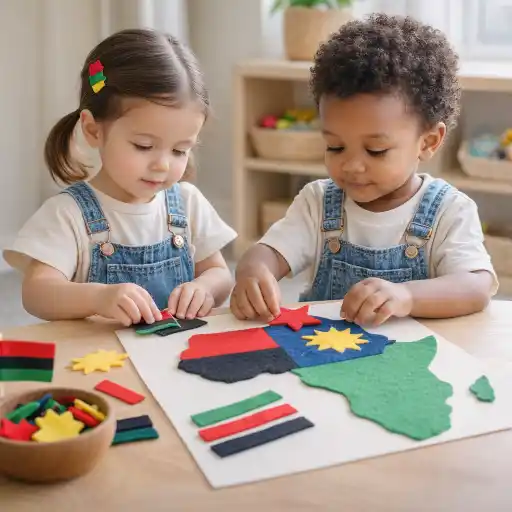
How can providers turn picture matching into a complete learning experience?
Think of matching as one part of a short sequence: prepare, explore, talk, and revisit. Before the activity, look through the pictures and decide what language you can explain accurately. Introduce the purpose in one or two sentences. During play, name what children notice and offer one simple prompt at a time, such as “What do you see?” or “Which picture looks the same?” Afterward, connect one word from the activity to a read-aloud, song, drawing, or family conversation.
Keep the lesson flexible. A child may be most engaged by comparing pictures; another may want to talk about family or celebration. Follow children’s interest while staying within the planned learning goal. You can document a brief observation—such as a child recognizing a repeated image, using a new word, or inviting a peer to take a turn—to inform future activities.
- Prepare a calm surface with the cards visible and enough space for children to handle them safely.
- Use a short round of matching, then pause for one vocabulary connection or open-ended question.
- Offer a follow-up such as drawing a picture about family, hope, or community, without requiring every child to make the same product.
- Revisit the words later in the week through a book, classroom conversation, or display of children’s own artwork.
As the National Museum of African American History and Culture resource notes, young children benefit from approaches that help them make sense of history in developmentally appropriate ways (NMAAHC Kids’ Juneteenth guide). A short, connected sequence provides more context than an isolated worksheet or game.
How can programs make the activity inclusive and avoid common pitfalls?
Inclusive planning begins with the recognition that children and families may have different experiences, knowledge, and relationships to Juneteenth. Avoid assuming every family observes the holiday or wants to share personal traditions. Communicate the learning purpose, invite input respectfully, and provide children with more than one way to participate. A child can observe, match, listen, speak, draw, or choose a different related activity without being singled out.
Be intentional about context. A playful matching game can build vocabulary and visual memory, but it should not stand in for historical learning or turn the holiday into decoration alone. Use accurate language, select thoughtful materials, and avoid asking a child to represent an entire culture. Providers who want to strengthen their approach can explore ChildCareEd’s Montessori Cultural Activities: Exploring the World Through Play and Learning Buy Now $24.00, which covers hands-on cultural learning, and Building Bridges for Dual Language Learners Buy Now $16.00, which addresses culturally responsive environments and language support.
- ⚠️ Avoid treating Juneteenth as a party-only theme; connect celebration with a brief, truthful explanation.
- Do not overload young children with complex historical details in a short matching activity.
- Do not assume that every child will want to discuss family history or participate in the same way.
- Check accessibility, material safety, and program policies when preparing activities or events; state requirements vary - check your state licensing agency.
Partnership and staff reflection help keep learning purposeful. ChildCareEd’s Art from the Heart for Preschoolers Buy Now $35.00 can also support providers who want to use open-ended art after a visual activity, while the Diversity, Equity, and Inclusion in Education Buy Now $16.00 course offers a broader foundation for culturally responsive practice.
How can educators tell whether children are learning?
Assessment can be simple, observational, and respectful. During or after the game, notice whether children can distinguish matching pictures, sustain attention for a turn, recall where an image appeared, or use a newly introduced word. The aim is not to test whether a child understands the full history of Juneteenth; a brief visual-memory activity cannot measure that. Instead, gather small clues about the skills and concepts the activity was designed to support.
Use a few observation prompts to guide reflection:
- Did the child notice a visual detail or recognize a repeated image?
- Did they use, repeat, or respond to one of the activity’s vocabulary words?
- Could they participate through speech, gesture, pointing, or another communication method?
- What adjustment—fewer cards, more modeling, extra time, or a peer partner—helped them engage?
Document a brief example rather than assigning a pass-or-fail judgment. If children show curiosity, build on it with a story or conversation; if the activity feels confusing, simplify the choices and model again. Invite family feedback when appropriate, especially if you plan to expand the lesson into a broader celebration. When children can see, name, and revisit meaningful images in an emotionally safe setting, visual matching can become a small but valuable part of wider learning about history, language, and belonging.
Conclusion: How can Juneteenth symbols support visual memory?
Juneteenth picture matching can give young children a playful way to practice visual recognition, attention, vocabulary, and turn-taking. Its strongest use is as one element in a wider, respectful learning experience: choose images thoughtfully, explain them accurately, connect pictures to simple words, and follow children’s questions without rushing them. The Juneteenth Picture Match Buy Now $0.99 offers a ready-to-use starting point; thoughtful conversation and follow-up help make the activity meaningful.
Keep the goal clear: build children’s visual memory while supporting age-appropriate, inclusive learning about Juneteenth. Observe how each child participates, adapt the activity to individual needs, and partner with families and colleagues as you plan. For deeper professional learning, consider the linked courses in cultural responsiveness, inclusive practice, and child-centered cultural activities.
- Lesson Planning for Preschoolers
- CDA Home Visitor Subject Area 3 Part 3 Birth to 5
- Working Together: Teachers & Preschoolers
- CDA Bridge Bundle: Family Child Care without Portfolio Review
- CDA Bridge Bundle: Infant/Toddler without Portfolio Review
- CDA Bridge Bundle: Preschool without Portfolio Review
- Matchmaking for Mentors
- Professional Integrity in Child Care
- Celebrate Juneteenth in Baltimore
- What is Shavuot, Eid al Adha & Juneteenth
- CDA Certification en Español: Recursos y Consejos para Educadores Bilingües
- 🔍 ¿Qué ves cuando observas a un niño aprender?
- 💛🧩 ¿Cómo puedo hacer que mi enseñanza sea inclusiva para los niños con autismo?
- 🤯 ¿Por qué este niño está teniendo un comportamiento difícil de repente?
- 👶 ¿Cuáles son las proporciones y grupos requeridos en Dakota del Norte? 🏫
- 10 Ejemplos de Cómo la Cultura Influye en el Desarrollo Infantil
- Proporciones de Cuidado Infantil y Tamaños de Grupo por Edad en Virginia (Guía Rápida para Centros y Hogares)
- Retraso del Habla en la Guardería: Cómo Pueden Ayudar los Proveedores
- Teaching Kids About Juneteenth Through Activities and Crafts
- Celebrando la amistad en el cuidado infantil durante el Día de los Mejores Amigos
- Canciones, juegos y preguntas de círculo para niños
- How can child care programs honor Juneteenth in age-appropriate, respectful ways?
- How Can Early Childhood Programs Introduce Juneteenth in Developmentally Appropriate Ways?
- How Can Child Care Programs Celebrate Juneteenth Through Respectful, Child-Centered Art?
- How Can Coloring Pages Spark Meaningful Historical Conversations About Juneteenth?
- How Can Juneteenth Symbols Build Visual Memory in Young Children?
- How Can Meaningful Juneteenth Vocabulary Support Early Writers?
- How Can Drawing and Dictation Help Children Respond to Juneteenth?
