Introduction — why this matters
When a child refuses to share, it can make the room loud and slow down learning. Teaching sharing is not about making kids obey. It is about helping them learn skills they will use for a lifetime. Strong social skills help children make friends, calm down, and join group work. For practical, classroom-ready steps, see How can we teach sharing without forcing it? and other ChildCareEd resources on friendship and guided play. State requirements vary - check your state licensing agency.
In this article, you will find short scripts, routines, and safe strategies you can use today. We focus on gentle steps that keep a child’s choice and still teach cooperation. You will see ideas for short practice, how to handle big refusals, and how to avoid common mistakes. Key ideas you will see again in the article: #sharing #turns #empathy #play #children.
1) What does it mean when a child won’t share and why does it matter?
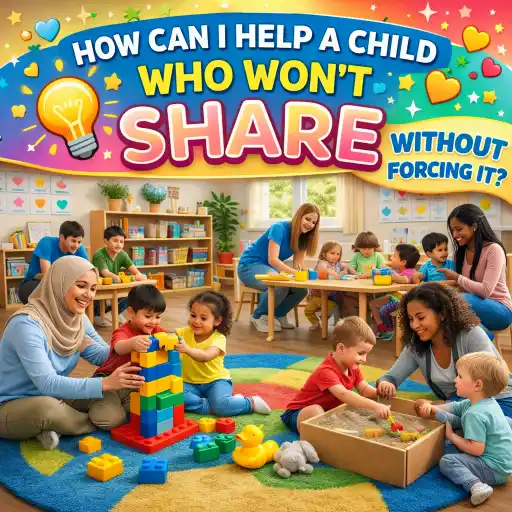
A child who won’t share may be:
- Holding on tightly to one toy.
- Refusing to let others try the toy.
- Saying “mine” loudly or crying when asked.
Not sharing is a behavior. Behavior is how a child tells us what they need. It can signal that the child is tired, unsure, afraid of losing a special toy, or still learning language and turns. The Center on the Social and Emotional Foundations (CSEFEL) describes how teaching steps and planned practice help children learn peer skills; see a useful brief at CSEFEL What Works Brief. When we teach skills instead of forcing, children learn to use words, wait, and show #empathy. That helps the whole classroom because there are fewer fights, more play time, and kinder connections among peers.
Why it matters in short:
- Children who practice sharing build friendships.
- Short, repeated practice turns a one-time lesson into a habit.
- Teaching with respect keeps trust between adults and kids.
2) How can I teach #sharing and #turns without forcing it?
Here are easy steps you can use right away. Each step is short, kind, and repeatable.
- Model short scripts and use them often.
- Say lines like: "Can I have a turn?" "You go next." Practice during calm times. ChildCareEd gives sample scripts and role-play ideas in How can we teach sharing without forcing it?.
- Offer fair choices instead of commands.
- Example choices:
- "Use the timer — you have two minutes, then I will have two minutes."
- "Would you like to trade for the blue car?"
- Visual timers and picture cards make choices clear for non-readers.
- Example choices:
- Use short role-play and social stories.
- Practice scripts with puppets for 2–3 minutes. See role-play ideas in How can preschool teachers teach friendship skills.
- Notice and praise small steps.
- Say exactly what you saw: "You handed the truck to Sam when he asked — thank you." Specific praise helps the behavior repeat.
- Teach alternatives to forcing.
- Try: "I will play with this part while you play with that part" or "You can have it after the timer." ChildCareEd explains non-forcing ways in How can we teach sharing without forcing it?.
Use short practice moments often. One 2–5 minute role-play each day is better than one long lesson. If you need research-based steps for prompting and praise, see CSEFEL materials at CSEFEL.
3) What classroom routines and activities help children practice sharing and #empathy?
Routines give repeated chances to learn. Use these practical ideas and make them part of your daily plan.
- 😊 Morning greetings & buddy jobs
- Let children choose a greeting and give a simple job (snack helper, plant waterer). Jobs invite cooperation and build trust. See inclusion and friendship ideas at Social skills in action.
- 🧩 Guided small groups (5–10 minutes)
- Plan a quick activity that requires turns — building a track or a shared collage. Coach with short scripts while they work. Guided play strategies are described in How can preschool teachers teach friendship skills.
- 📚 Read-and-reflect
- Pause during a story and ask: "How does this character feel? What could a friend do?" Books help children see feelings and practice #empathy. Scholastic has helpful book lists about sharing; see Best Books About Sharing.
- 🏷️ Kindness spotting and reward moments
- Keep a board or jar for kind acts: "Lina shared blocks" or "Jamal invited a friend." Praise and small rewards like a class cheer help habits grow. CSEFEL suggests simple positive feedback systems at CSEFEL.
- ⏳ Timers & visuals
- Use sand timers, picture cards, or concrete countdowns so children can see when a turn ends. Visuals support children who are still learning words.
Why routines work: repetition gives children many low-stakes tries. If a behavior repeats, collect quick notes and plan one short practice each day. For lesson plan examples and guided play ideas, see ChildCareEd sample lesson plans at How can preschoolers learn to share, take turns, and make friends?.
4) How do I handle big refusals or repeated problems without taking toys away?
Big refusals are stressful for everyone. The goal is safety first and teaching next. Use calm steps that help the child learn repair skills.
- 🛑 Stop and keep safe
- Say a short limit: "Hands down. Safe bodies." This lowers energy and keeps others safe.
- 🔍 Name the feeling and the problem
- Say: "You look upset because you both want the red truck." Labeling feelings gives words and cools the child. See emotion and self-control ideas at Emotions for Kids.
- 💬 Offer short choices and scripts
- Give 2–3 options: "Use the timer, trade, or find a second toy." Teach short lines: "Can I have a turn after you?" Practice these when calm so children can use them when upset. For conflict scripts, see How can I manage challenging behaviors.
- 🔧 Repair the relationship
- Ask for small fixes: "Can you help put the blocks back?" or teach an apology script: "I’m sorry. Are you okay?" Praise the repair right away. Repair helps friendships stay strong.
- 🔁 Use priming and supports for repeat issues
- Prime a child before play: tell them who to ask and what to say. Role-play joins and assigns peer buddies. If a child needs extra help, adapt the environment (fewer toys, bigger pieces, quieter spot). ChildCareEd discusses priming and peer supports in How can preschoolers learn to share.
When is removal okay? Use removal only if safety is at risk. Otherwise, teach alternatives so children learn cooperation, not compliance. If problems continue despite consistent teaching, work with your team, family, and a behavior specialist. State requirements vary - check your state licensing agency for reporting rules and referrals.
Summary, common mistakes, and FAQ
Quick checklist to use daily:
- Model short phrases and role-play regularly.
- Use timers and visuals for #turns.
- Plan short guided practice sessions (5–10 minutes).
- Praise specific helpful actions right away.
- Partner with families and note progress.
Common mistakes and how to avoid them:
- Forcing sharing by taking toys — teaches compliance, not cooperation. Avoid by offering choices and timers.
- Long lectures during a meltdown — use short scripts and calm tones instead.
- Missing small wins — notice tiny helpful acts and praise them.
FAQ (short):
- Q: How long before I see change? A: Small gains in weeks with daily, short practice; bigger change in months.
- Q: What if a child refuses even with scripts? A: Use priming, role-play, a peer buddy, and environmental changes. Track patterns and work with families.
- Q: Should I ever remove a toy to stop problems? A: Only for safety. Teaching alternatives leads to real learning. See ChildCareEd guides above.
- Q: Can children with special needs learn to share? A: Yes. Use visual supports, repetition, and smaller steps. CSEFEL and ChildCareEd resources can help.
You are doing important work. Small, steady steps, short scripts, and lots of encouragement help children learn that #sharing can be fair, safe, and kind. For more classroom ideas and step-by-step plans, explore ChildCareEd trainings like Supporting Social Learning: Creating Classrooms that Care  Buy Now $24.00 and other linked resources in this article. Thank you for the care you bring to every day.
- 45 Hour Child Growth and Development
- CDA Bridge Bundle: Family Child Care without Portfolio Review
- CDA Bridge Bundle: Infant/Toddler without Portfolio Review
- CDA Bridge Bundle: Preschool without Portfolio Review
- 45-Hour Infant and Toddler Curriculum
- Texas Director Credential
- CDA: Stand With Respect and Professionalism
- Bridging Cultures: Family Communication & Collaboration
- Supporting Families and Caregivers in Language and Literacy
- CDA Certification en Español: Recursos y Consejos para Educadores Bilingües
- How can I help a child who won’t share without forcing it?
- Recursos en Español sobre el Sueño Seguro del Bebé
- Celebrando la amistad en el cuidado infantil durante el Día de los Mejores Amigos
- How can child care providers teach sharing and turn-taking without forcing it?
- What Does Gentle Parenting Sound Like? Examples of What to Say in Common Situations
- Time-In or Time-Out? 7 Real Classroom Scenarios and What to Try
- What Does Compassion Look Like in Child Care? 10 Everyday Moments That Matter
- How Can Child Care Providers Teach Children to Share and Take Turns Without Forcing Them?
- How Can Child Care Providers Respond When Children Exclude Others From Play?
- How Can Teachers Encourage Sharing Without Forcing It?
- How Can Child Care Providers Teach Sharing Without Forcing It?
- How Can Providers Teach Children to Notice When a Friend Needs Space?
- How Can Child Care Providers Teach Children to Join Play Without Grabbing or Interrupting?
- How Can Child Care Providers Teach Conflict Resolution to Preschoolers?
- How Can Child Care Providers Teach Preschoolers to Wait Their Turn?
- What Should Child Care Providers Do When a Child Refuses to Share?
- What Should Child Care Providers Do When a Child Refuses to Share?
- How Can We Teach Toddlers What to Do Instead of Hitting?
- How Can Strong Relationships Help Reduce Biting and Hitting?
