Introduction: Why this matters for our classrooms
Managing #challenging moments in early care is one of the hardest and most important parts of our job. When children act out, they are trying to tell us something. If we respond with calm teaching instead of punishment, we help children learn new skills and keep the classroom safe and happy for everyone. This article gives simple, practical steps you can use tomorrow.
Why it matters:
1) Children who feel safe learn better. 2) Staff who use clear plans feel less stressed. 3) Families who are included support the work we do in class. For research-based guidance and ready tools, see resources such as How to Support Children with Challenging Behaviors and the Pyramid Model training from the National Center for Pyramid Model Innovations at NCPMI Resource Library.
Quick note: state requirements vary - check your state licensing agency.
1) What is the child trying to tell me?
Start by remembering that behavior is communication. Before you act, pause a breath and ask: What happened before this? What did the child get from this behavior? This is the ABC method: Antecedent, Behavior, Consequence. Use it to spot patterns and plan supports. For an easy guide to decoding behavior, read How to Decode Children’s Behavior.
Try these steps:
- 📌 Observe quietly for a few moments. Note time, place, people, and what led up to the event.
- 😀 Ask: Is the child tired, hungry, overwhelmed, or trying to get attention?
- 📝 Record patterns: same time of day? same activity? This helps make a plan.
Use short notes or a simple behavior log. The Pyramid Model and CSEFEL materials offer free tools and modules to help staff learn how to watch for patterns; see Training Modules and CSEFEL strategies at CSEFEL Resources.
2) What can I do to prevent problems before they start?
Prevention is powerful. Small changes in routine and environment stop many problems. Follow these easy steps to make your room calmer and more predictable.
- 🔁 Create a predictable day: post a picture schedule at child eye level and give warnings ("2 minutes until clean-up"). See tips in Creating a Positive Learning Environment.
- 🪑 Check the space: remove crowded areas, add clear centers, and give children room to move. If one area causes trouble, change the layout.
- 🎯 Teach simple rules and show what they look like (pictures help). Keep 3–5 rules like "Be safe," "Use kind hands," "Listen."
- 🔄 Use movement breaks and choices so children do not get stuck waiting.
These steps come from evidence-based approaches such as the Pyramid Model and many ChildCareEd training tips. For quick classroom wins, try the short checklist from ChildCareEd: Creating a Positive Learning Environment Checklist Buy Now $0.00.
3) What do I do in the moment to keep everyone safe and teach?
When a child is upset, use a calm, simple 4-step plan. This keeps the focus on safety and teaching, not shaming.
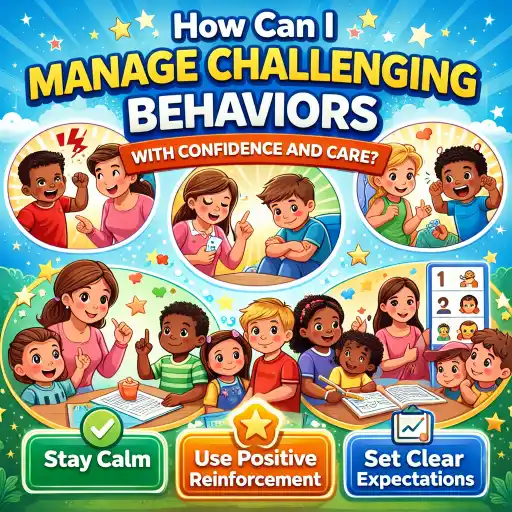
- 🧘 Stay calm and get close (but not crowding). Your tone helps the child calm. See guidance in Managing Challenging Behavior Without Shame.
- 📣 Name the feeling briefly: "You look upset." This helps children learn emotional words.
- ⛔ Set a clear limit: "Hands are for helping. I won't let you hit." Keep words short and firm.
- 🔁 Teach one replacement skill: "Use your words: 'My turn please'" or a calming strategy like 3 deep breaths.
Common mistakes to avoid:
- Relying on long lectures when children are upset — they can’t hear long instructions.
- Shaming language like "bad kid" — it hurts trust. Use short, respectful phrases instead. For examples see no-shame guidance.
Time-out or removal can be used only as part of a clear plan and for safety, and only after prevention and teaching are tried. For research-based guidance on when to use time-out, see the CSEFEL brief: What Is Time-Out?.
4) How do I work with families and the team so the child gets consistent support?
Children do best when home and school use the same approach. Use respectful, short messages when you talk with families.
- 💬 Start with a strength: "Lina loves building with blocks."
- 📊 Share the fact: "This week she needed help when we changed centers."
- 🤝 Offer a plan and ask for ideas: "We will teach 'my turn' and a 2-minute warning. What works at home?" See tips on family partnership in Building Strong Partnerships.
Also involve your supervisor, coach, or any mental health consultant when behaviors are unsafe, frequent, or not improving. Use team-based tools like PTR-YC or the Pyramid Model for layered supports; find resources at NCPMI. Remember: state requirements vary - check your state licensing agency.
Summary: What to try this week
1) Pick one predictable routine to strengthen (post a picture schedule). 2) Teach one replacement skill and practice it during circle time. 3) Try the 4-step calm response in the moment. 4) Share one short strength + fact + plan message with a family this week.
For more help and trainings, ChildCareEd offers many courses like "The ABCs of Behavior" and "Solutions NOT Punishments". See examples at ChildCareEd and the Pyramid Model resources at NCPMI Training Modules. You’re not alone — small, steady steps create big change for our #children and our #classrooms. Keep using #guidance and bring your #calm to each moment.
FAQ (quick answers)
- Q: When should I ask for extra help? A: If behavior is unsafe, repeated, or not improving after planned strategies. Ask your director or a consultant.
- Q: Do I need to record every incident? A: Start with patterns—note time, activity, and consequence to find triggers.
- Q: How do I stay calm when I’m tired? A: Use a 3-second pause, ask for a teammate to help, and review simple scripts to use in stress.
- Q: Can families use the same strategies at home? A: Yes—share one or two short strategies and a brief plan. Families often welcome clear, kind steps.
- 45 Hour Child Growth and Development
- Solutions NOT Punishments
- From Tantrums to Triumphs: Equipping Preschoolers with Self-Regulation Skills
- The ABCs of Behavior: Turning Challenges into Learning Opportunities
- Heart-to-Heart Communication: Challenging Behaviors
- Developing Program Tranquility
- Texas Director Credential
- Every Moment Matters: Schedules and Transitions
- Developing Program Tranquility
- Going Head-to-Head with Challenging Behavior
- Coping Strategies for Back-to-School Anxiety
- Cómo Empezar una Guardería en Casa: Requisitos y Pasos
- Proporciones de Cuidado Infantil y Tamaños de Grupo por Edad en Nueva Jersey (Guía Rápida para Centros y Hogares)
- How can child care teams manage challenging behaviors with calm, confidence, and care?
- Managing an Early Childhood Classroom with Confidence
- How can ChildCareEd's behavior management courses help Minnesota childcare providers handle challenging situations without outside support?
- Cómo simplificar la capacitación para sus empleados de daycare
- How Can Child Care Providers Handle Challenging Behavior?
- How can we encourage good behavior while building children's confidence and emotional skills?
- How Can Child Care Providers Help School-Age Children Manage Stress?
- How can child care providers understand and respond to tantrums?
- Toddler Classroom Management: Routines, Behavior, and Big Feelings
- How to Manage a Preschool Classroom with Confidence
- How can child care leaders manage complaints and difficult conversations effectively?
