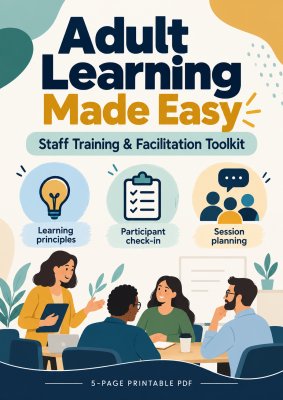
The 18-Hour Train the Trainer course, approved by MSDE, prepares child care professionals to effectively train and mentor adult learners. This training is essential for MSDE-approved trainers and focuses on developing skills in communication, adult learning principles, SMART goal-setting, and diversity, equity, and inclusion (DEI) practices.
Trainers play a crucial role in enhancing the skills and knowledge of child care professionals, fostering high-quality education and care for children. This course equips trainers with strategies to engage diverse learners, create professional materials, and lead impactful training sessions.
Key Benefits
- Gain confidence and expertise in delivering engaging, effective trainings.
- Learn to design impactful materials aligned with best practices.
- Build essential skills like active listening, conflict resolution, and advocacy.
Completion Requirements
To complete the course, participants must submit a Core of Knowledge training outline, deliver a 15-minute video presentation, and provide supporting materials like slides and handouts. Evaluations are based on clarity, organization, and adherence to adult learning principles.
This course ensures trainers meet MSDE standards while fostering excellence in professional development for child care providers.
By the end of this training, the learner will be able to:
- Give examples of ways to apply and model ethical behavior and professional integrity with community members and organizations.
- Demonstrate an understanding of the different learning styles of adult learners.
- Identify the components of active listening skills.
- Explain the value of self-evaluation and reflection.
- Define SMART goals and describe its historical context.
- Demonstrate understanding of how to write effect SMART Goals.
- Recognize the importance of maintaining confidentiality and privacy in communication with staff.
- Describe ways child care professionals can support advocacy issues.
- Identify the importance of problem-solving and conflict-resolution strategies with colleagues and administrators.
- Identify the responsibilities of trainers.
- Identify steps in creating realistic training goals and objectives.
- Demonstrate an understanding of the importance of professional etiquette while training.
- Identify the necessary components of a successful training.
- Identify strategies for training individuals with challenging personalities.
- Identify the necessary skills of successful trainers.
- List MSDE basic requirements for trainers
- Give examples of approved types of continuing education for trainers.
- Demonstrate an understanding of the different principles behind adult learning.
- Define what it means to be a trainer.
- Identify trainer prerequisites.
- List strategies for trainers on how to apply DEI practices.
- List the elements of a training proposal.
- Identify ways to meet the needs of diverse learners during training sessions.
- Identify ways to determine training effectiveness.
- Demonstrate an understanding of how to develop assessments using Blooms Taxonomy.
- Identify presentation strategies and training techniques.
- Identify the components of a successful trainer presentation.
- Demonstrate an understanding of media trends in child care.
- Identify ways to reflect on one's own personal perspectives with courage and/or humility
- Identify ways to interact respectfully and appropriately in a variety of cultural contexts
- Give examples of ways to collaborate with other professionals involved in the care and education of all children and youth.
- Identify strategies to make connections and interact substantively with those who are different from oneself
- Identify strategies to listen while withholding judgement about the new or unfamiliar
- Explain the importance of two-way communication.
- List strategies to collaborate with specialists to administer developmental screenings.
- Demonstrate an understanding of how to be open to new perspectives and diverse others.
- List strategies to implement SMART goals.
- Demonstrate an understanding of diverse perspectives, and navigate the ambiguity and complexity that comes with that.
- Describe the importance of responding sensitively to differences in individual communication styles.
- Demonstrate communication skills that enable intercultural communication, including effective listening skills
- Demonstrate an understanding of the importance and components of a mission statement.
- Identify communication issues that are common in the early care and education environment
- Criteria to earn CEUs:
- Certificates are awarded when the following criteria have been met by the learner:
- Class has been paid in full
- All material has been reviewed
- All review questions and final test have been completed with a passing score of 80% or higher.
- Learning Assessment Method:
- Learners will be assessed through questions after every section is completed. Learners will not be
allowed to proceed to the next section of the training until all questions have been answered correctly.
Learners will be presented with a final test composed of true/false and multiple choice questions.
Upon successful completion of the training, learners will receive their certificate by email.
- Learning Methodology:
- Online material will be presented in the form of slides,
accompanied with speech. Videos will be used to demonstrate ideas and concepts. Charts and tables
will be used for illustration.
- Logistics/Required Technology:
- A stable internet connection is required for the completion of this course. Users are highly encouraged to take their online course on Google Chrome on either a laptop or desktop computer. Speakers and/or headphones are also required to hear speech.
- Payment Policy:
- Payments need to be made in full. No refunds will be issued after starting the class.
- Proprietary or conflict of interest disclosure:
- Unless otherwise stated in the course description none of H & H subject matter experts and editor has any conflict or proprietary interests related to the material they prepared in this course.
- Support Services:
- Please visit our contact us page
You are purchasing a session of an online training that includes online assessments. Your certificate will be emailed to you once you pass the final exam with a passing grade of 80%.
Your certificate will bear the name you provided to us when you signed up. For support and questions regarding the material presented in this class please contact us at info@childcareed.com. Please consult our frequently asked questions page for other questions or feel free to contact us.
To successfully complete the 18-hour Train the Trainer course, participants must meet the following submission and performance requirements. Submissions will be graded based on the rubric outlined below.
Submission Requirements
Participants must submit the following materials:
1. Core of Knowledge (CKO) Training Outline
- A training outline for a Core of Knowledge topic, which includes:
- Training Title: Strength-based and clearly reflective of the subject.
- Training Description: Detailed explanation of the content, the need for the training, and the benefits to participants.
- Learning Objectives: Clearly stated, measurable, and realistic objectives.
- Summary Statement: A concise overview of the training, including two key points.
2. 15-Minute Training Presentation
- Develop and submit a PowerPoint presentation covering your chosen topic.
- Record a 15-minute video of yourself delivering the presentation, ensuring:
- Clarity and engagement in delivery.
- Inclusion of objectives and a summary or wrap-up.
- Adherence to the principles of adult learning and active engagement.
3. Supporting Materials
Submit the following materials to support your presentation:
- PowerPoint Slides: Professional, clear, and free of errors.
- Handouts: Practical, user-friendly, and professionally formatted.
- Trainer Note Pages: Detailed notes for each slide or section.
Grading Rubric
Submissions will be evaluated using the following criteria, with scores ranging from 0 to 5 (5 being the highest). Must meet a minimum score of 40 out of 50 to be approved.
Organization
- PowerPoint, Training Proposal, and Documentation:
- Well-organized materials with clear structure and logical flow.
- Consistency among training description, learning objectives, content, and methods.
- Written Materials:
- High quality in writing, grammar, spelling, and mechanics.
Content
- Training Description and Objectives:
- Clear explanation of training content, its need, and benefits.
- Realistic and measurable learning objectives.
- Adaptations and Sensitivity:
- Addressing cultural sensitivity, diversity, and inclusion.
- Incorporation of ADA guidelines and person-first language.
- Relevance and Standards:
- Alignment with Core of Knowledge content areas.
- Use of reputable sources published within the last 5–7 years.
- Content reflects national standards and best practices.
Presentation
- Engagement and Clarity:
- Explicit explanation and illustration of content.
- Connection of training content to practical application.
- Methods of delivery cater to a variety of learning styles and promote active learning.
- Materials and Visuals:
- Professional quality handouts and visuals.
- Content adapted to audience needs and level.
- Time Management:
- Presentation timeline allows adequate time for content, activities, and assessment.
Additional Notes
- The video presentation is crucial for evaluating delivery style, clarity of content, and audience engagement.
- Reviewers will assess all materials and the video holistically to determine readiness as a trainer.
- Use the rubric provided as a guide when developing and submitting your materials.
By meeting these requirements and adhering to the grading criteria, participants demonstrate their ability to effectively plan, organize, and deliver training sessions in alignment with professional standards for adult learners.